1. Huawei Cloud launches openPangu-2.1-Pro on its MaaS platform, strengthening agents, HarmonyOS code and Ascend inference;
2. Agnes AI open-sources Agnes 2.5 Pro Theta, a 187.8B multimodal MoE model;
3. OpenAI launches a dedicated science blog, whose first guest post describes how GPT-6 Astra helped build a lattice definition of the Standard Model;
4. The Financial Times reports that Jensen Huang is discussing a return as Nvidia CEO with close allies.
I. Model releases and open source
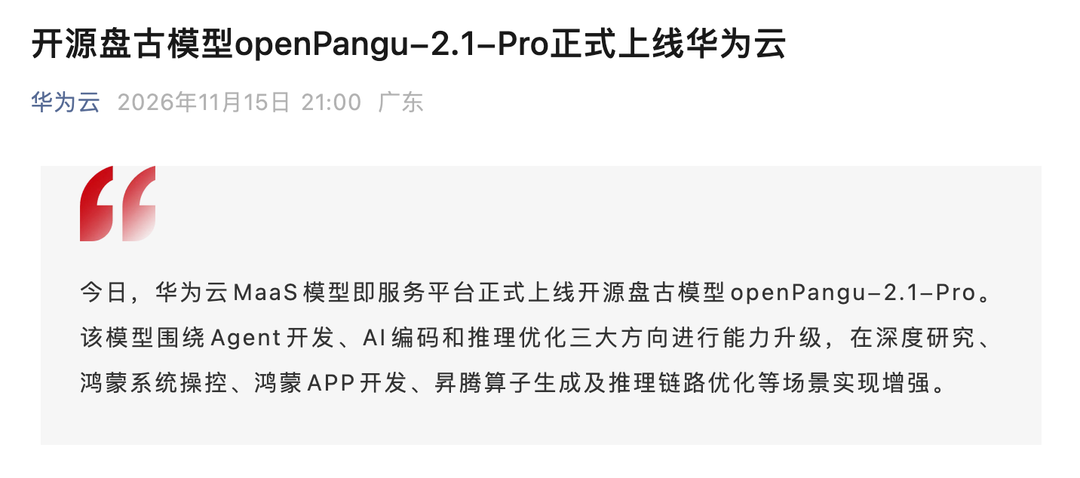
1. Huawei Cloud launches openPangu-2.1-Pro on its MaaS platform
Huawei Cloud's MaaS (model-as-a-service) platform has launched the open-source Pangu model openPangu-2.1-Pro, upgraded in three areas: agent development, AI coding and inference optimisation. For agents, the model was tuned on more than 100,000 specialised examples for skill triggering, tool selection and tool calling, improving deep research and HarmonyOS device control. For code, it focuses on HarmonyOS ArkTS app development and Ascend operator generation. For inference, optimised key operators and inference paths deliver what Huawei calls a large throughput gain in typical deployments. Users can access it through preset model APIs on Huawei Cloud MaaS, with rate limiting, usage statistics and performance monitoring. The model is already integrated into Huawei Cloud products including AgentArts, CodeArts and OfficeAce.
Noticemp.weixin.qq.com/s/8JfFmscBTDl_mPQMycD8Nw
Platformwww.huaweicloud.com/product/modelarts/studio.html
2. Agnes AI open-sources Agnes 2.5 Pro Theta, a 187.8B multimodal MoE model
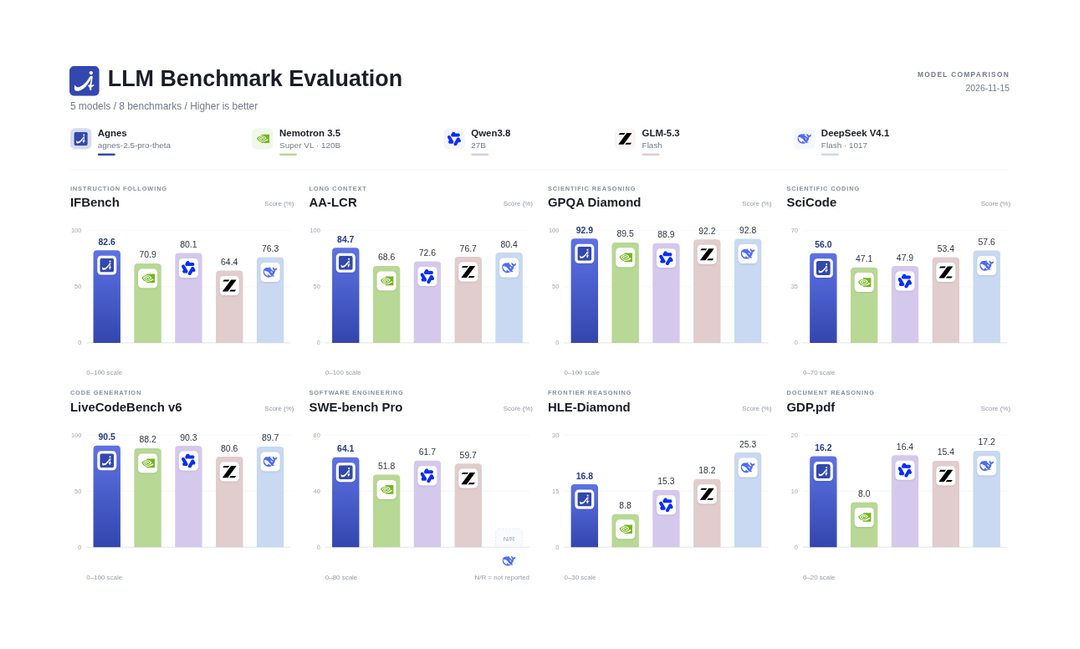
Agnes AI has open-sourced Agnes 2.5 Pro Theta on Hugging Face under the Apache 2.0 licence. It is a multimodal MoE model with about 187.8 billion total parameters and 512 routed experts per MoE block; it takes text, images and video frames as input and outputs text, with a configured context limit of 262,144 tokens and BF16 weights of about 375GB. In its own evaluation of eight benchmarks, it ranks first on five, including 92.9 on GPQA Diamond, 90.5 on LiveCodeBench v6 and 84.7 on AA-LCR, but not on SciCode, HLE-Diamond or GDP.pdf.
Weightshuggingface.co/Agnes-AI/Agnes-2.5-Pro-Theta
II. Developer ecosystem and tooling
No major verified developer tooling updates in this issue's 24-hour window.
III. Products shipping
No new standalone product launches in this issue. Available to use now: openPangu-2.1-Pro through the API on Huawei Cloud MaaS, and the downloadable Agnes 2.5 Pro Theta weights for local inference with Transformers.
IV. Technical insight and frontier research
1. OpenAI launches a science blog with a guest post on defining the Standard Model on a lattice
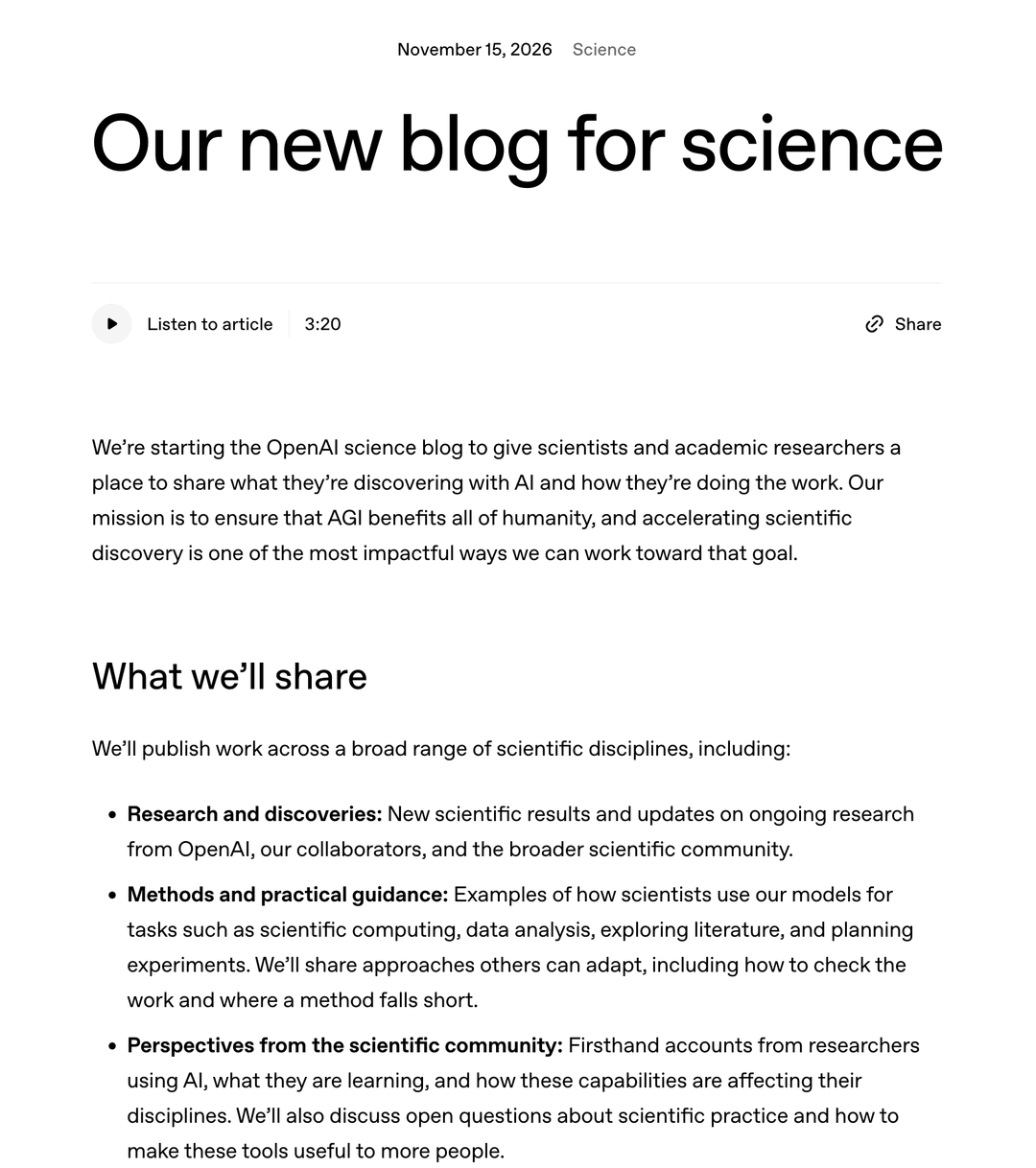
OpenAI has started a science blog to give scientists and academic researchers a place to share what they are discovering with AI and how they do the work. In the first guest post, Nathaniel Craig, a visiting scientist at OpenAI who leads the particle theory group at the University of California, Santa Barbara, describes how he worked with GPT-6 Astra on a candidate nonperturbative definition of the Standard Model of particle physics on a lattice: he proposed the strategy, and Astra turned it into a construction and took the lead in developing the detailed proof. The paper was submitted to arXiv on 6 October, so the blog post is an accessible explanation rather than a first announcement of new results.
Blogopenai.com/index/our-new-blog-for-science/
Guest postopenai.com/index/step-toward-defining-the-standard-model/
2. Analysis: openPangu-2.1-Pro is tightly bound to China's own hardware and software
Unlike general-purpose base models, openPangu-2.1-Pro takes a vertical hardware-software route, tightly integrated with HarmonyOS ArkTS and the Ascend compute stack. For developers in China, the advantage is a connected path for device-cloud agents and native HarmonyOS apps; the drawback is higher cost to move to other hardware, with the ecosystem benefits concentrated among Huawei's own customers.
3. Analysis: know the limits of MoE benchmark results
Agnes 2.5 Pro Theta's benchmark results are impressive, but they are the developer's own figures and have not been independently reproduced. High benchmark scores don't guarantee stable production service, and MoE models often suffer from uneven expert load, weaker long-context performance and variable inference costs, so reproduce the evaluations yourself before deploying.
V. Industry moves
1. Nvidia leadership turmoil continues as reports of a Jensen Huang return spread
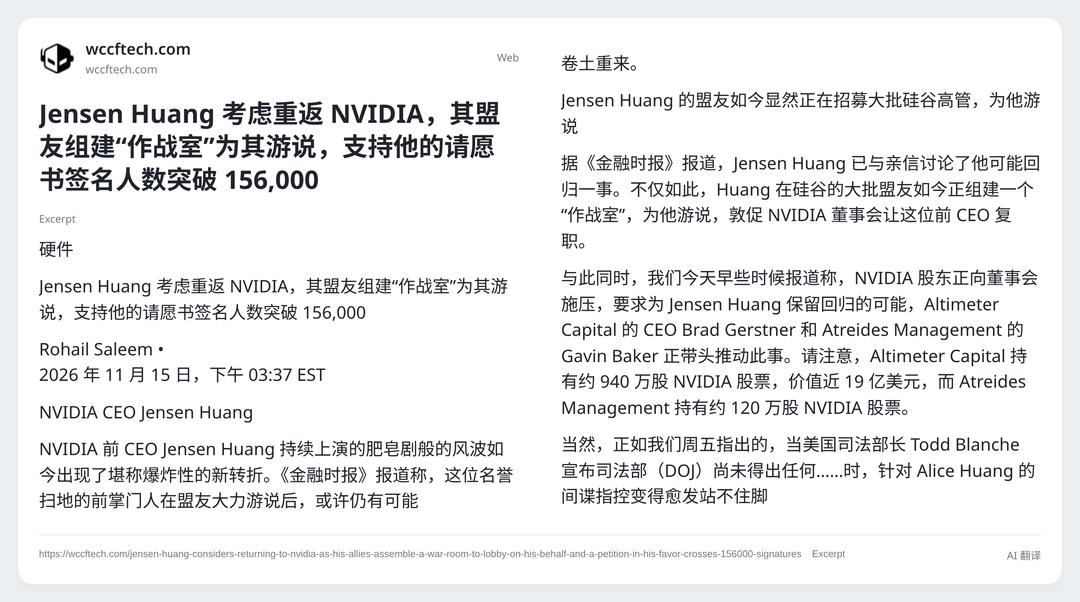
The Financial Times reports that Jensen Huang, who resigned days ago, is discussing with close confidants the possibility of returning as Nvidia CEO, and Reuters, Bloomberg and others have followed the story. According to Wccftech, his allies are recruiting Silicon Valley executives to lobby the board to reinstate him, and a petition supporting his return has more than 156,000 signatures, including more than 7,500 current Nvidia employees. Nvidia's internal investigation into the related matters is still under way, the company has not commented on a return, and CFO Colette Kress is serving as interim CEO.
VI. Outlook and market rumours
No major market rumours confirmed by multiple sources in this issue's 24-hour window.
VII. Claw roundup
No major verified updates to the OpenClaw ecosystem in this issue. As a reminder, Claw-style autonomous agents have broad execution permissions, so production use should include human approval steps and full audit logs of actions, and should never grant unrestricted permissions.
VIII. Trending open source on GitHub
1. openclaw/openclaw
Momentum: about 395,000 GitHub stars. Summary: an open-source local autonomous AI agent that runs across operating systems and platforms, written in TypeScript, MIT-licensed.
Repogithub.com/openclaw/openclaw
2. vllm-project/vllm-omni
Momentum: about 7,800 GitHub stars. Summary: vLLM's official framework for inference with omni-modal models, supporting images, audio, video and more, Apache-2.0 licensed.
Repogithub.com/vllm-project/vllm-omni
3. unclecode/crawl4ai
Momentum: about 87,000 GitHub stars. Summary: a web crawling and extraction tool for AI agents that you can self-host, Apache-2.0 licensed, with a hosted cloud API also available.
Repogithub.com/unclecode/crawl4ai
4. plannotator
Summary: a review and annotation tool for AI coding agents, letting you comment on agent-generated plans and code diffs.