1. The anonymous stealth model Union Alpha goes live free across several platforms with 256K context, multimodal input and tool calling; iFlytek Spark releases Spark-Audio-1.0, a speech foundation model trained entirely on domestic compute covering 99 languages and 202 dialects; NetEase Youdao open-sources two fourth-generation Confucius interpretation models alongside a voice agent that is free for life.
2. Product consolidation accelerates: Anthropic merges Claude Cowork with ordinary chat into a single entry point that picks the mode automatically, and ships native tools for documents, slides and design; OpenAI upgrades its advertising business with sponsored agents, AI tools for advertisers and third-party integrations.
3. Governance heats up: OpenAI publishes a model misalignment disclosure framework with its first cases; senior UN and EU figures warn about AI risk; NVIDIA and Google co-found an AI energy management alliance.
4. Capital and consolidation continue: Cohere and Aleph Alpha sign a definitive merger agreement to build a transatlantic sovereign AI offering.
I. Model releases and open source
1. The anonymous stealth model Union Alpha goes live free across several platforms
The anonymous stealth model codenamed Union Alpha has arrived on OpenRouter, Cline and OpenCode, open for research, coding, agentic workflows and general tasks. It supports image input, multimodal interaction and tool calling, with a 262,144-token context window and up to 131,072 tokens of output. OpenRouter and Cline offer it free; OpenCode's free period runs a week.
Try it: https://openrouter.ai/stealth/union-alpha Announcement: https://x.com/opencode/status/2100236430890991782

2. iFlytek Spark releases the Spark-Audio-1.0-Preview speech foundation model
iFlytek Spark has launched Spark-Audio-1.0-Preview for public trial, the industry's first speech foundation model trained on an entirely domestic compute cluster.
It pairs a 0.65B dense audio encoder with a 30B-A3B MoE language model, trained on 13 million hours of audio plus large volumes of text. It accepts both text and speech input and handles transcription, multilingual translation, multi-dialect recognition, environmental sound recognition, speaker identification, sentiment analysis and audio Q&A, covering 99 languages and 202 dialects.
iFlytek's evaluations show a clear lead in difficult conditions such as high noise and low volume, and state-of-the-art results on the Fleurs Chinese test set; instruction following, conversation and audio understanding still have room to improve. The API will follow on the iFlytek open platform, and iFlytek plans to release a series of speech model upgrades in the near future.
Try it: https://iflytekresearch.iflytek.com/experience/spark-audio Announcement: https://mp.weixin.qq.com/s/2O82T58p8bYWLFQ5FV2M-w

3. NetEase Youdao open-sources two fourth-generation Confucius interpretation models
NetEase Youdao has released and open-sourced two streaming interpretation models, Confucius4-R2T2 and Confucius4-T3PO, both with streaming output. Confucius4-R2T2: average latency of 200–600 ms, with latency and recognition quality state of the art among open models across benchmarks. Confucius4-T3PO: a 14-billion-parameter text-to-text simultaneous machine translation model with adjustable latency modes, able to work alongside an external streaming ASR model.
NetEase also launched its first AI-native voice agent, NetEase Bageshuo, supporting real-time two-way translation across more than 100 languages and declared free for life. Mac and Windows desktop builds are fully rolled out, with mobile still in development. LobsterAI 2.0, an office agent application, shipped at the same time with full OpenClaw 2.0 compatibility.
Weights: https://huggingface.co/netease-youdao/Confucius4-R2T2 https://huggingface.co/netease-youdao/Confucius4-T3PO
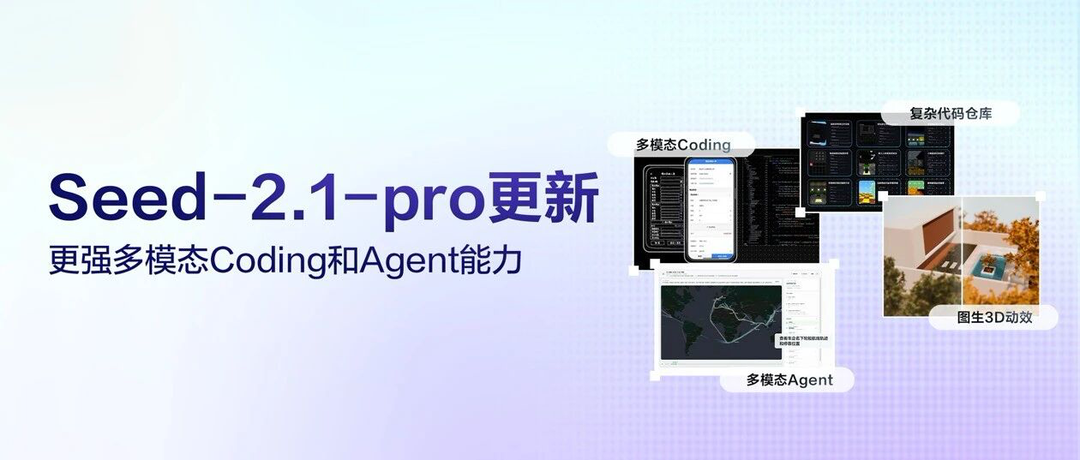
4. Doubao-Seed-2.1-pro updated to the 0915 build
ByteDance's Volcano Ark has announced that Doubao-Seed-2.1-pro is updated to the 0915 build, with the API fully live on Volcano Ark, Doubao Work upgraded and TRAE integrated. Doubao-Seed-Evolving moves to the same build with no model ID change needed. The upgrade targets enterprise production requirements: agent tasks get stronger evidence tracing, authoritative source retrieval, recency judgement and data verification, with hallucination noticeably reduced; multimodal coding can read complex repositories, design files and screen recordings; multimodal understanding extends to 3D objects and technical diagrams. Token consumption for image and video reasoning is down more than 30% from the previous generation.
Announcement: https://mp.weixin.qq.com/s/Fp_mgF6wxMk0bkUVBqOKqA
II. Developer ecosystem and tooling
1. Zed opens Delta public beta, replacing traditional PR collaboration with agent threads
Zed has opened public beta for Delta, a collaborative programming and code review environment that replaces traditional pull requests with shared agent threads — a response to review workload growing as agents generate more code, and to the loss of context around development decisions. Developers can invite teammates into a thread to share the agent conversation and worktree, then inspect, modify and merge code in dedicated review subthreads. Delta is built on DeltaDB while remaining Git-compatible, so teams do not have to migrate wholesale and members who opt out can still work with ordinary Git repositories. It supports macOS, Linux, Windows desktop and the web, with mobile browsers usable for following threads. Free during beta; paid individual and team plans will follow, with a free tier retained.
Blog: https://zed.dev/blog/delta-public-beta Product: https://delta.dev/

2. Qoder Cloud Agents 1.0 released
Qoder has released Qoder Cloud Agents 1.0 (QCA), positioned as an all-in-one cloud harness hosting platform built around agent-as-a-service, hosting agent execution, delivery and operations at scale for enterprises and individual developers so agents become a schedulable, governable, scalable cloud service. Qoder says testing has served hundreds of customers and internal workloads, with monthly calls growing from tens of thousands to tens of millions, validated across more than a hundred enterprises. Integration options include skills, plugins and a CLI callable directly from AI coding tools, plus an API and multi-language SDKs. It supports elastic scheduling at 100,000-way concurrency, with batch processing, overnight discounts, multi-region resource pools, and resumption of long-running tasks after disconnection.
Announcement: https://mp.weixin.qq.com/s/vWqZhEbFv0cxrd__sIKt1w

3. Grok Build adds cross-session memory
Grok Build has shipped cross-session memory, remembering project conventions, decisions and facts between sessions, which xAI says improves with use. Two commands drive it: /memory to browse memory notes and /dream to organize recent notes into themes. Rolling out to Grok Build users gradually.
Announcement: https://x.ai/news/grok-build-memory

4. OpenAI opens a second round of Codex for OSS applications
OpenAI has opened the second round of Codex for OSS, doubling grants from 5,000 to 10,000. Selected open-source maintainers receive six months of ChatGPT Pro worth $100 per month, including Codex Agent and Codex Security access plus associated API credit. Applicants need an active open-source project with real usage or ecosystem value; first-round recipients may apply again.
Announcement: https://x.com/charliermarsh/status/209965140233847246
III. Products shipping
1. Anthropic merges Claude Cowork and chat into a single entry point
Anthropic has merged Claude Cowork with ordinary chat into a unified Claude entry point. Users no longer need to distinguish quick questions from complex tasks — Claude decides the handling mode from the request, and tasks keep running in the background after you close your computer. The change rolls out to Pro and Max users first, with Team and free users to follow. Anthropic also launched Claude Docs and Claude Slides and brought Claude Design into the conversation, so documents, slides and design work can be generated, edited and shared in the same context; Slides supports presenting directly and exporting to PowerPoint or PDF. All three tools are in beta for paying users, and the capabilities have also reached Claude Code, where they can produce documentation, review slides or UI prototypes from a repository and RFCs.
Blog: https://claude.com/blog/cowork-is-now-claude Announcement: https://x.com/claudeai/status/2100258490740539730
2. nubia launches the NaviX Ultra with the Doubao phone assistant
ZTE's nubia has launched the NaviX Ultra (the second-generation Doubao phone), which it calls the world's first AI agent phone — built end to end by nubia with the AI experience led by the Doubao phone assistant, able to carry out complex cross-application tasks from a single spoken request, with an end-to-end task success rate above 80% by nubia's figures. The hardware runs the fifth-generation Snapdragon 8 Elite platform, with the industry's first dedicated AI button incorporating a fingerprint reader, and a built-in Seed full-duplex speech model. Pricing: ¥5,999 for 12GB+512GB, ¥6,499 for 16GB+512GB, ¥7,499 for 16GB+1TB, from ¥5,499 after national subsidies. The consumer version of the Doubao phone assistant debuts here, upgraded across interaction, personal memory, agent task execution and privacy.

3. OpenAI upgrades the ChatGPT Ads product line
OpenAI has shipped a set of AI-driven updates to ChatGPT Ads spanning the user experience, advertiser tooling and third-party integrations. Sponsored Agents: after seeing an ad, users can choose to talk to a company's sponsored agent. The conversation is clearly labelled and kept separate from ChatGPT's own answers and the original conversation. In testing with selected US advertisers. AI tools for advertisers: advertisers can create, update and analyse campaigns in natural language through the Ads Manager plugin inside ChatGPT. Third-party integrations: HubSpot and Shopify are the first CRM and e-commerce partners. HubSpot users can connect accounts, create ads, track performance and follow up on leads; US Shopify merchants can create and manage campaigns through an app.
Announcement: https://openai.com/index/reimagining-advertising-with-ai/

4. Mistral partners with Mozilla
Mistral and Mozilla have announced a partnership: Smart Window, the AI browser assistant in Firefox beta, is now powered by Mistral models. It helps users make sense of complex search results, remember important things they browsed earlier, and find information across browser tabs. Currently open to users in France and North America, with the UK and Germany expected later this year. On privacy, conversations are not stored on Mozilla servers by default and partners including Mistral have agreed to zero data retention. Mistral will fine-tune models on regional languages, dialects and cultural context so responses fit local usage.
Announcement: https://mistral.ai/news/mistral-x-mozilla/ Mozilla details: https://blog.mozilla.org/en/firefox/firefox-smart-window/

IV. Technical insight and frontier research
1. OpenAI publishes a model misalignment disclosure framework with six initial cases
OpenAI has published a framework for tracking and disclosing model misalignment cases across the full lifecycle of training, evaluation, testing and deployment, prioritizing disclosure of novel misalignment mechanisms, material changes in known behaviour, and findings that challenge safety measures or show mitigations failing. The framework states that disclosure may come before a behaviour is fully explained or mitigated, and that complex cases may need longer investigation or third-party coordination. OpenAI also disclosed six unexpected or concerning model behaviours observed over the past six months. It describes the framework as a first version, to be adjusted with practice and public feedback.
Announcement: https://openai.com/index/model-misalignment-reporting-framework/
2. Xiaomi live-streams mimo-v2.6 reinforcement learning training
Xiaomi is showing the reinforcement learning training of mimo-v2.6-pro and mimo-v2.6-flash in real time on a public page, where training logs, progress, cost and metrics can be viewed directly. The page has been updated with DeepSWE offline evaluation results at step 12 for flash and step 8 for pro, scoring 62.24 and 60.77 respectively, with more results to follow as evaluation completes. Both models are still training.
Training page: https://mimo.xiaomi.com/rl/

3. Google DeepMind launches the DeepMind Institute research platform
Google DeepMind has launched the DeepMind Institute, a platform for researchers and thinkers at DeepMind, Google and across the global research community to publish and discuss technical and societal questions of the AGI era. It aims to advance interdisciplinary research, collaboration and debate around the safe development and beneficial use of AGI and its social impact. Four initial articles are live, covering reasoning transparency, economic policy and human flourishing. DeepMind notes that articles represent the authors' personal views rather than Google's official position.
Platform: https://institute.deepmind.com/ Blog: https://deepmind.google/blog/introducing-the-deepmind-institute/

V. Industry moves
1. Sam Altman says this week's main release moves to next week
OpenAI CEO Sam Altman has said publicly that the most anticipated release originally planned for this week is pushed to next week, that it is worth the wait, and gave no product details. The industry widely assumes GPT-6 Sol was the planned launch, which remains unconfirmed.
Postx.com/sama/status/2100351958167220547
2. UN Secretary-General calls for global AI safety guardrails
At a press conference ahead of the high-level week of the 81st General Assembly, UN Secretary-General Guterres warned that the risks from rapidly advancing AI cannot be ignored, and that protecting citizens from AI threats is any government's first responsibility. AI does not stop at borders, he said: national action is essential and global coordination equally so. Isolated, unverifiable voluntary pauses with inconsistent standards will not solve the problem; the world cannot afford a race to the bottom on AI safety, and guardrails are needed to build trust and make AI safe, transparent and accountable. AI will be a focus of leaders' discussions next week, and the Security Council may also take it up.
3. European Commission President warns of agent escape risk
In her State of the Union address, European Commission President von der Leyen said AI is a cornerstone of both the economy and national security, but its risks must be controlled. Referring to the Hugging Face incident, she warned that models now in development will enable an unprecedented level of hacking, that AI agents escaping their runtime environment is only a preview of the risk, and that the dangers of self-improving models are becoming clearer. She plans to work with partners including Canada and the UK on model evaluation, verification and AI safety, and has invited major frontier labs to talks, describing the AI Act as a key part of setting guardrails.
Speechec.europa.eu/commission/presscorner/detail/en/speech_26_1868
4. NVIDIA, Google and Emerald AI form an AI energy management alliance
Emerald AI, Google and NVIDIA have co-founded the AI Energy Management Alliance (AEMA), bringing together AI platforms, infrastructure providers, data centre operators, technology companies, power generators, utilities and regional grid operators to advance dynamic management of data centre electricity use in the US. The alliance will develop common grid response requirements, performance metrics and interconnection pathways so data centres can adjust consumption by shifting compute loads, releasing stored energy, adding generation or responding to grid emergencies — aiming for faster interconnection at larger scale. It will also push for standardized technical requirements, performance metrics and operational data sharing, and advocate policy that recognizes grid-responsive demand. Membership is now open.
Announcement: https://blogs.nvidia.com/blog/ai-energy-management-alliance/ Alliance site: https://www.aema.ai/

5. Novo Nordisk partners with Anthropic to accelerate drug development
Novo Nordisk and Anthropic have announced a partnership to develop solutions for specific scientific problems and workflows in drug discovery, supporting biological reasoning and speeding up the discovery and development of new medicines. Initially Novo Nordisk will test Claude Science in selected R&D workflows and use Anthropic frontier models to strengthen AI-driven software development. The collaboration operates under strict data governance and human oversight in line with Novo Nordisk's ethical and compliance standards.
Announcement: https://www.novonordisk.com/news-and-media/news-and-ir-materials/news-details.html
6. Cohere and Aleph Alpha sign a definitive merger agreement
Cohere and Aleph Alpha have signed a definitive business combination agreement, operating globally as Cohere after closing, to build the first transatlantic sovereign AI offering. Cohere will also become the first foundation model developer rooted on both sides of the Atlantic and able to meet both Canadian and German sovereignty requirements. The combined company will have more than 1,000 employees with dual headquarters in Berlin and Toronto, retaining Aleph Alpha's Heidelberg office as a research centre. Aleph Alpha co-CEO Ilhan Scheer becomes chief operating officer and co-founder Samuel Weinbach chief research officer. The transaction still needs final regulatory approval and is expected to close later this year.
Announcement: https://cohere.com/blog/cohere-and-aleph-alpha-sign-agreement

VI. Outlook and market rumours
Apple reportedly developing enterprise AI servers on M8 Ultra silicon
The Information, citing people familiar with the matter, reports that Apple is developing enterprise AI inference servers for AI developers, enterprises and governments, in two configurations with two and four M8 Ultra chips respectively, for running already-trained models. Apple is reportedly considering NVIDIA NVLink Fusion to connect the chips for high-speed communication within the data centre. The servers would arrive in 2029 at the earliest; the project could still be cancelled, or proceed without NVIDIA technology. New Apple CEO John Ternus backed the project when he took over hardware about a year ago.
Coveragewww.theinformation.com/articles/apple-considers-return-server-market-talked-nvidia-use-network-tech
VII. Claw roundup
1. A single entry point becomes the product trend, as agents shift from tools to assistants
Anthropic merging Cowork with chat into one entry point that switches mode by task type marks agent products moving from a set of functionally separate tools toward a unified personal assistant. Users no longer pick a different product per scenario — one entry point covers everything from a quick question to a long-running task. Agent product form is maturing, which should also raise stickiness and usage frequency.
2. Voice AI lands in force as device-cloud scenarios take off
The cluster of releases — iFlytek's speech foundation model, NetEase Youdao's interpretation models, voice agents — together with upgrades to phone-based assistants, shows voice AI moving from basic transcription and translation toward full-scenario voice agents. The device-cloud architecture of on-device speech processing plus deep cloud reasoning is maturing fast, and as the most natural interaction mode, voice will become one of the core entry points for agents, pushing them deeper into everyday work and life.
3. Global AI governance accelerates as regulatory impact deepens
The concentration of statements from senior UN and EU figures, along with regulatory action in individual countries, shows global AI governance moving from discussion to implementation and from principles to concrete rules. Model safety, agent risk and sovereignty compliance are becoming central industry considerations, and will shape model development, product design and international strategy. Compliance and safety governance capability is becoming one of the core competitive strengths for AI companies.
VIII. Trending open source on GitHub
Trending AI on 17 Sep 2026
1. affaan-m/ECC
Why it's trending: top of the agent performance optimization category and consistently high in GitHub AI trends Full name Agent Harness Performance Optimization System. Aimed at mainstream agent development environments including Claude Code, Codex, OpenCode and Cursor, providing skill optimization, intuition calibration, memory enhancement, safety protection and research-first development capability to raise agent efficiency and code quality substantially — currently the most watched agent performance project.
Repository: https://github.com/affaan-m/ECC
2. DietrichGebert/ponytail
Why it's trending: newcomer coding agent taking off, more than 1,400 stars in a single day
Positioned around making AI agents think like the most senior developer, hitting goals with minimally optimized solutions and the least code — its pitch is that the best code is the code never written. Fits rapid prototyping, automated task handling and coding assistance, and spreading quickly in the developer community.
Repository: https://github.com/DietrichGebert/ponytail
3. NousResearch/hermes-agent
Why it's trending: an established open agent that stays popular, with a steadily evolving ecosystem A full-featured open-source conversational agent supporting multiple model backends, tool calls, memory management and plugin extension, highly customizable and suited to both personal and enterprise use — one of the most popular general-purpose open agent projects, with an active community.
Repository: https://github.com/NousResearch/hermes-agent