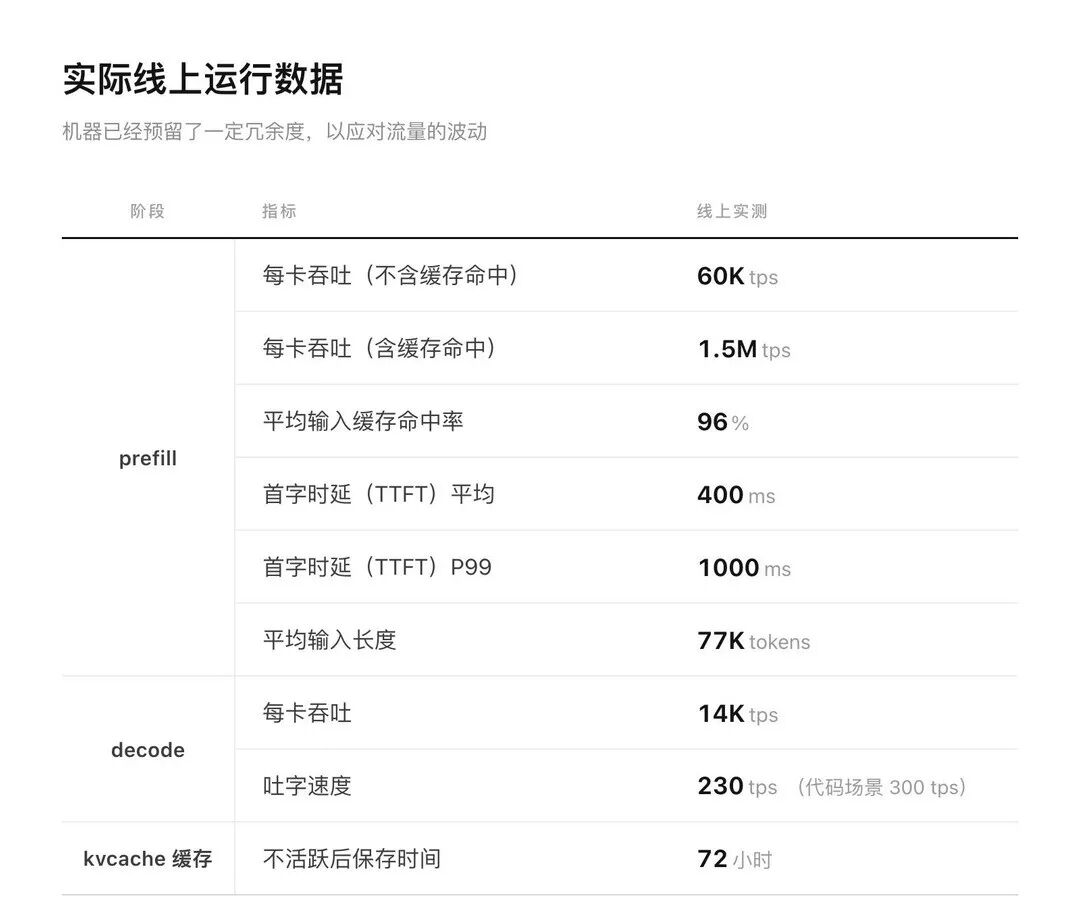
1. DeepSeek open-sources DeepInfer, its internal production inference framework, along with token encoding components; it supports both NVIDIA SM100 and Huawei Ascend 950 NPUs, a single cluster handles 155 trillion tokens a day, and the average input cache hit rate is 96%;
2. ChatGPT launches locked chats, protected by a PIN or biometrics;
3. OpenAI completes the day-15 Codex usage reset and fixes allowance mismatches on 40,000 accounts with compensation;
4. ElevenLabs and Mistral both release new real-time voice models and agent SDKs, bringing voice latency down to hundreds of milliseconds
5. OpenAI acquires Orchestra Bio to push further into life sciences;
6. OpenAI is reportedly pursuing a US$30 billion raise, and Anthropic's draft IPO filing discloses plans for tens of billions in compute spending.
I. Model releases and open source
1. ElevenLabs releases two real-time voice models, Eleven Realtime
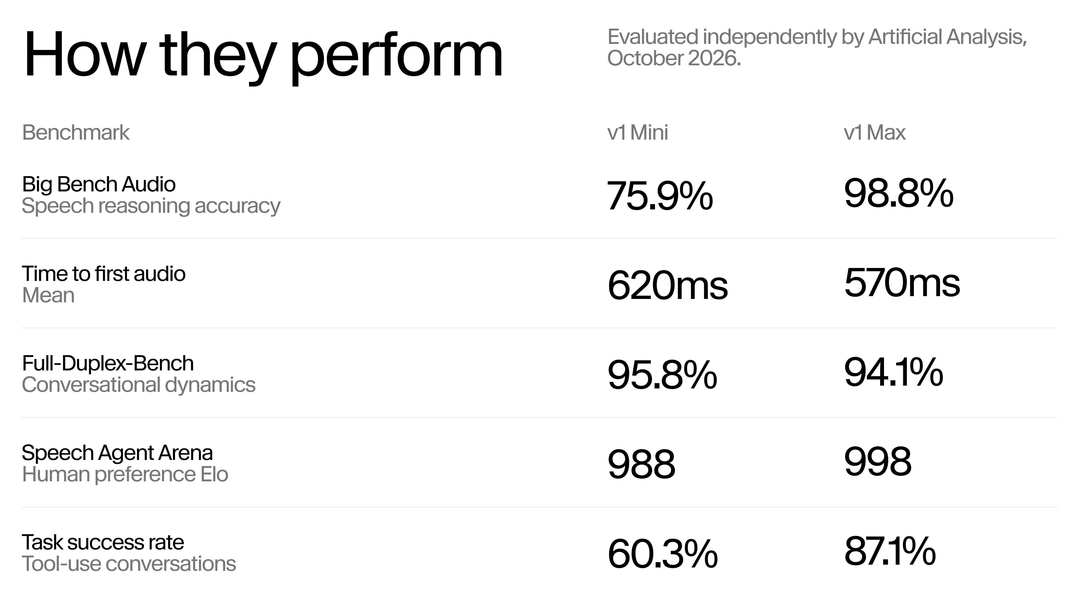
ElevenLabs has released Eleven Realtime v1 Mini and Eleven Realtime v1 Max, two speech-to-speech real-time models that can each serve as a complete voice agent, aimed respectively at low-cost natural conversation and complex multi-step reasoning tasks. In Artificial Analysis's independent evaluation on the Big Bench Audio benchmark, Max reaches 98.8% accuracy with an average time to first audio of 0.57 seconds, and Mini reaches 75.9% with 0.62 seconds. Both support more than 90 languages and can use more than 1,700 voices from the ElevenLabs voice library. They are available through ElevenAgents or the Realtime API, which is compatible with the OpenAI Realtime specification and supports WebSocket connections only.
Blogelevenlabs.io/blog/realtime
2. Mistral AI releases the Voxtral 3 voice models and a voice agent SDK
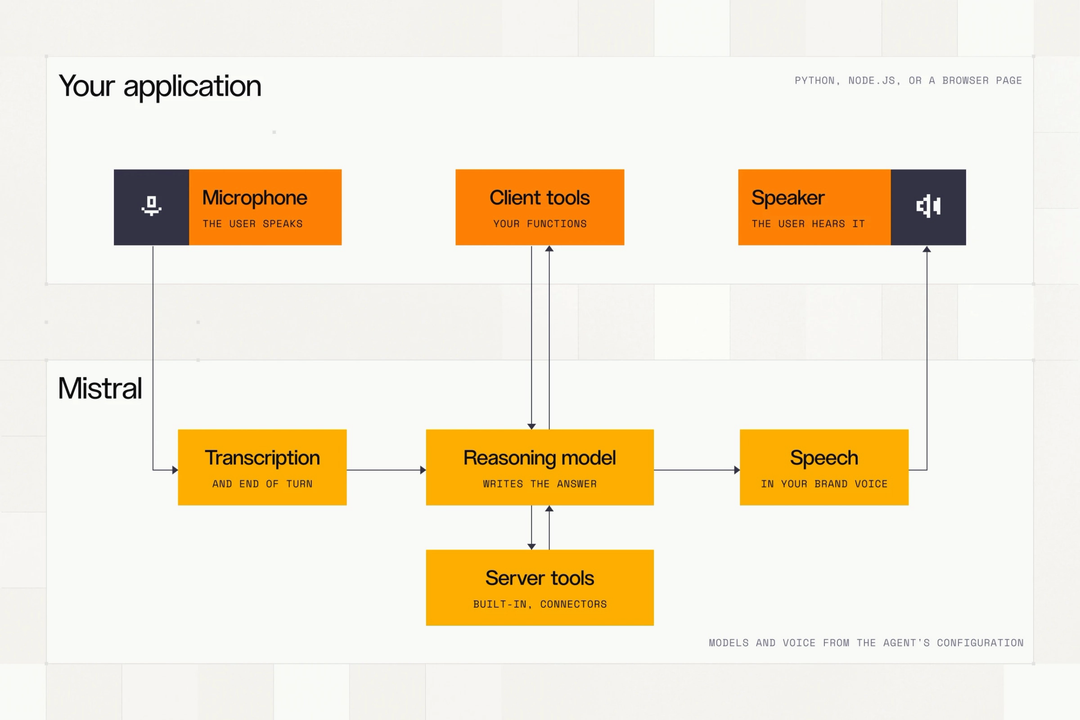
Mistral AI has released the Voxtral 3 voice model family and a voice agent SDK, combining transcription, reasoning, tool calling and speech synthesis into an end-to-end real-time streaming pipeline. Transcription supports more than 50 languages, and speech synthesis more than 35 languages and 50 dialects, adjusting emotion, pace and stress as the conversation goes. Pro Voice can adapt to a speaker's vocal style from 30 minutes of audio. Mistral says real-time transcription latency is under 500 ms, each voice agent turn completes within a second, and users can interrupt in real time. The family is available now through the Mistral API.
Announcement: https://mistral.ai/news/voxtral-3
II. Developer ecosystem and tooling
1. DeepSeek open-sources its internal inference framework, DeepInfer
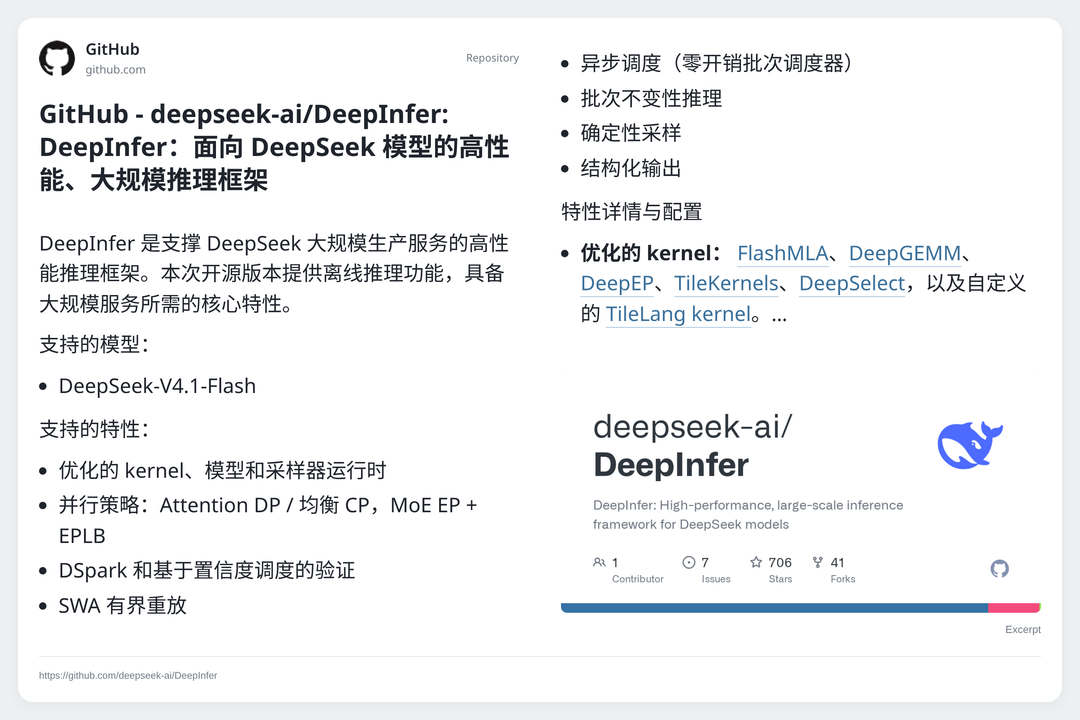
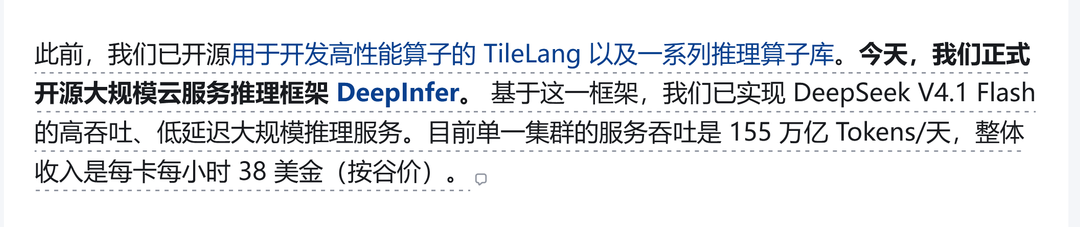
DeepSeek has open-sourced DeepInfer, the internal inference framework behind its online services, along with deepseek-recipe, a token encoding component. DeepSeek says its online DeepSeek V4.1 Flash service runs on DeepInfer, with a single cluster handling 155 trillion tokens a day and earning US$38 per GPU per hour at off-peak prices; the average input cache hit rate is 96%. The framework supports distributed inference, DSpark speculative decoding, SWA Bounded Replay and structured output. The open-source version supports NVIDIA SM100 GPUs and Huawei Ascend 950 NPUs and is Apache 2.0-licensed. DeepSeek says inference code and later optimisations for future models will keep being open-sourced in DeepInfer. deepseek-recipe encodes and decodes between model tokens and three API protocols — Chat Completions, Responses and Messages — matching the official API's handling exactly.
Repository: https://github.com/deepseek-ai/DeepInfer Explainer: https://zhuanlan.zhihu.com/p/2095560295930508953
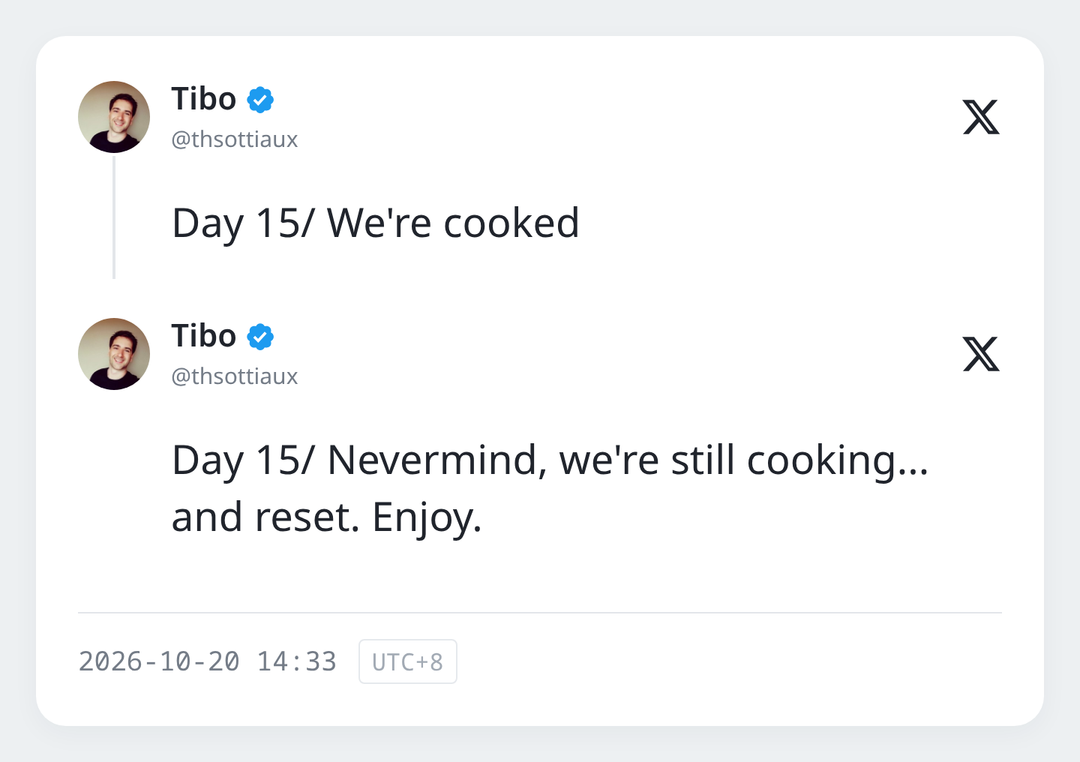
2. Day 15 of Codex's 28-day improvement plan: usage reset complete
Codex lead Tibo announced that day 15 of the 28-day continuous improvement plan brought a full usage reset; OpenAI had promised a feature improvement or a usage reset every day for 28 days.
Postx.com/thsottiaux/status/21124320767289678
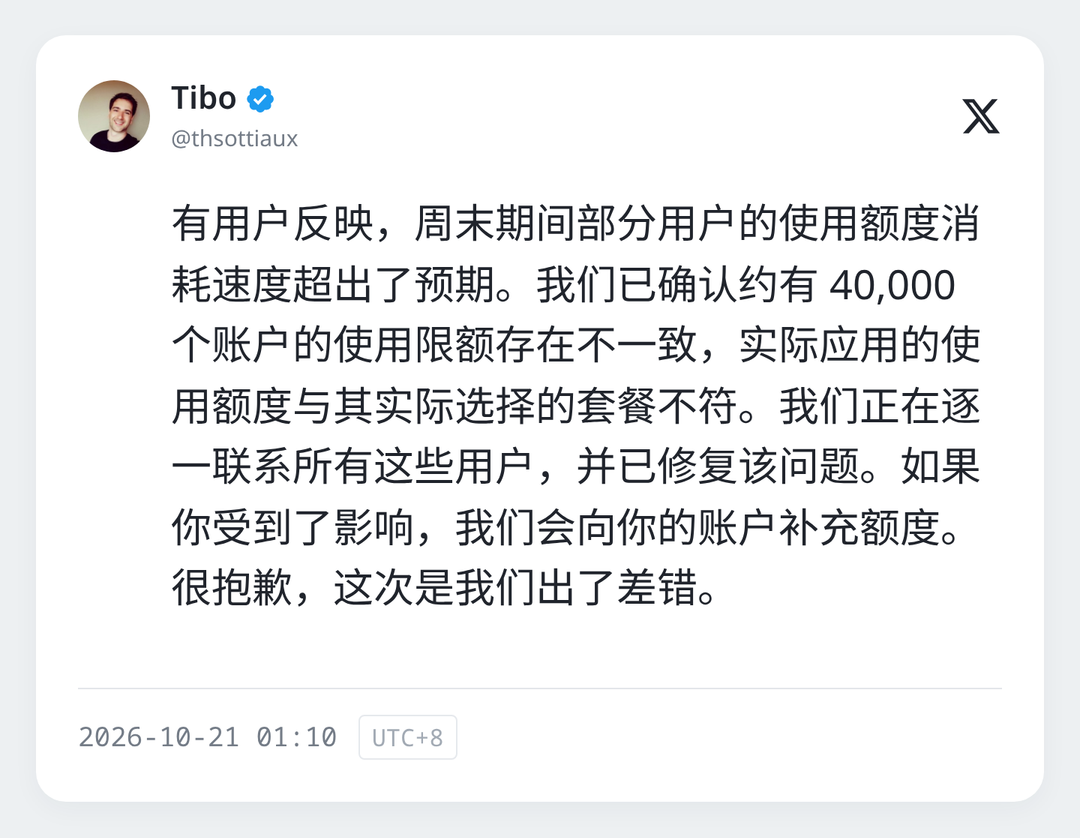
3. OpenAI fixes allowance mismatches on about 40,000 accounts and compensates users
OpenAI confirmed that about 40,000 accounts had usage allowances calculated in a way that did not match their plan, so some users ran through their allowance faster than expected. The problem has been fixed and affected users will be compensated. Some users who moved from Pro 200 to a cheaper plan did not have their weekly allowance adjusted, so after the 16 October correction this week's usage counted against the new allowance and left them with less remaining. Affected accounts get a dedicated allowance worth US$500 (12,500 credits), counted separately from the weekly allowance and expiring on 20 January 2027.
Postx.com/thsottiaux/status/2112592264686149749
4. OpenAI API adds 12-hour extended prompt caching
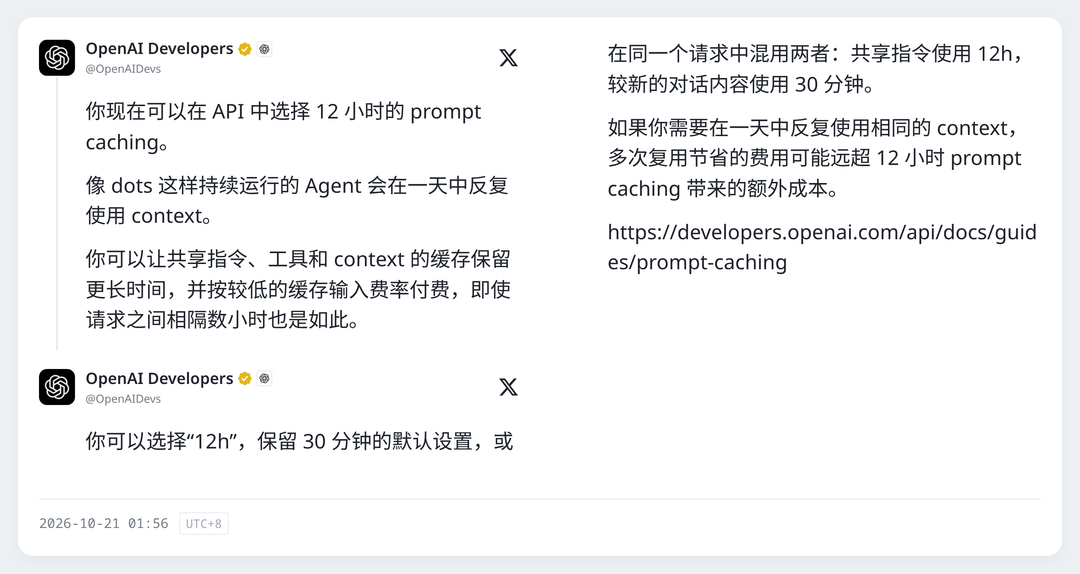
OpenAI has added optional 12-hour prompt caching for GPT-5.6 and later models in the Responses API, so requests hours apart can still reuse shared instructions, tools and context at the cached input rate. Developers can keep the default 30 minutes, or within the same request use 12-hour caching for shared content and 30-minute caching for newer conversation. Cache writes cost 2.5 times and 1.25 times the normal input rate for the two durations respectively, while cache reads cost the same regardless of duration.
Docs: https://developers.openai.com/api/docs/guides/prompt-caching Post: https://x.com/OpenAIDevs/status/2112603916076781778
5. Google open-sources TorchTPU, a PyTorch-native software stack
Google has open-sourced TorchTPU, a software stack built with Meta's PyTorch team that lets existing PyTorch workloads train, run and deploy models natively on TPU chips with only small code changes. It supports the standard PyTorch API, allows debugging in eager mode, and uses torch.compile to improve TPU utilisation and reduce memory overhead. It already integrates with Hugging Face, vLLM, SGLang, TorchTitan and Ray, covering training, inference serving and deployment; in Hugging Face Transformers v5, setting device_map="tpu" deploys a model to TPU.
Repository: https://github.com/google-pytorch/torch_tpu Blog: https://cloud.google.com/blog/topics/ai-infrastructure/torchtpu-is-now-open-source-run-native-pytorch-on-tpus
6. Tencent opens Yuanbao Search to outside developers, with three ways to connect
Tencent has opened Yuanbao Search to outside users through Tencent Cloud, with three ways to connect — Skill, MCP and API — and 2,000 free calls a month. Tencent says Yuanbao Search has an index of hundreds of billions of items covering 157 authoritative sources across 13 verticals including finance, healthcare, law and travel, with policy, news, weather and market data updated within minutes. Index retrieval takes 8 ms on average with a 94% recall rate.
Announcement: https://mp.weixin.qq.com/s/DHbVEwhHjiggPI5EQ5LgkQ
III. Products shipping
1. ChatGPT launches locked chats protected by a PIN or biometrics
OpenAI is gradually rolling out Locked Chats on all plans. Users can move conversations into a separate area hidden from regular history, pinned chats and search, accessed with a 4-digit account PIN or, on mobile devices with biometrics, Face ID, Touch ID or the device unlock method. With memory turned on, new messages in locked chats can create memories used by other locked chats, but they do not update the regular chat memory. OpenAI notes that locking does not provide end-to-end encryption and does not change chat retention or model training settings; resetting the PIN permanently deletes all locked chats, their files and their dedicated memories.
Help: https://help.openai.com/en/articles/20001411-using-locked-chats-in-chatgpt Post: https://x.com/ChatGPT/status/211259776633673624
2. OpenAI introduces team recurring tasks in ChatGPT
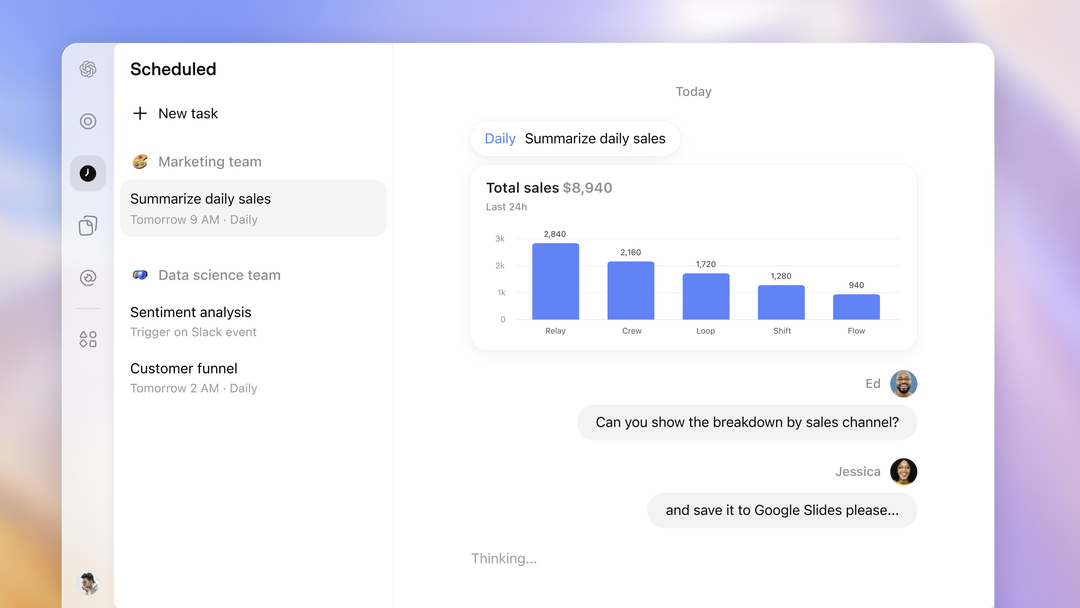
OpenAI has launched team tasks in ChatGPT for business users, letting several people jointly manage recurring engineering work such as a weekly summary of releases and blockers; colleagues can see the results and change instructions for future runs. Tasks run in the cloud on a schedule or triggered by app events, without keeping ChatGPT open. The feature is available in Business and Enterprise workspaces, with creation and management governed by workspace permissions.
Help: https://help.openai.com/en/articles/20001540-creating-and-managing-team-tasks-in-chatgpt Post: https://x.com/OpenAIDevs/status/2112565702552940794
3. Google launches a toolkit for small business owners in Gemini
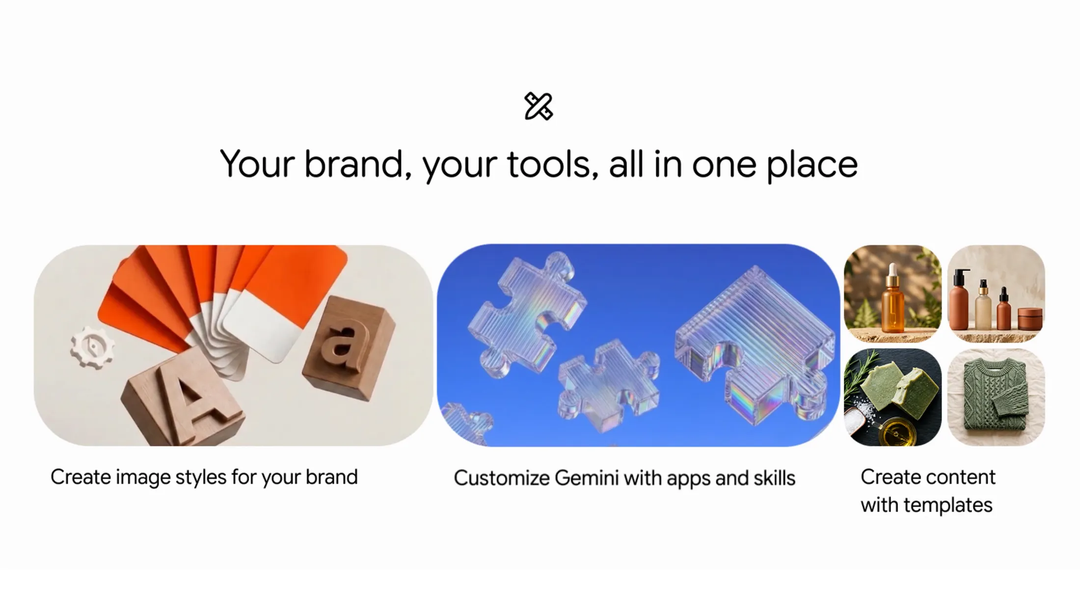
Google has launched a toolkit in Gemini for small business owners worldwide, centred on a business landing page that brings together everyday work such as managing the brand, analysing finances and understanding customers. Gemini can connect to Google Business Profile, Google Ads and Google Workspace as well as third-party apps such as Adobe, Canva and Shopify. Once owners upload brand assets, the Nano Banana 2.1 image model can keep producing on-brand visuals, and receipts and purchase records can be turned automatically into financial charts and interactive models. The features will roll out to all Gemini app users worldwide over the next few days.
Blogblog.google/innovation-and-ai/products/gemini-app/new-tools-small-business-owners/
4. Google brings Gemini personalisation to Android Auto
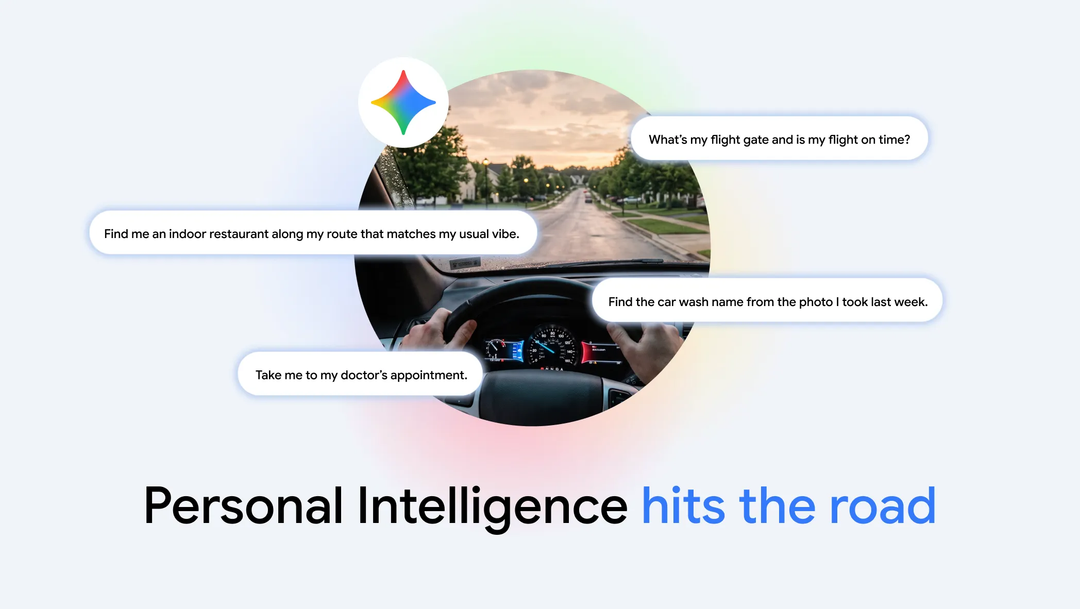
Google is starting to roll out Gemini's Personal Intelligence on Android Auto, with cars with Google built-in to follow in the coming months. With the user's permission, it connects information from Gmail, Google Calendar, Google Photos, Google Maps, YouTube, Search and other apps to give personalised answers from multiple sources, supporting voice requests such as checking flights and navigating to places.
5. Qwen app launches a "shop with Qwen" assistant
For the Singles' Day shopping season, the Qwen app has launched "shop with Qwen". After starting a call and sharing their screen, users can ask about products by voice while browsing shopping apps; the AI uses what is on screen to summarise reviews, specifications and prices, highlight negative feedback, calculate price differences and remember the user's preferences. Users need to update the Qwen app to the latest version and enter screen sharing through the call icon in the top right; the feature is rolling out gradually.
Announcement: https://mp.weixin.qq.com/s/5MEu2eeqNfBWXlkCKTd6sg
6. X adjusts its timeline recommendations with two model improvements
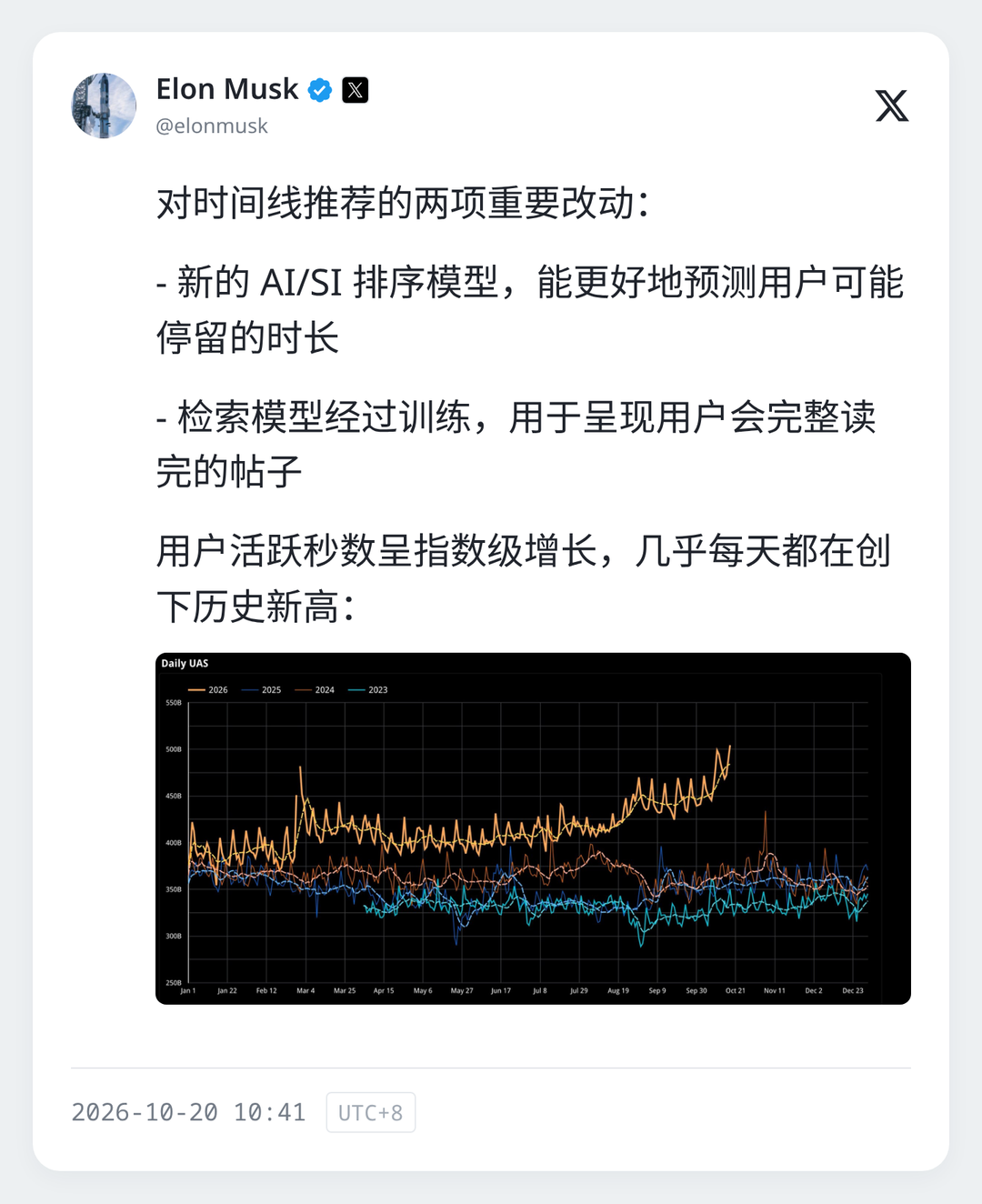
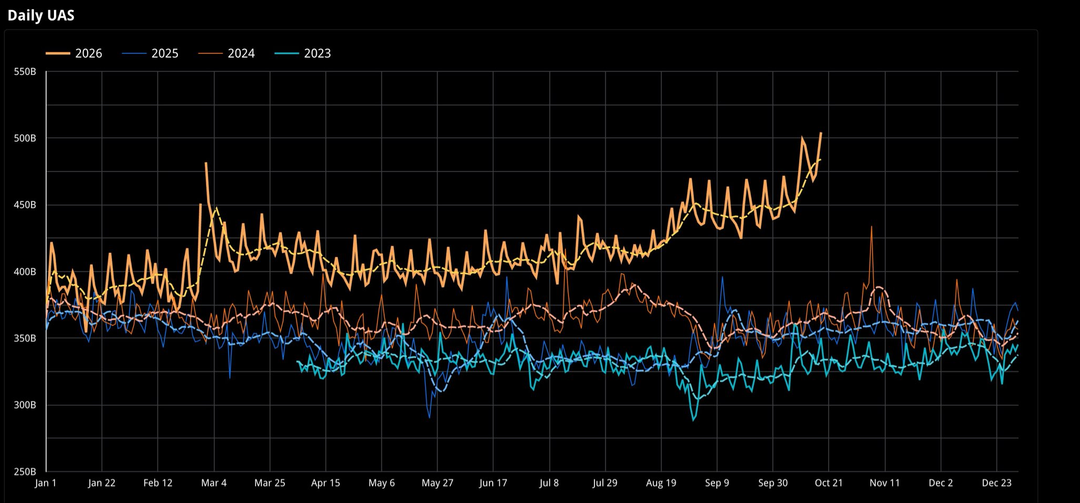
Elon Musk said X has made two core changes to timeline recommendations: a new AI/SI ranking model that better predicts how long users will spend on content, and a retrieval model optimised to surface posts users will read in full. Musk also said user active seconds on X are growing exponentially and keep setting new records.
Postx.com/elonmusk/status/2112373713937084809
IV. Technical insight and frontier research
1. Anthropic AI designs scorpion toxin binders, 17 of which pass binding tests
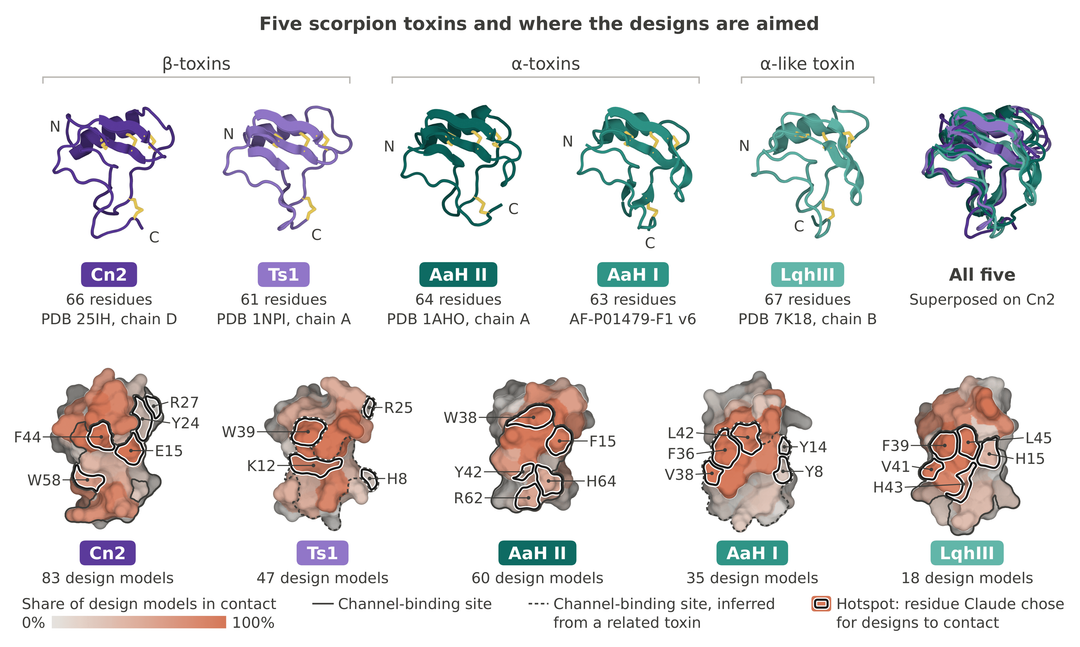
Anthropic has published life sciences results: an internal research model working in the Claude Science environment designed binding proteins against scorpion neurotoxins, and 17 of 21 designs sent for testing met the company's binding criteria, covering 4 toxins. Binding proteins are the foundation for developing new antivenom drugs; scorpions sting about 1.2 million people a year, and existing antivenoms are costly and in short supply. During the research, the model generated more than 300,000 designs in 64 hours from an initial prompt and four follow-up instructions, and Adaptyv Bio and Twist Bioscience carried out the lab binding tests. Anthropic has released all 21 tested designs and the binding data for researchers to use.
Report: https://www.anthropic.com/research/claude-scorpion-toxin-binder-design Dataset: https://huggingface.co/datasets/Anthropic/scorpion-toxin-binder-design
2. Google: Gemini 4 Argon processed three times its predecessor's volume in 72 hours
Google says Gemini 4 Argon processed nearly 25 trillion tokens in its first 72 hours, about three times what Gemini 3 handled over the same period after launch. Alphabet CEO Sundar Pichai said Argon is still constrained by compute capacity; Google is prioritising compute for frontier AI research and model development, and its cloud business is giving up some short-term revenue as a result.
Coverage: https://www.bigtechnology.com/p/sundar-pichai-googles-frontier-imperative Post: https://x.com/NewsFromGoogle/status/2112669319108927590
V. Industry moves
1. OpenAI acquires drug development platform Orchestra Bio
OpenAI is acquiring Orchestra Bio, a drug development platform, and will integrate its team and technology with Rosalind, its models and toolchain for life sciences research. Orchestra Bio lets researchers hand project monitoring and tracking to AI agents that identify affected activities and timelines, gather information and compare options, while researchers make the decisions. Within Rosalind, GPT-Rosalind helps scientists reason through biology and chemistry problems, and Rosalind Workbench connects scientific tools and data to help analyse results and plan experiments. OpenAI plans to combine the two to build end-to-end agents that connect scientific discovery with advancing drug programmes.
Announcement: https://openai.com/index/openai-to-acquire-orchestra-bio/ Post: https://x.com/OpenAI/status/2112607347688583586
2. Former head of OpenAI's Preparedness team returns
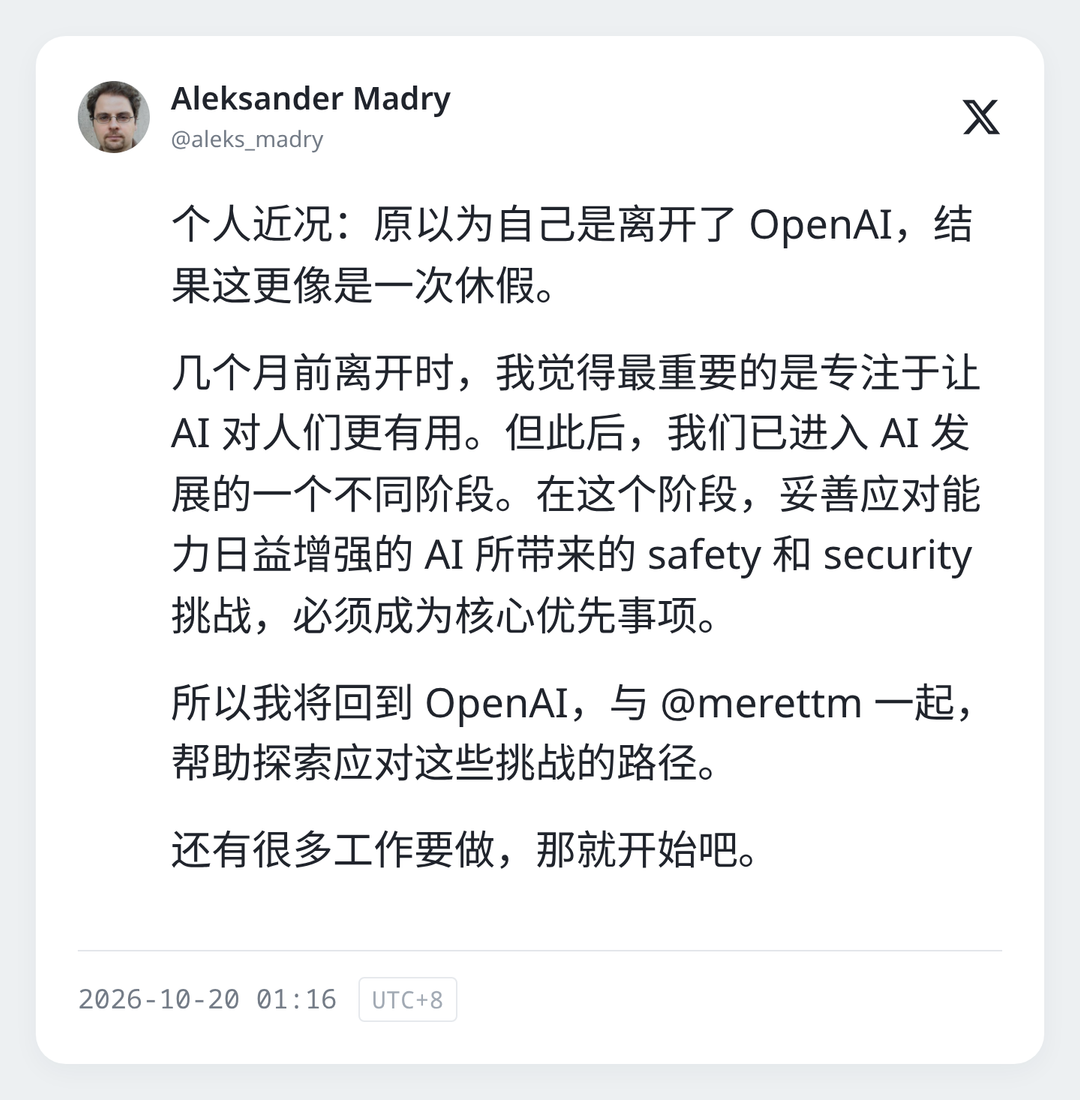
Aleksander Madry, who previously led OpenAI's Preparedness team, has announced he is returning to OpenAI to work on the safety and security challenges posed by advancing AI capabilities. Sam Altman said he accepted Madry's request to return and called the challenges around superintelligence daunting. Madry said AI development has entered a new phase and solving safety problems must become a core priority.
Post: https://x.com/aleks_madry/status/21123144810323998 Post: https://x.com/sama/status/2112652656602923366
3. OpenAI reportedly pushing ahead with a new raise of about US$30 billion
Reuters, citing people familiar with the matter, reports that OpenAI is accelerating talks on a new funding round of about US$30 billion, aiming to lock in investor commitments before Anthropic's expected IPO in mid-November; the round could value OpenAI at more than US$1.4 trillion. Existing investors including SoftBank and Abu Dhabi's MGX are in the talks. OpenAI was valued at US$852 billion after raising US$122 billion in March; the report says OpenAI wants to secure the money before Anthropic lists, using its recent revenue growth to attract investors.
4. Anthropic's draft IPO filing discloses revenue and cloud capacity challenges
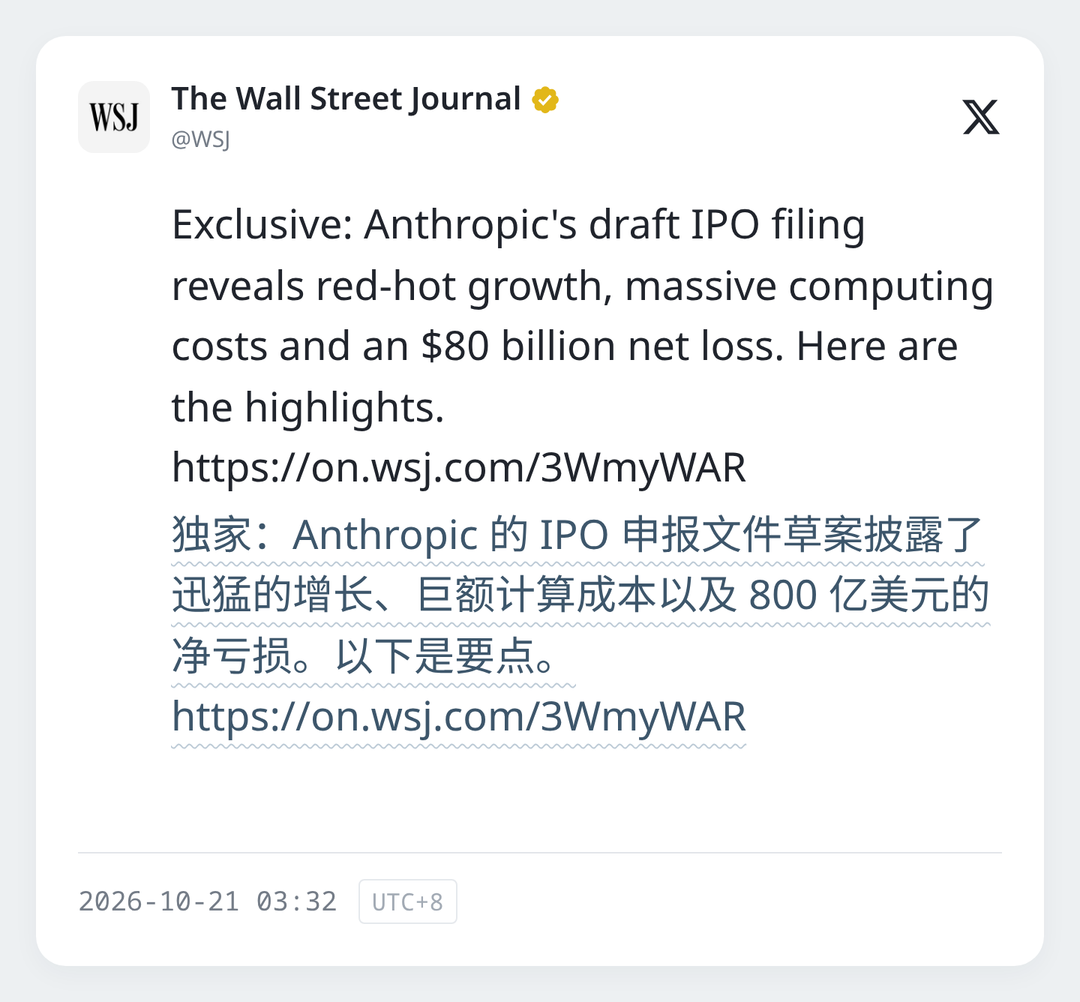
A draft of Anthropic's S-1 IPO filing seen by The Wall Street Journal shows first-half revenue of US$16.3 billion, up from US$1.1 billion a year earlier, and a net loss of US$80.7 billion, of which US$72 billion comes from non-cash accounting adjustments related to convertible notes and financing instruments. Anthropic expects compute spending of up to US$75 billion over the next few years, including deals still under negotiation. AWS, Google and Microsoft increasingly see it as a direct competitor, and Anthropic is leasing data centres and working with third-party operators, though it is concerned that these operators have limited operating histories and are less reliable than the large cloud providers.
Coverage: https://www.wsj.com/tech/ai/anthropic-revenue-growth-ipo-accaf0f1 Coverage: https://techcrunch.com/2026/10/20/anthropics-cloud-partnerships-are-getting-messy/
VI. Outlook and market rumours
No other new outlook rumours independently verified by third parties in this 24-hour window.
VII. Claw roundup
1. Inference infrastructure goes open source as the domestic compute ecosystem matures
DeepSeek open-sourcing DeepInfer, its internal production inference framework, with support for both NVIDIA and Huawei Ascend, shows LLM inference infrastructure moving from closed black boxes to open source and domestic hardware. Open-sourcing the full inference stack lowers the barrier to deploying LLM services and helps the domestic compute ecosystem mature, steadily strengthening self-reliance across the stack from models to inference frameworks and hardware.
2. Voice interaction goes real time, upgrading the agent entry point
ElevenLabs and Mistral both releasing new real-time voice models and agent SDKs, with latency in the hundreds of milliseconds and support for interruption, multi-turn conversation and tool calling, show voice agents moving from simple Q&A to fully featured real-time entry points. As the most natural way to interact keeps improving, it will bring agents into more scenarios and reshape how people interact with machines.
3. Longer-lived caching gets finer, steadily optimising compute costs
OpenAI's 12-hour prompt caching and DeepSeek's disclosed 96% cache hit rate show caching strategies moving from minutes to hours and becoming more refined. Reusing frequently used context with long-lived caches sharply cuts the cost of repeated calls and makes long conversations and long tasks more efficient. Fine-grained management of compute costs is extending from the infrastructure layer to the API service layer, driving cost and efficiency gains across the chain.
VIII. Trending open source on GitHub
1. deepseek-ai/DeepInfer
Momentum: a new top project among inference frameworks. Summary: DeepSeek's official open-source production inference framework, powering its online service at the scale of tens of billions of tokens, with distributed inference and speculative decoding on both NVIDIA and Ascend hardware under Apache 2.0 — a core reference for LLM inference deployment.
Repository: https://github.com/deepseek-ai/DeepInfer
2. google-pytorch/torch_tpu
Momentum: a popular open project for TPU development. Summary: Google's official PyTorch-native TPU software stack that migrates PyTorch workloads with small changes, with a complete toolchain covering training, inference and deployment — the first choice for TPU development.
Repository: https://github.com/google-pytorch/torch_tpu
3. vllm-project/vllm
Momentum: a benchmark high-throughput inference engine. Summary: a high-performance LLM inference engine supporting many models with high concurrency and low latency for large-scale production deployment, with a mature ecosystem — one of the most widely used open-source inference frameworks.
Repository: https://github.com/vllm-project/vllm
4. open-webui/open-webui
Momentum: the go-to front end for self-hosting. Summary: a full-featured open-source AI interface with multi-model support, plugins, RAG and multi-user management, deployable locally or in the cloud — the mainstream front end for self-hosted AI services.
Repository: https://github.com/open-webui/open-webui
5. deepseek-ai/deepseek-harness
Momentum: a leading Chinese agent framework. Summary: a fully plugin-based open-source agent framework with multi-model support, tool calling and workflow orchestration. It is highly customisable for enterprise agent development and self-hosted deployment and keeps adapting to new models and use cases.
Repository: https://github.com/deepseek-ai/deepseek-harness