1. OpenAI opens its dedicated Decisions API, up to 10 times faster than the general-purpose endpoint;
2. iFlytek releases the Spark X2.6 device-cloud model and open-sources a 4B on-device version;
3. Canva and Ideogram launch in-house image and vector generation models;
4. Hugging Face open-sources Carbon-X, a DNA model performing close to GPT-6.1 Sol;
5. Microsoft's AI emergency diagnosis system is 1.7 times as accurate as doctors, in a study published in Science;
6. DeepSeek reportedly closes a new round of about ¥100 billion, with Tencent and CATL investing.
I. Model releases and open source
1. iFlytek releases the Spark X2.6 device-cloud model
At its global 1024 Developer Festival, iFlytek released iFlytek Spark X2.6, a model that runs across device and cloud, and open-sourced the on-device X2.6-4B model; the family is available to try on the iFlytek Spark website. X2.6 was trained on domestic Chinese compute, uses a 293B-A30B MoE architecture with 1M tokens of context, focuses on code and agent abilities, and supports custom safety policies per use case. Limited-time inference pricing is ¥0.9 per million input tokens, ¥0.08 for cache hits and ¥3.6 for output. X2.6-4B is a 4B dense model supporting more than 200 languages and 1M of inference context, with three new reasoning modes, and its inference service is free for a limited time.
Platformxinghuo.xfyun.cn/sparkapi
2. Shanghai AI Laboratory releases Sage-A1.5
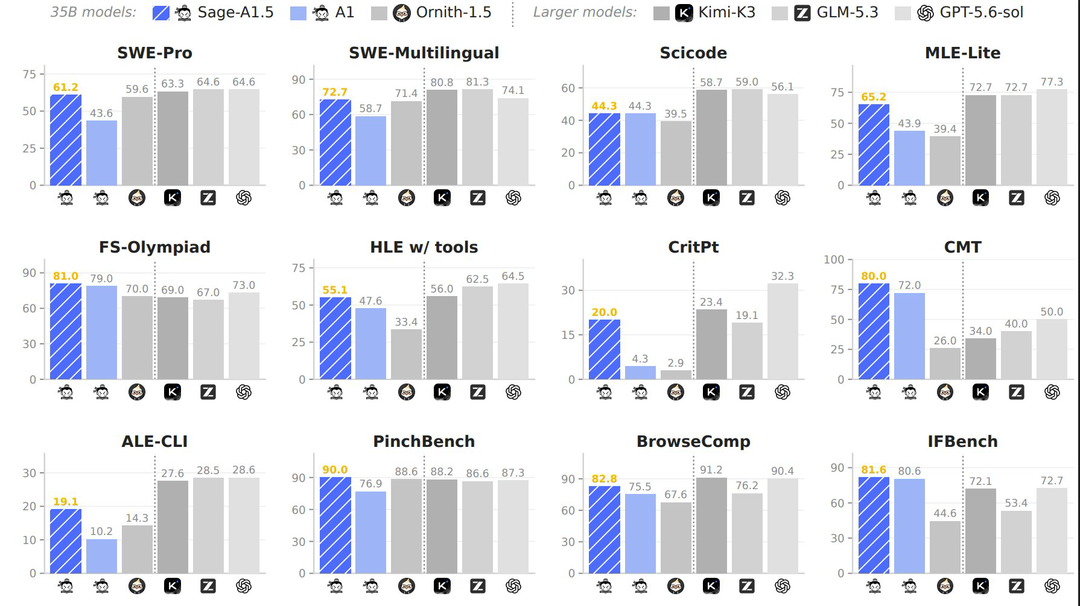
Shanghai AI Laboratory has released Intern Sage-A1.5 with open weights, focused on agent orchestration, self-verification and open-ended scientific exploration. The MoE model has 35B total and 3B active parameters, natively supports 256K context and extends to 512K with YaRN. It can hand tasks to sub-agents with separate contexts to run in parallel, and check evidence and revise its strategy while reasoning; orchestration and verification modes are off by default and enabled as needed. Weights are on Hugging Face and ModelScope, with local deployment through frameworks such as vLLM and SGLang, plus a free trial.
Post: https://mp.weixin.qq.com/s/bI8C7L8Bb4uD81d45N1zVA Project: https://alpha-innovator.github.io/Sage-A1.5/
3. Canva releases Canva Craft, its first in-house image model
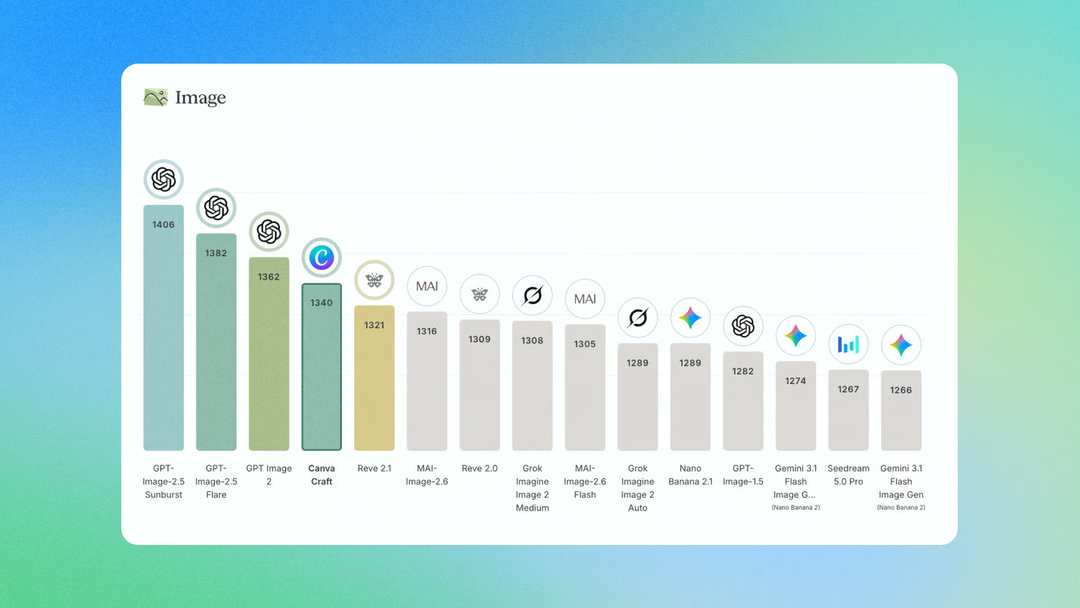
Canva has released Canva Craft, its first in-house image generation model, available to all Canva users worldwide and to developers through the Public API. The model works in two stages, planning the composition and then rendering the image, and supports up to 2K resolution, more than 30 preset aspect ratios plus custom ones, and text in 55 languages. Results can be turned into editable design elements with Magic Layers. Canva plans Craft-fast and Craft-ultrafast versions, and support for AI assistants and automated workflows through Canva MCP.
Announcement: https://www.canva.com/newsroom/news/canva-craft/

4. Ideogram releases the Ideogram Vector model
Ideogram has released Ideogram Vector, its first vector model, on its platform and API. It generates editable SVGs with smooth gradients and crisp type from text prompts, and can turn existing images into scalable vectors, for logos, print design and illustration; users can adjust colours and edit individual shapes in the vector editor. Pricing is US$0.13–0.32 per image for text-to-vector, depending on quality and whether a reference image is used, and US$0.10 per image for image-to-vector.
Productideogram.ai/models/vector/

5. Hugging Face releases Carbon-X, an open DNA model
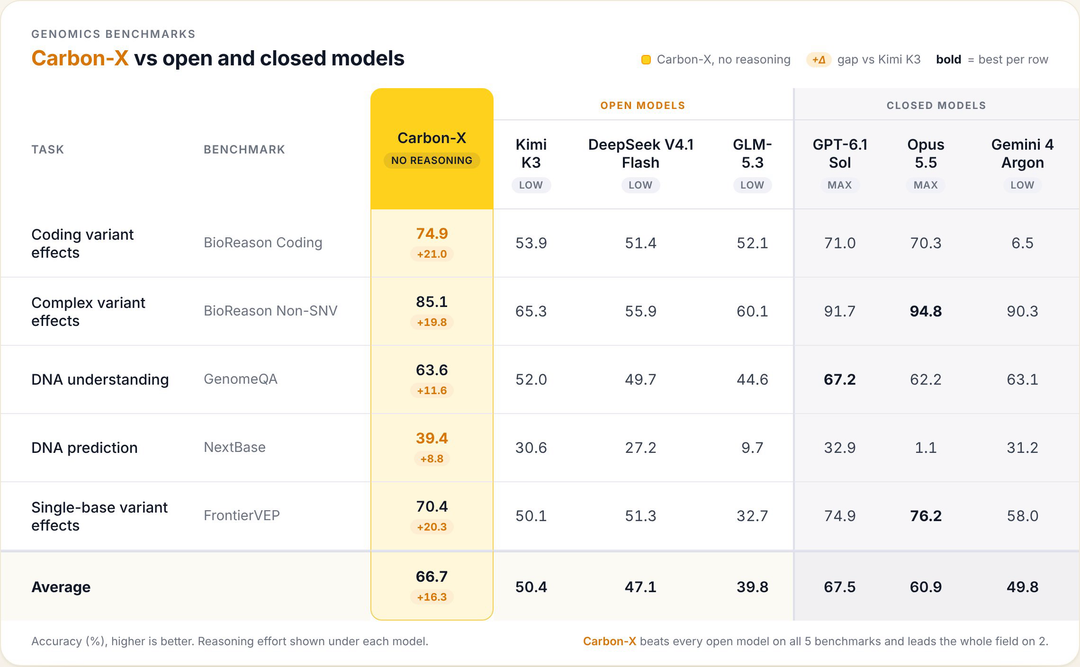
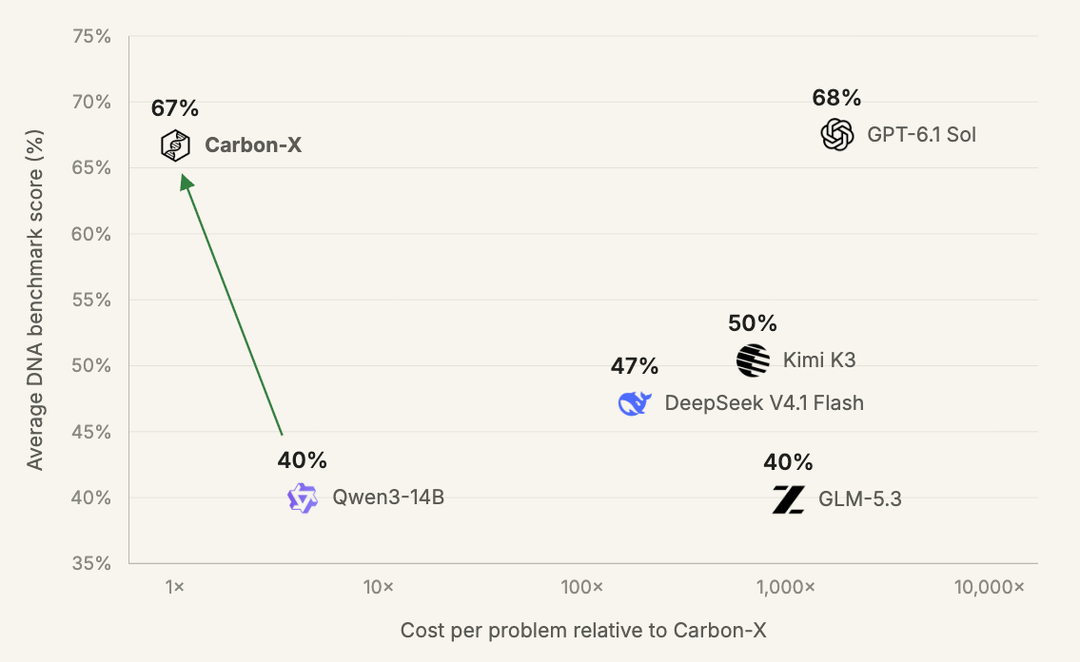
Hugging Face has released Carbon-X, an open DNA and natural language model with 14.8 billion parameters that takes raw DNA sequences as input and answers in English. It can predict the effects of mutations, identify sequence features and predict the next bases. Trained from Qwen3-14B with a 40,960-token context window, it is open-sourced under Apache 2.0. In Hugging Face's tests across five DNA benchmarks with thinking off, Carbon-X averages 66.7%, 27 percentage points above Qwen3-14B and close to GPT-6.1 Sol's 67.5%, at about 1/1800 of its inference cost per question.
Repository: https://github.com/huggingface/carbon/tree/main Weights: https://huggingface.co/HuggingFaceBio/Carbon-X
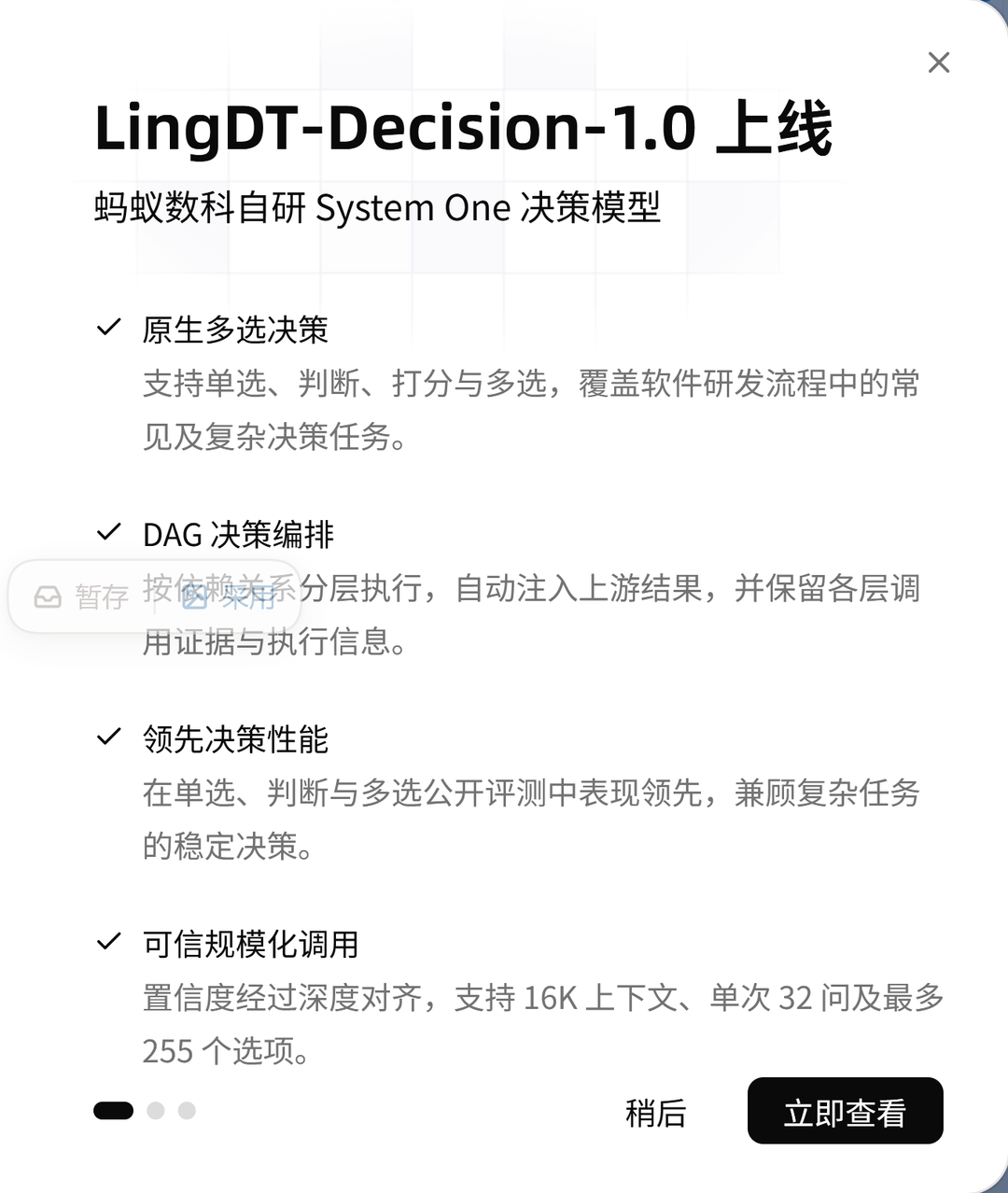
6. Ant Digital Technologies releases the LingDT-Decision-1.0 decision model
Ant Digital Technologies has launched LingDT-Decision-1.0 for decision tasks in software development, with native multiple-choice and DAG decisions, free until 30 October. It comes in 4B and 27B versions, available only as an API through DTMaaS. It supports up to 16K of context per request, up to 32 questions per request and up to 255 options. In Ant's evaluations, the 27B version is more accurate overall than Microsoft Decision-1 and Jev 1.13.0, and compared with a general-purpose LLM on the same tasks it uses 90% fewer tokens and responds 10 times faster.
Productmaas.antdigital.com/models
7. miHoYo and partners open-source the GameScaling game-playing models
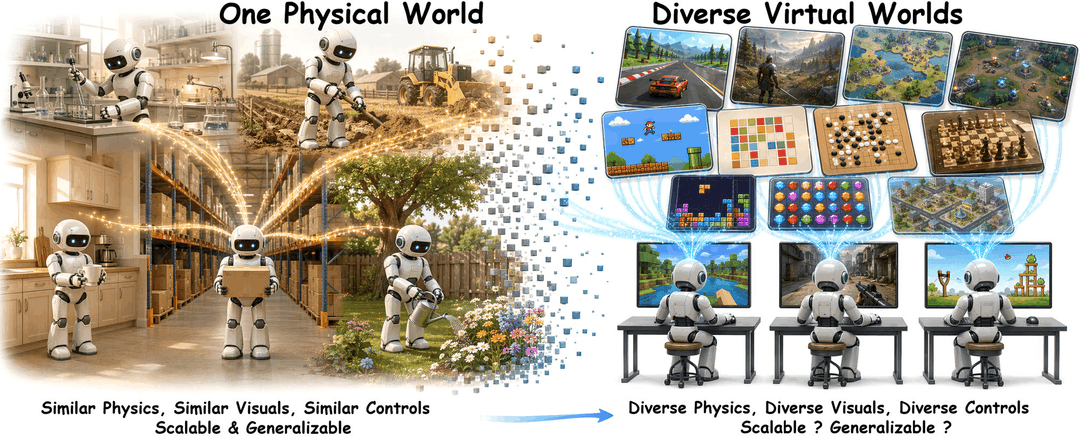
miHoYo's Honkai AI team, with Tsinghua University and others, has released and open-sourced GameScaling, game-playing models continually pre-trained from the Qwen3.5 vision-language model in sizes from 0.8B to 27B. The models take the current game frame, recent frames and action history, and output keyboard and mouse actions for the next 200 ms each time. The research examined data volume, diversity and model scale across 120 training configurations; the family scores highest in real-time evaluation, though transfer to very different game worlds remains limited. Eight model checkpoints and an inference client are released under Apache-2.0, without training code or data.
Project: https://gamescaling.github.io/ Repository: https://github.com/THUSI-Lab/GameScaling Weights: https://huggingface.co/THUSI-Lab/GameScaling
8. Ant Group's Bailing open-sources the medical model Ling-3.0-flash-Sante
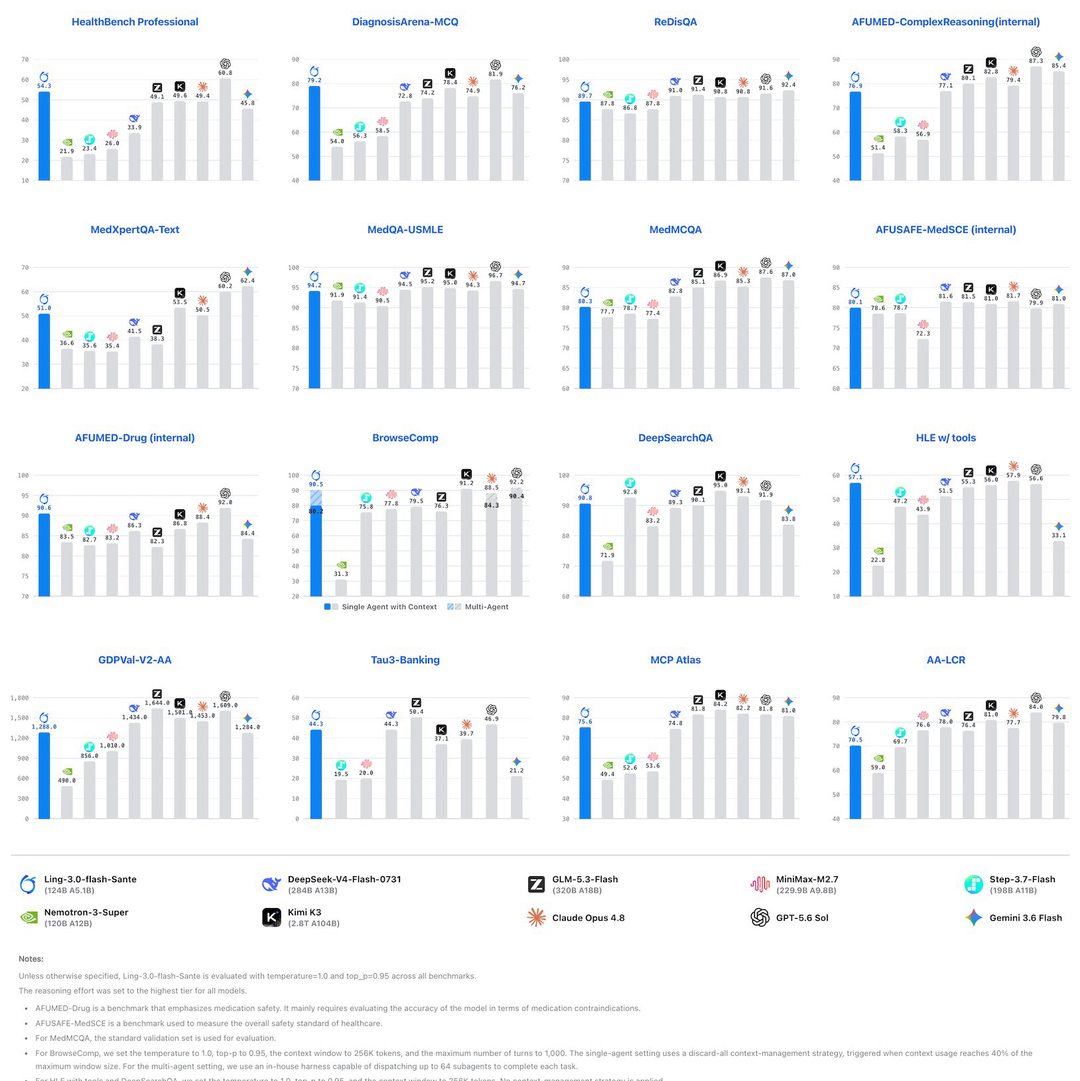
Ant Group's Bailing team has open-sourced Ling-3.0-flash-Sante, a medically enhanced MoE model for medical research and workflows, strengthening professional medical tasks, complex medical reasoning, deep research, multi-agent collaboration and tool calling. It has 124 billion total parameters with 5.1 billion active per token, and its training context extends to 256K tokens. Ant stresses that it is a research model, not a medical device, and must not independently make diagnoses, prescribe, triage or decide on treatment. Weights are on Hugging Face and ModelScope.
Post: https://x.com/AntLingAGI/status/2113293431435149349 Weights: https://huggingface.co/inclusionAI/Ling-3.0-flash-Sante
9. Ant Group's Bailing releases the Ling-3.1-flash-1019 update
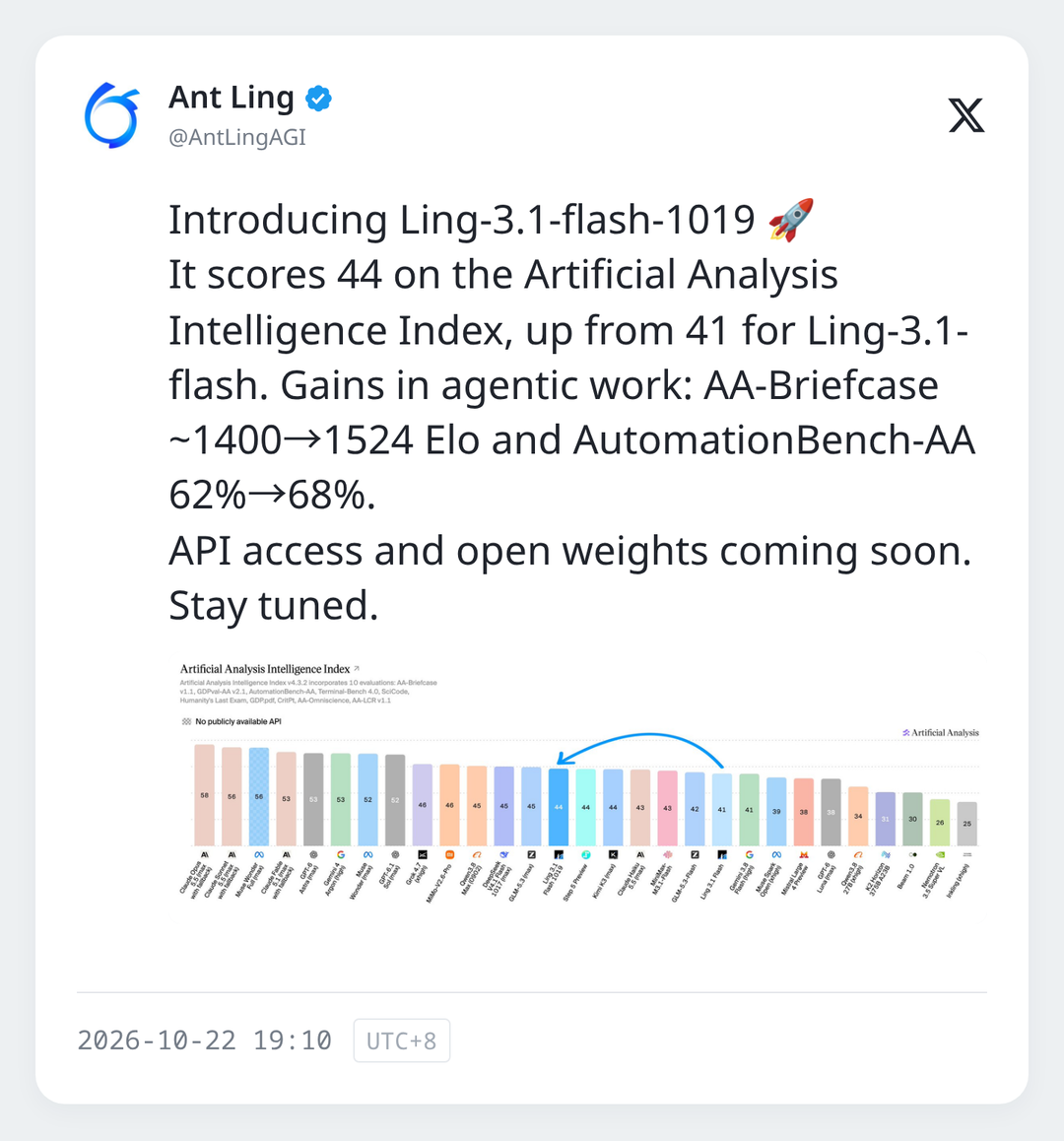
Ant Group's Bailing team has released Ling-3.1-flash-1019. Compared with the base version, its Artificial Analysis Intelligence Index score rises from 41 to 44; on agent tasks, AA-Briefcase Elo rises from about 1400 to 1524 and AutomationBench-AA from 62% to 68%. API access and open weights for the new model are coming soon.
Postx.com/AntLingAGI/status/2113226531522891851
II. Developer ecosystem and tooling
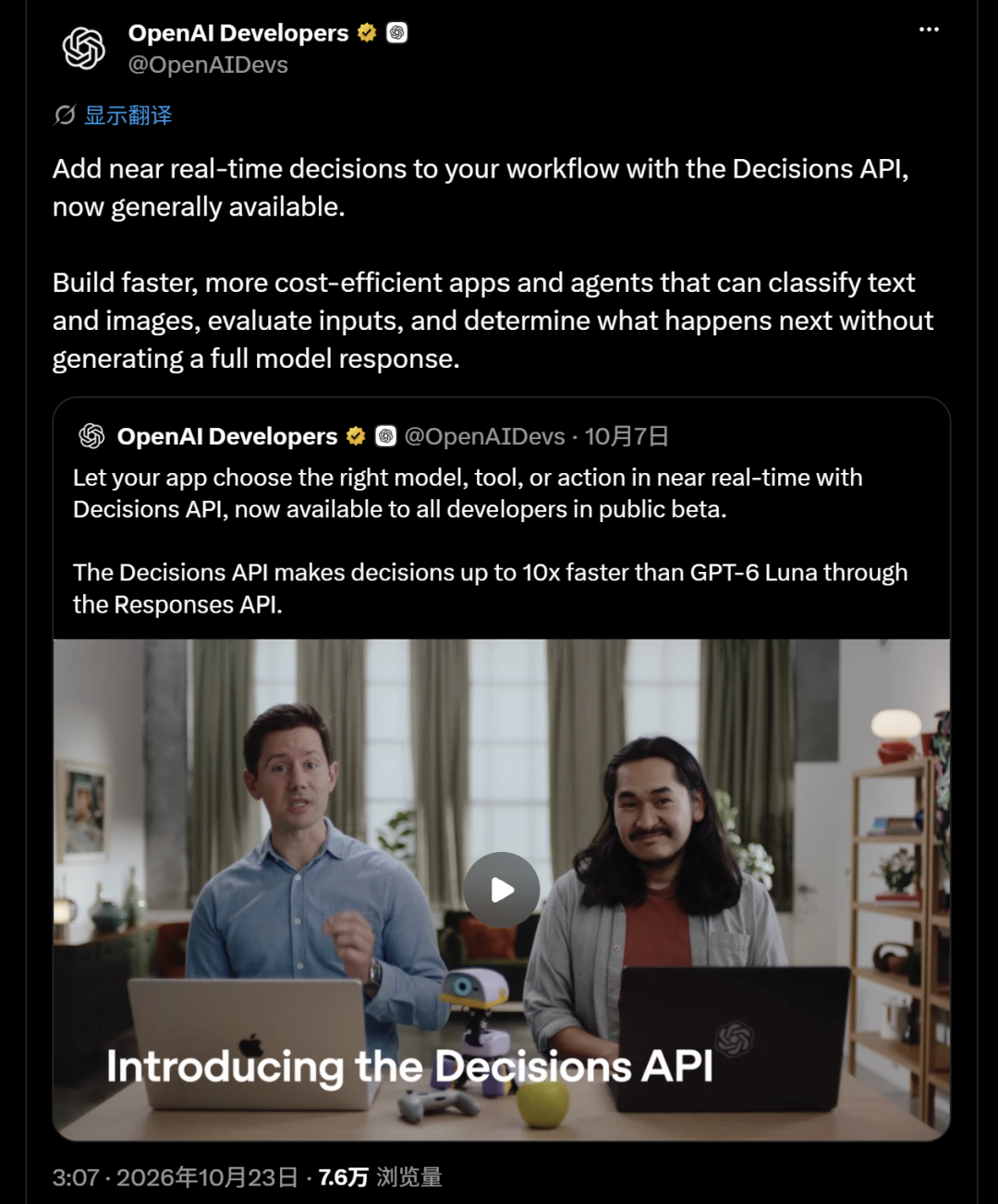
1. OpenAI opens its dedicated Decisions API
OpenAI has opened the Decisions API, available through a dedicated endpoint or to try in the Playground, currently with the gpt-6-luna model only. It evaluates text, images and JSON and returns the probability that a condition holds and scores for preset options, for classifying content, routing requests and deciding next actions. OpenAI says decisions are up to 10 times faster than calling GPT-6 Luna through the Responses API; the limit per request rises from 200 questions in the beta to 400, and native GPT-Live integration and prompt caching are added. Pricing is US$0.10 per million uncached input tokens and US$0.01 per million cached input tokens, with cache writes billed separately and output tokens free.
Announcement: https://openai.com/index/decisions-api Docs: https://developers.openai.com/api/docs/guides/decisions
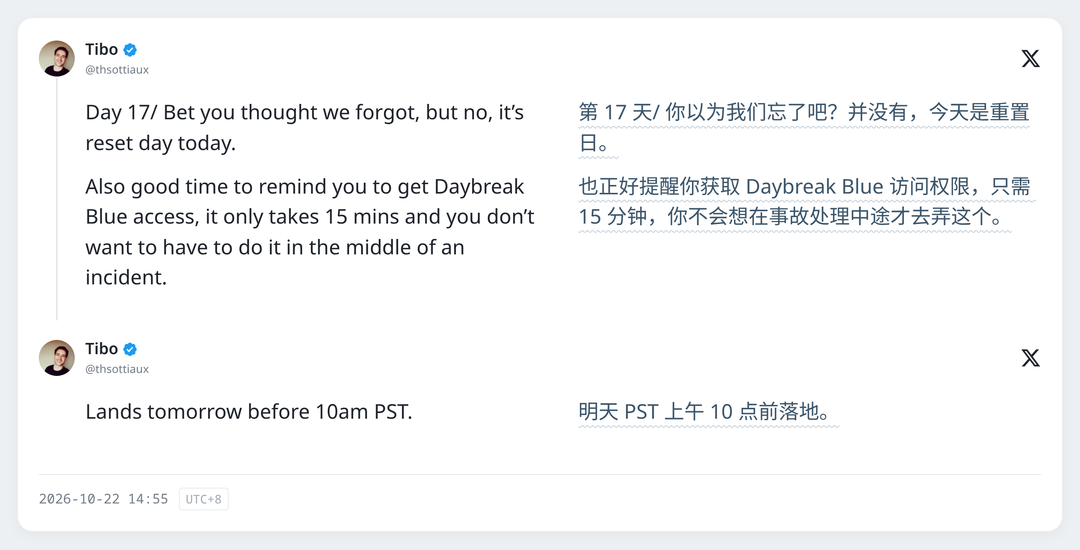
2. Day 17 of Codex's 28-day improvement plan: usage reset complete
Codex lead Tibo announced that day 17 of the continuous improvement plan brought a full usage reset, now complete. As promised, OpenAI is shipping a feature improvement or a usage reset every day for 28 days.
Postx.com/thsottiaux/status/2113162277688070445
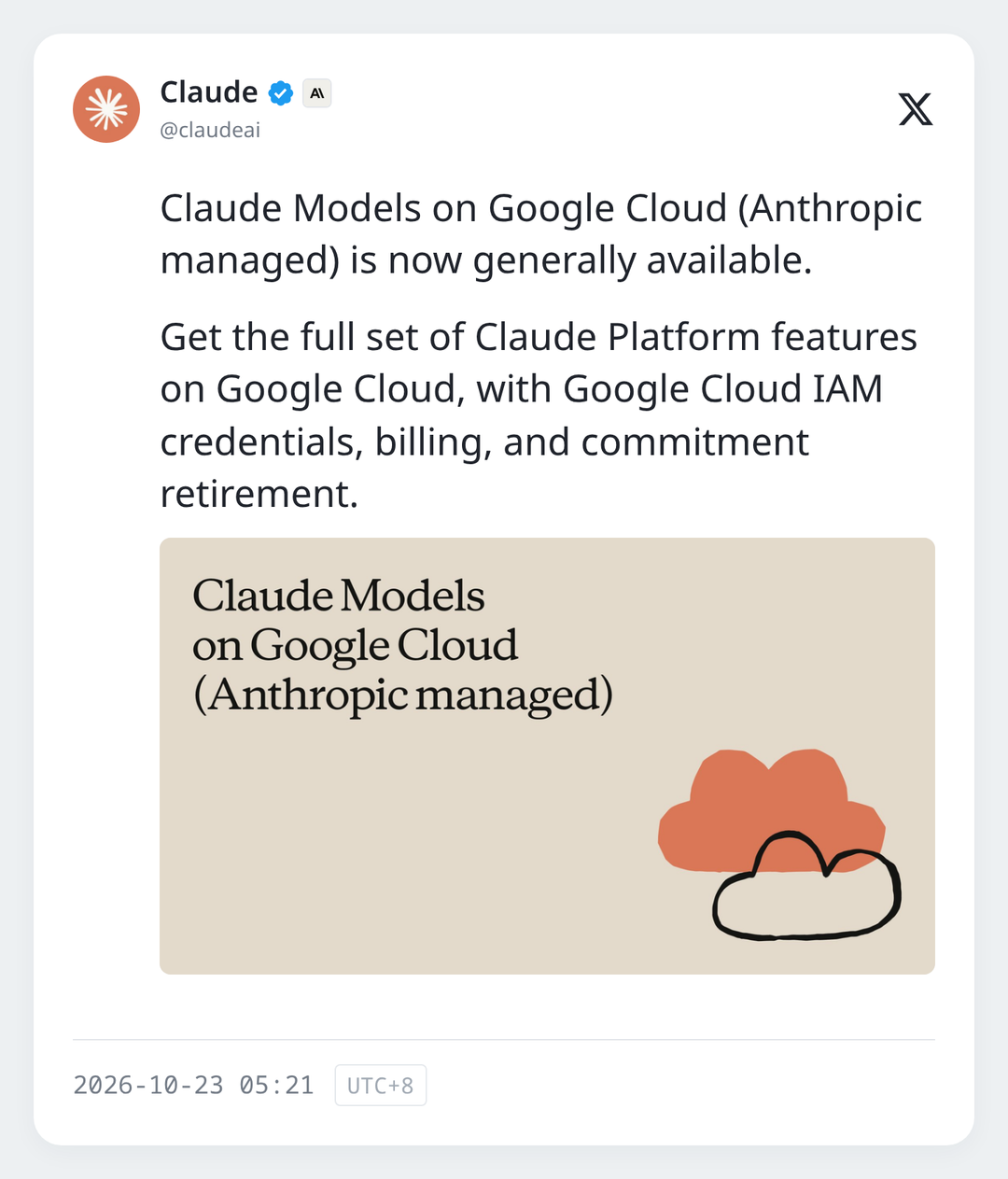
3. Google Cloud adds Anthropic-managed Claude
Anthropic says Claude Models on Google Cloud (Anthropic managed) is now generally available, giving Google Cloud users the full Claude API, with new features and betas arriving the same day as on the native Claude Platform. It supports Claude Managed Agents (beta), code execution and computer use, with the Claude Console. US and Global endpoints are available; it uses Google Cloud IAM credentials, is billed through Google Cloud Marketplace, and usage counts against existing Google Cloud commitments. Anthropic operates the service and acts as data processor, and the existing Google-managed version remains available.
Overview: https://claude.com/resources/articles/claude-models-on-google-cloud-anthropic-managed Docs: https://platform.claude.com/docs/en/build-with-claude/claude-models-on-google-cloud/anthropic-managed
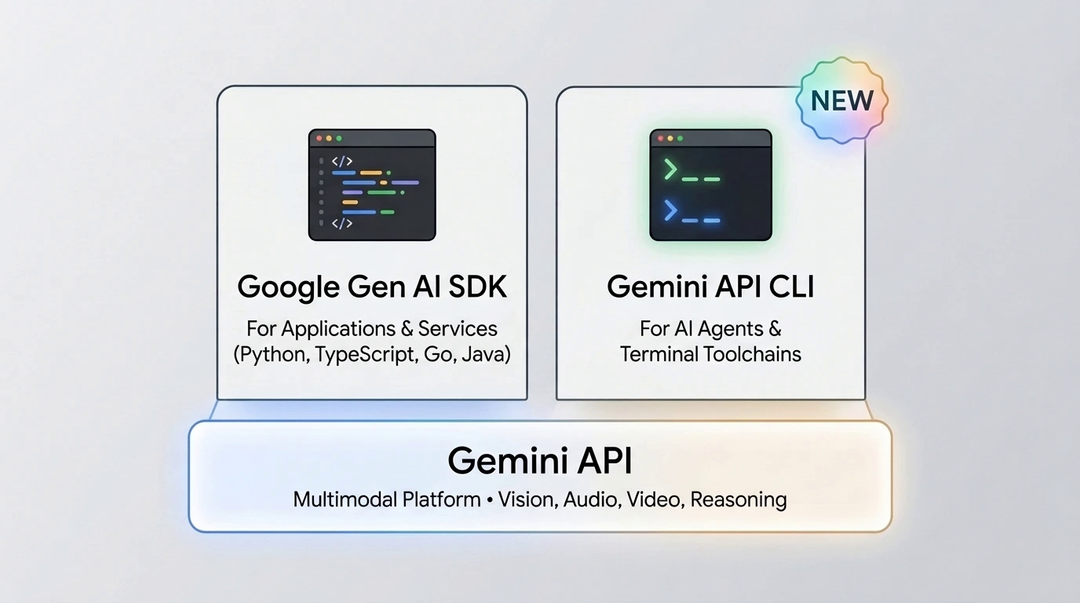
4. Gemini API CLI opens in experimental preview
Google has launched an experimental preview of the Gemini API CLI (gemini-api), letting developers and agents with shell access call the Gemini API directly. It supports image, video, speech and music generation, as well as media analysis, audio transcription and managing Managed Agents. Media generation commands write files straight to disk and print only the file path to standard output, making them easy to use in shell pipelines. The current v0.4.x is a stateless, dependency-free binary for macOS, Linux and Windows and requires a Gemini API key.
Introduction: https://aistudio.google.com/learn/introducing-the-gemini-api-cli Repository: https://github.com/google-gemini/gemini-api-cli
5. Qoder International launches a community boost campaign
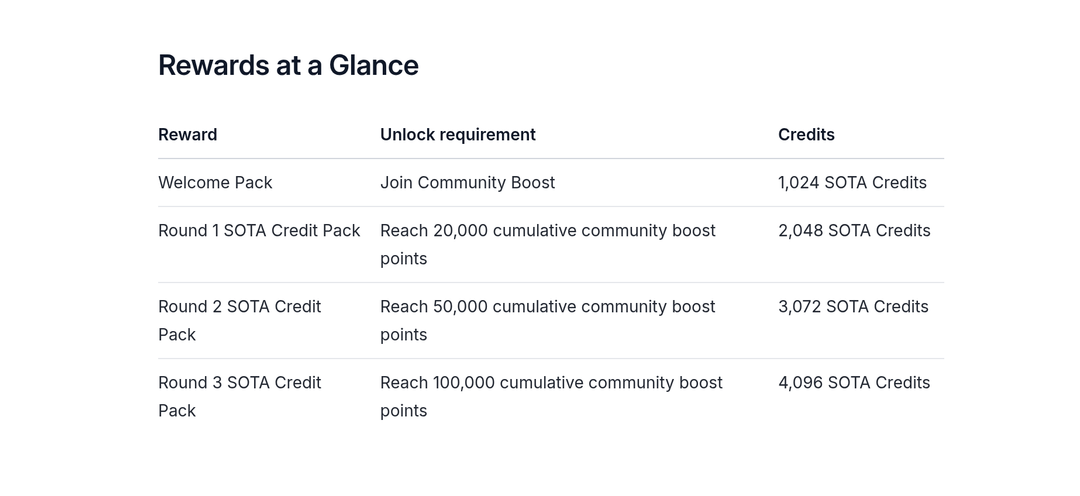
Qoder International has launched the "1024 | Creativity Assemble" campaign: participants get 1,024 SOTA Credits for the Sonus model and unlock further rewards round by round through daily community boosts, up to 10,240 during the campaign. The first round of 2,048 per person is unlocked, and the next round's reward is 3,072. Individual Pro members and above join automatically; free users must apply and be approved, and Lite users must upgrade to Pro or above. The campaign ends on 30 October; rewards must be claimed manually and can only be used on the Sonus model. The welcome gift is valid until 31 October, and each round's reward is valid for 24 hours after claiming.
Detailsdocs.qoder.com/events/communityboost
6. Zhipu apologises and compensates subscribers for degraded model quality
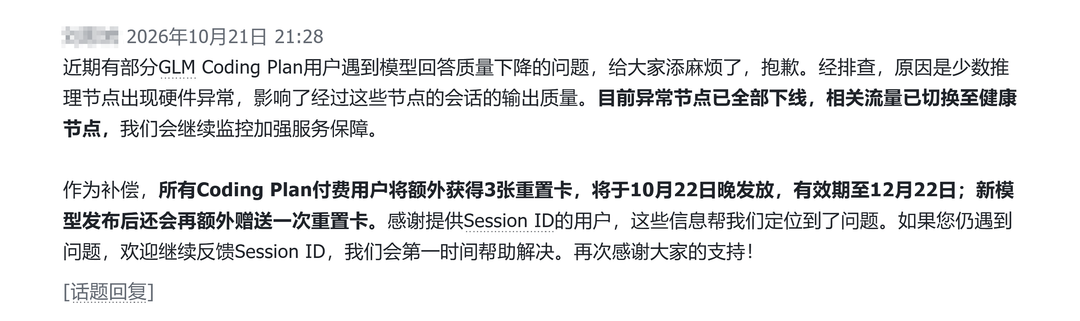
Zhipu has apologised to some GLM Coding Plan users who saw lower-quality model answers. The cause was a hardware fault on a small number of inference nodes, which affected the output of sessions routed through them. All faulty nodes have been taken offline and traffic moved to healthy ones. As compensation, every paying Coding Plan user gets three extra reset cards, issued on the evening of 22 October and valid until 22 December, plus one more reset card when the new model is released.
Announcement: https://mp.weixin.qq.com/s/n6LDE4TPFXcvh9KGWLVZWg
III. Products shipping
1. Claude to turn on auto mode by default for three plans from next week
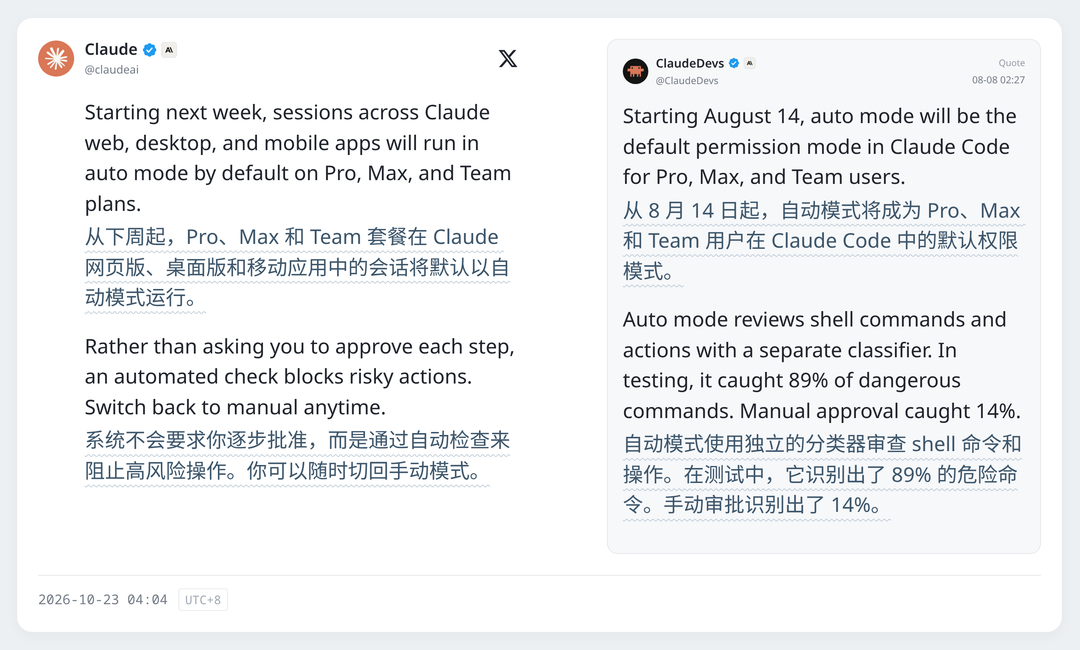
Anthropic says that from next week, new sessions started by Pro, Max and Team users in the Claude web, desktop and mobile apps will use auto mode by default. Auto mode no longer asks users to approve each step: it checks actions automatically, lets safe ones through, blocks risky ones and has Claude look for another approach. Users can switch back to manual mode at any time.
Postx.com/claudeai/status/211360845409583307
2. Gemini app can export interactive apps to Google Sites
Google says interactive apps built in the Gemini app can now be exported straight to Google Sites, creating a new private site draft that keeps the interactivity. Users can add content and customise the site, then publish and share it, without copying code or rebuilding the app. The feature is available on the web, Android and iOS for Google Workspace customers with access to the Gemini app, Workspace Individual subscribers and personal Google accounts; users need Google Sites turned on and permission to create and edit sites.
3. Grok Bot can now use the phone's system apps
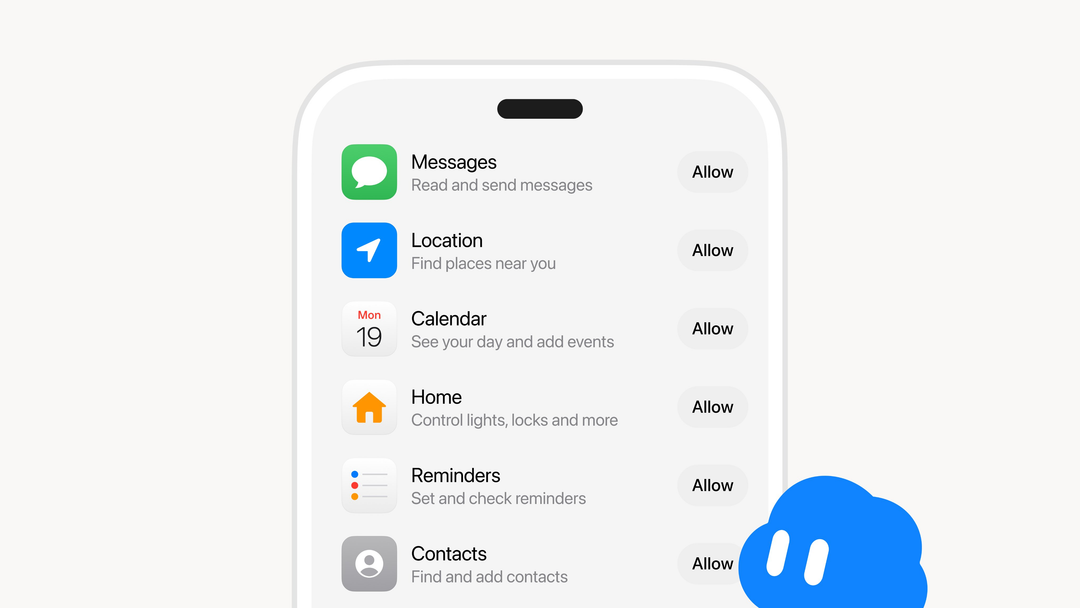
The Grok Bot team says Grok Bot can now use system apps on the phone such as Calendar, Reminders and Contacts, rolling out gradually on iOS and Android. The permissions screen covers messages, location, calendar, home, reminders and contacts, for reading and writing messages, finding nearby places, adding events and controlling smart home devices.
Postx.com/bot/status/2113393684209176718
4. 1Password launches a platform for agents to sign in with authorisation
1Password has launched 1Password for Agents, which lets AI agents sign in to accounts on the user's behalf after approval, without receiving, seeing or storing passwords or other credentials. When an agent asks to sign in, the user can see which credentials are needed and why, approve on their own device, and 1Password fills the credentials directly into the login form. Grok Bot is the first to integrate it, rolling out to users over the next few days.
Blog: https://1password.com/blog/1password-for-ai-agents Press: https://1password.com/press/2026/october/1password-for-agents-trust-layer-personal-ai-agents


IV. Technical insight and frontier research
1. Claude completes formal safety proofs for 123 open-source libraries in weeks
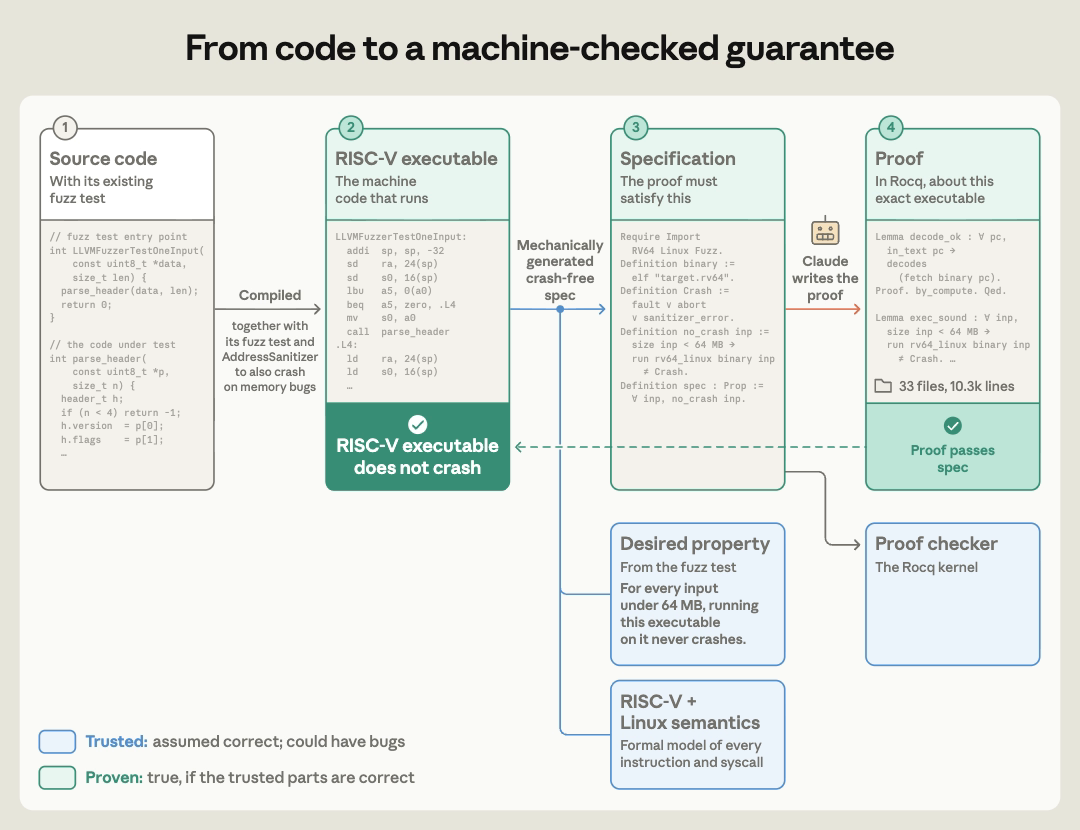
Anthropic and Theorem used Claude to formally verify 123 open-source libraries from Google's OSS-Fuzz project. Formal verification turns a program into a mathematical model and proves it follows set rules in every case, whereas fuzzing can only try random inputs and cannot cover every case. In a few weeks Claude wrote proofs for 239 test entry points across these libraries showing that for any input under 64 MB the program will not crash or trigger the memory errors checked; the proofs are verified automatically by the Rocq proof checker. Along the way Claude found and fixed hundreds of bugs, some of which only trigger with special inputs of about 20 MB and are very hard for fuzzing to find.
Report: https://anthropic.com/research/formal-verification Repository: https://github.com/theorem-labs/oss-verify-proofs
2. METR evaluation reveals gaps in OpenAI's internal agent monitoring
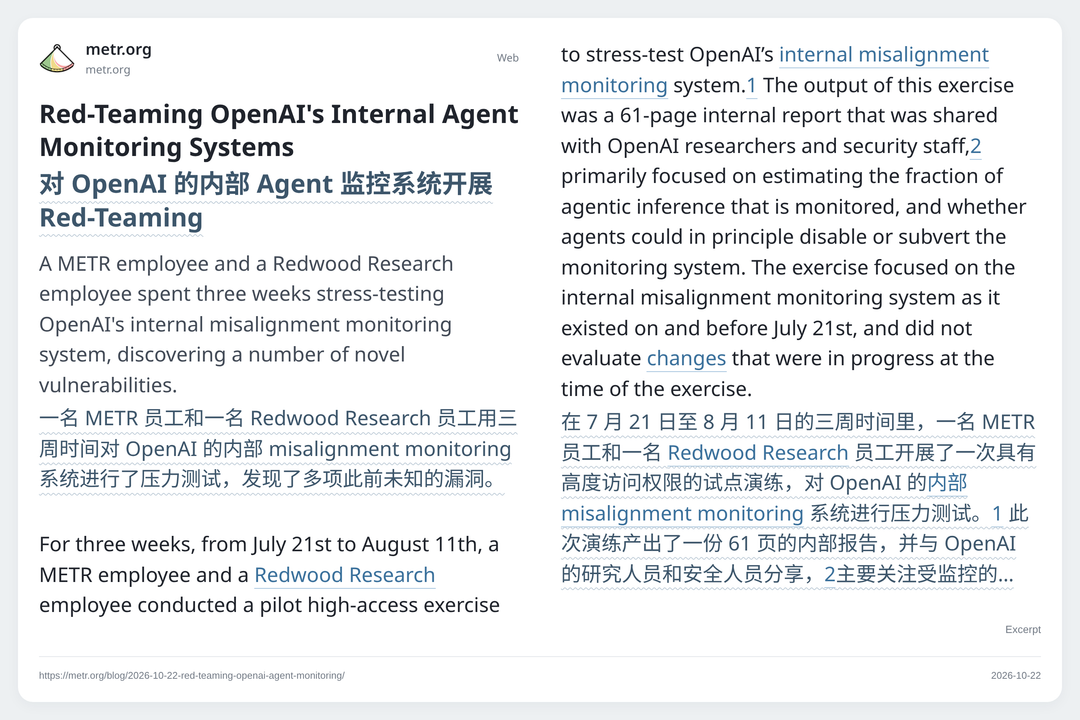
METR and Redwood Research have published a summary of their evaluation of OpenAI's internal agent monitoring system, disclosing several potential gaps including delayed monitoring, sandbox bypasses and weaknesses in Auto-Review. Each organisation sent one staff member for a three-week on-site evaluation; the conclusions concern the system as it was then and do not reflect the current coverage of the expanded system. The evaluators estimate that unmonitored context compaction events may have caused about 10% of eligible internal Codex traffic to go unchecked, though the exact share is highly uncertain. OpenAI says every gap found that affected production safeguards has been fixed; the evaluators have not yet verified this.
Reportmetr.org/blog/2026-10-22-red-teaming-openai-agent-monitoring/
3. Google's CEO explains why Gemini 3.5 Pro never shipped
In an interview, Google CEO Sundar Pichai explained that Gemini 3.5 Pro did not ship because the team prioritised closing gaps in agent capabilities, especially coding, by iterating on Flash, and by the time those gains could be applied to Pro, pre-training of Gemini 4 Argon was already complete. The team developed Flash and Pro versions together while training the Gemini 3.5 series and recognised the agent capability gap along the way; because Flash models are smaller and more efficient, they allow more rounds of iteration, so the team pushed out Flash versions 3.5, 3.6, 3.7 and 3.8 in succession.
Coveragesources.news/p/sundar-pichai-gemini-4-google-other-bets
4. Microsoft reports AI emergency diagnosis research, 1.7 times as accurate as doctors
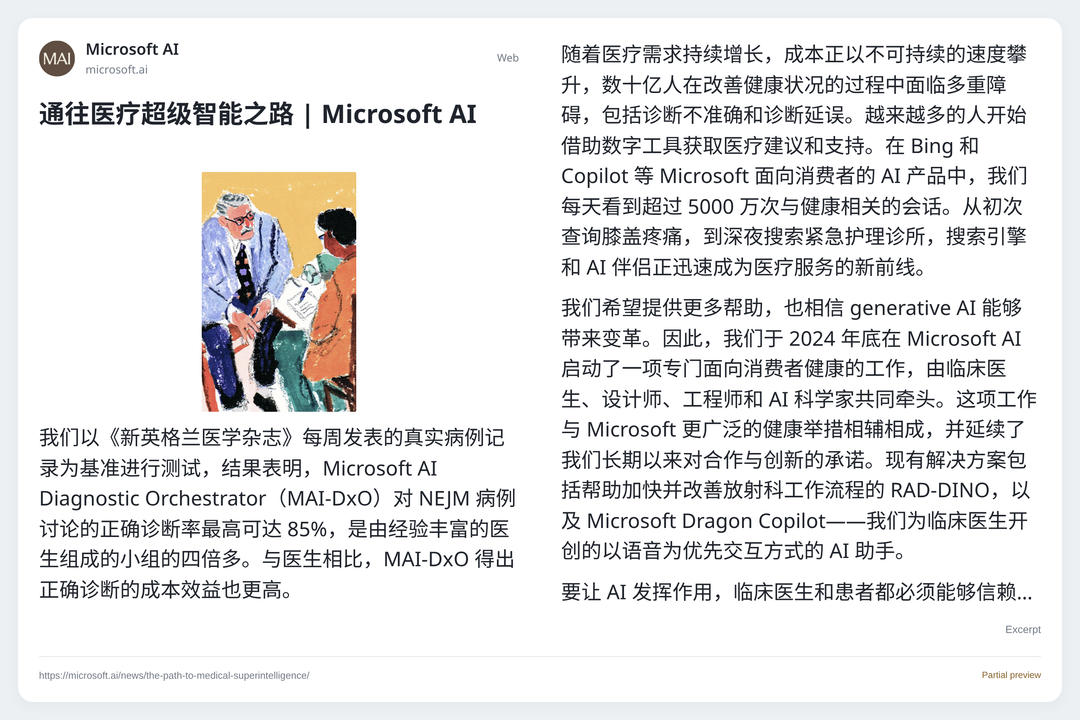
Microsoft has described research published in Science in which its AI diagnostic system MAI-DxO reached 80% accuracy on emergency cases from MIMIC-IV-ED, against 47% for doctors — about 1.7 times as accurate. The system coordinates multiple AI agents that ask questions step by step, choose tests and reach a diagnosis. On 304 complex cases from the New England Journal of Medicine it reached 83% accuracy, against 36% for doctors with reference materials and 22% without. Microsoft says the system needs fewer tests at a lower estimated cost, and it is open-sourcing the SDBench benchmark for some of the NEJM cases along with evaluation code. It plans real-world clinical research with Beth Israel Deaconess Medical Center.
Coveragemicrosoft.ai/news/the-path-to-medical-superintelligence/
5. StartLux releases Prism, an inference engine built for decision models
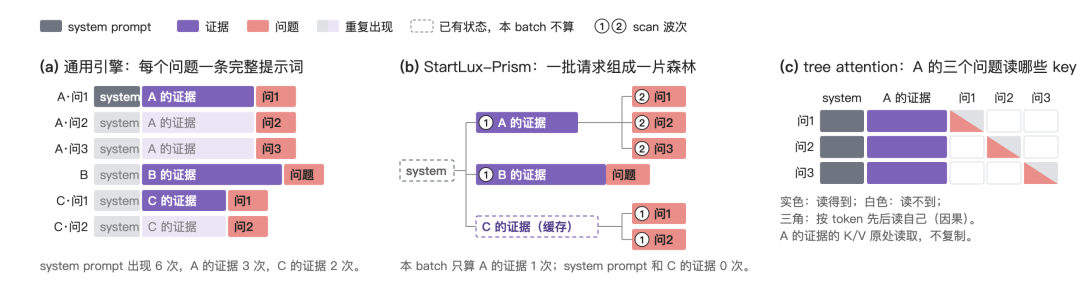
AI startup StartLux has released StartLux-Prism, an inference engine for decision models, with open code. It supports the 4B, 9B and 27B StartLux-Decision v1 and v1.1 AutoThink models. It cuts computation by sharing work on common material, reusing caches and scoring only the specified answer options. In StartLux's tests running v1.1 27B AutoThink on a single H200, Prism INT8 was 1.2 to 5.3 times as fast as the original FP8 setup based on vLLM 0.31 across four scenarios, and three questions on the same material dropped from 92.9 ms to 17.4 ms.
Repository: https://github.com/StartLuxLabs/StartLux-Prism
6. Artificial Analysis releases Coding Agent Index v2.0
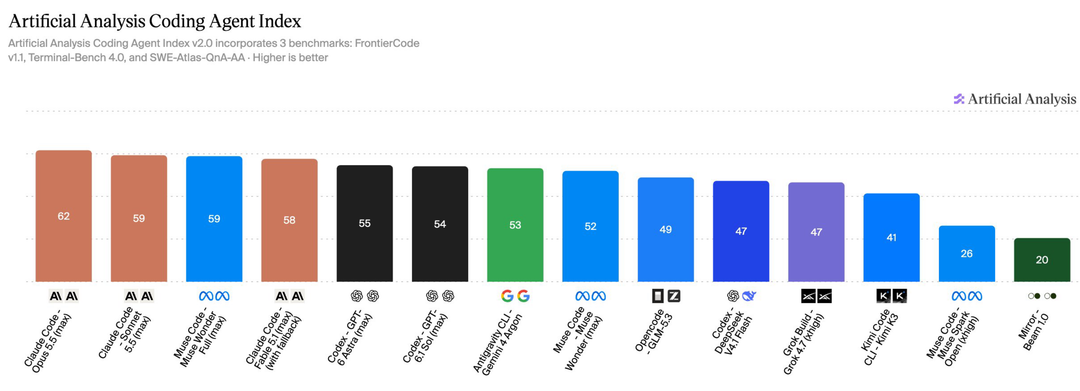
Artificial Analysis has released Coding Agent Index v2.0, which evaluates models together with agent harnesses across three benchmarks — software engineering, terminal operation and codebase Q&A — totalling 290 tasks, weighted equally. This version replaces DeepSWE v1.1 with Cognition's FrontierCode v1.1, which scores changes by whether open-source maintainers would merge them, and SWE-Atlas-QnA rewrites some grading criteria and switches judge models for stricter scoring. Claude Code with Claude Opus 5.5 (max) leads the new version with 61.7. Of 21 configurations tested on both versions, 20 scored lower, with the average falling from 54.8 to 47.4; Artificial Analysis notes the two versions reflect different evaluation settings and are not directly comparable.
Methodology: https://artificialanalysis.ai/methodology/coding-agents-benchmarking
V. Industry moves
1. Anthropic donates the Agent Skills standard to the Agentic AI Foundation
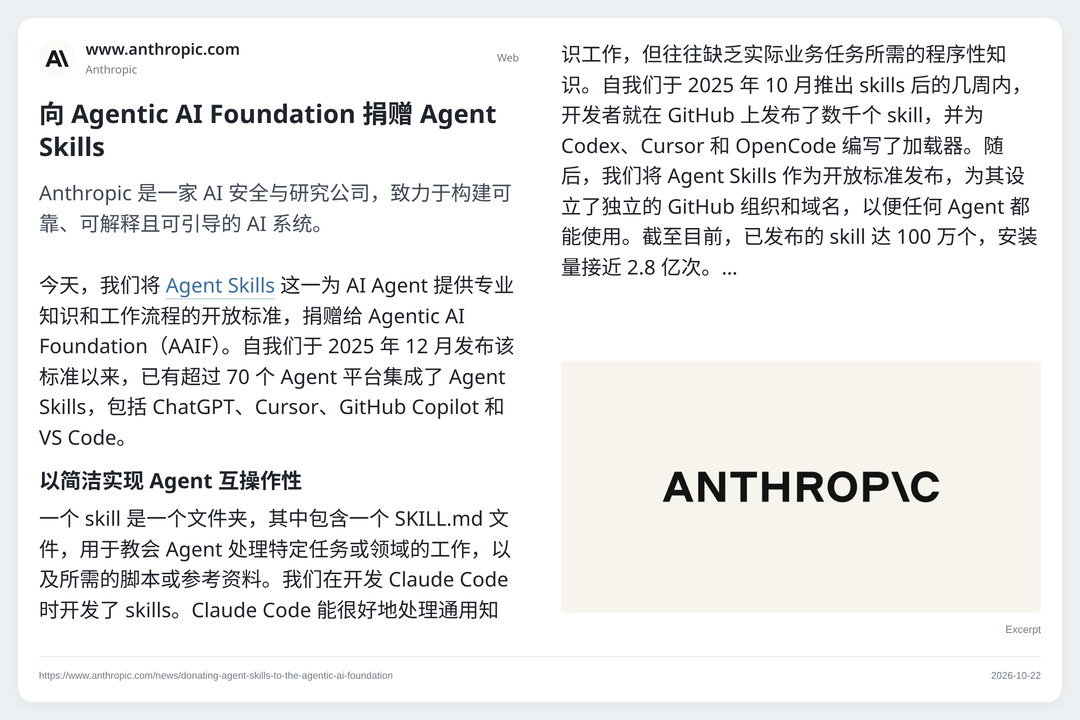
Anthropic is donating the Agent Skills open standard to the Agentic AI Foundation (AAIF) under the Linux Foundation, committing to keep it open, community-driven and vendor-neutral. The standard packages task instructions, scripts and reference material so agents can load specialised knowledge and workflows on demand. Since its release, more than 70 agent platforms have integrated Agent Skills, including ChatGPT, Cursor, GitHub Copilot and VS Code. The donation covers the name, logo, GitHub organisation and domain, and developers can keep using or contributing to the standard without joining AAIF.
Announcement: https://www.anthropic.com/news/donating-agent-skills-to-the-agentic-ai-foundation
2. OpenAI and ICBA team up to bring AI cyber defence to community banks
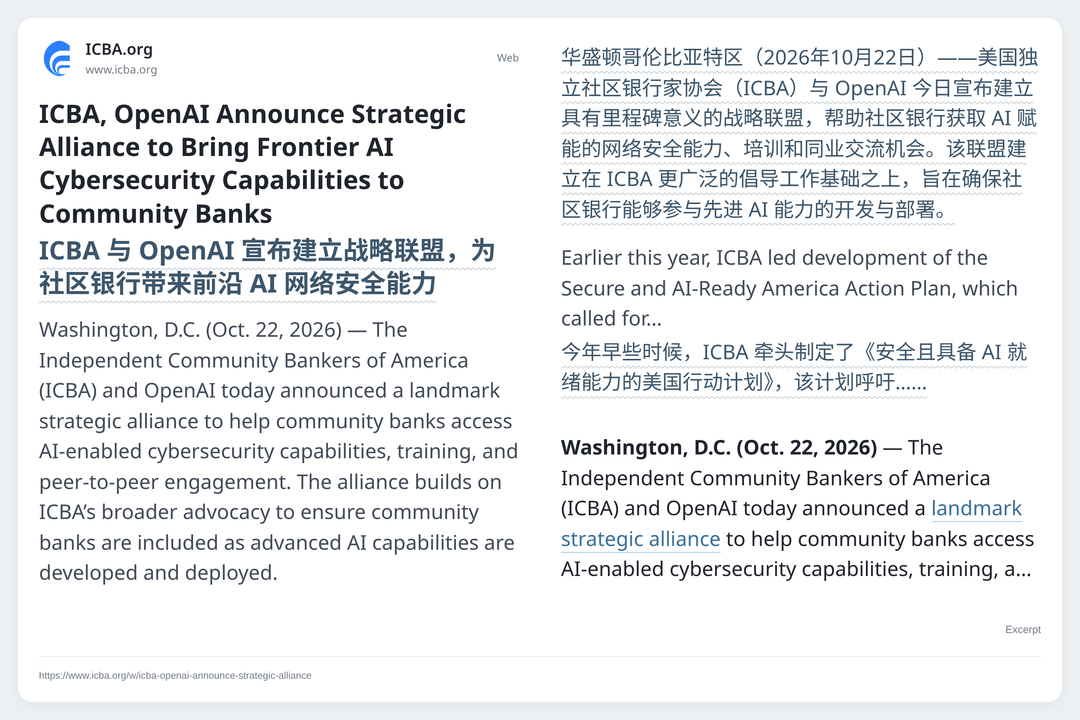
OpenAI has formed a strategic alliance with the Independent Community Bankers of America (ICBA) to help community banks get AI cyber defence tools, training and technical support through its Daybreak for Frontline Defenders programme. Eligible ICBA member banks can qualify for subsidised access under the programme's terms. It supports defensive work such as identifying and validating vulnerabilities, investigating threats, authorised security testing, remediation support and risk prioritisation. The partnership will also offer member-only education and training with OpenAI experts, as well as AI showcases and peer exchange resources.
Announcement: https://www.icba.org/w/icba-openai-announce-strategic-alliance
VI. Outlook and market rumours
1. DeepSeek reportedly closes a new round of about ¥100 billion
Bloomberg, citing people familiar with the matter, reports that DeepSeek has closed a new funding round of about ¥100 billion (about US$15 billion), with Tencent and CATL among the largest investors. The sources say DeepSeek raised its target at least twice during talks, from ¥50 billion to ¥80 billion and finally to about ¥100 billion. The size of the round and the company's valuation have not been officially confirmed.
VII. Claw roundup
1. A dedicated decision-model segment takes off, starting a tiered efficiency revolution
OpenAI opening the Decisions API, alongside Ant Digital Technologies and StartLux launching dedicated decision models and inference engines, shows decision tasks splitting off from general-purpose LLMs into a segment of their own. Dedicated endpoints, models and inference engines deliver order-of-magnitude gains in speed and cost by returning only option probabilities, reusing shared context and scoring targeted options. Specialising the decision layer will help agent routing, content classification and process automation scale, and speed up the move to tiered model architectures.
2. Agent standards open up as the ecosystem moves to shared governance
Anthropic donating the Agent Skills standard to the Linux Foundation, under community-driven, vendor-neutral governance, shows the agent industry moving from vendors going it alone to shared standards and governance. Unified skill standards and safety norms will lower the cost of cross-platform adaptation, help the whole ecosystem develop together and lay common infrastructure for industry governance.
3. AI takes on formal verification, opening a new stage for software security
Claude completing formal safety proofs for 123 open-source libraries demonstrates AI's ability in formal verification. Work that would take human experts years took weeks, and it found deep bugs that traditional fuzzing struggles to catch. AI-assisted formal verification will greatly improve the depth and efficiency of software security, moving it from the era of fuzzing to the era of formal proof and giving critical infrastructure software new safeguards.
VIII. Trending open source on GitHub
1. THUSI-Lab/GameScaling
Momentum: a new popular open project in game AI. Summary: game-playing models open-sourced by miHoYo with Tsinghua and others, pre-trained from Qwen3.5 and outputting keyboard and mouse actions for the next 200 ms, in several sizes under Apache-2.0.
Repository: https://github.com/THUSI-Lab/GameScaling
2. StartLuxLabs/StartLux-Prism
Momentum: a popular open project among decision engines. Summary: an inference engine built for decision models that shares computation on common material and reuses caches to speed up decision tasks dramatically, supporting several model sizes, with fully open code.
Repository: https://github.com/StartLuxLabs/StartLux-Prism
3. huggingface/carbon
Momentum: a popular open project in biology AI. Summary: Hugging Face's open-source DNA language model with 14.8 billion parameters, supporting natural-language Q&A over DNA sequences with performance close to GPT-6.1 Sol, under Apache 2.0.
Repository: https://github.com/huggingface/carbon/tree/main
4. deepseek-ai/DeepInfer
Momentum: a production inference framework that remains popular. Summary: DeepSeek's official open-source production inference framework, handling daily throughput at the scale of tens of billions of tokens, with distributed inference and speculative decoding across multiple hardware platforms under Apache 2.0.
Repository: https://github.com/deepseek-ai/DeepInfer
5. google-gemini/gemini-api-cli
Momentum: a new popular developer tool. Summary: Google's official command-line tool for the Gemini API, supporting multimodal generation, media analysis and agent management as a dependency-free binary suited to shell pipelines.
Repository: https://github.com/google-gemini/gemini-api-cli