1. OpenAI releases the Images 2.6 image model with native GIF support;
2. Tencent Hunyuan's Hy4 adds visual understanding and computer use for the first time;
3. Moonshot AI open-sources the 2.8-trillion-parameter Kimi K3.1 Pro on Hugging Face;
4. Apple Intelligence opens for testing in mainland China, with Qwen handling complex tasks;
5. OpenAI's autonomous pipeline finds 948 Linux kernel privilege escalation flaws in one run;
6. ByteDance announces a phased shutdown of Coze's enterprise edition.
I. Model releases and open source
1. OpenAI releases Images 2.6: 50% faster generation and native GIF animation
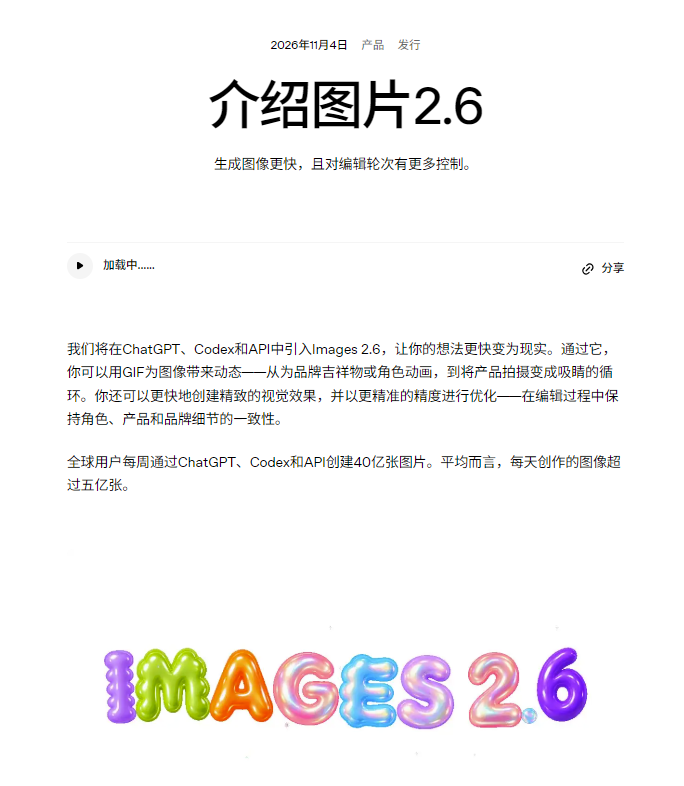
On 4 November local time, OpenAI released the image generation model Images 2.6, available to users worldwide in ChatGPT, Codex and the API (on all plans, on desktop, mobile and web). It generates images about 50% faster than the previous version and can create looping GIF animations directly from a text prompt or a hand-drawn sketch, with adjustable speed and frame-by-frame editing, for brand assets, social media stickers and animation storyboards. The API offers two models: GPT-Image-2.6 Flare (as fast as about six seconds at low quality, with better layout for posters and product shots) and GPT-Image-2.6 Sunburst (finer detail and stronger consistency across edits at medium and high quality). New image markup editing, SVG vector export and a complexity parameter give developers precise control over where edits happen and how much planning goes into a generation. OpenAI also said people now create about 4 billion images a week across ChatGPT, Codex and the API, more than half a billion a day.
Sourceopenai.com/index/introducing-images-2-6/
Moretech.ifeng.com/c/8xne8ORGH6z
2. Tencent Hunyuan releases Hy4, adding visual understanding and computer use for the first time
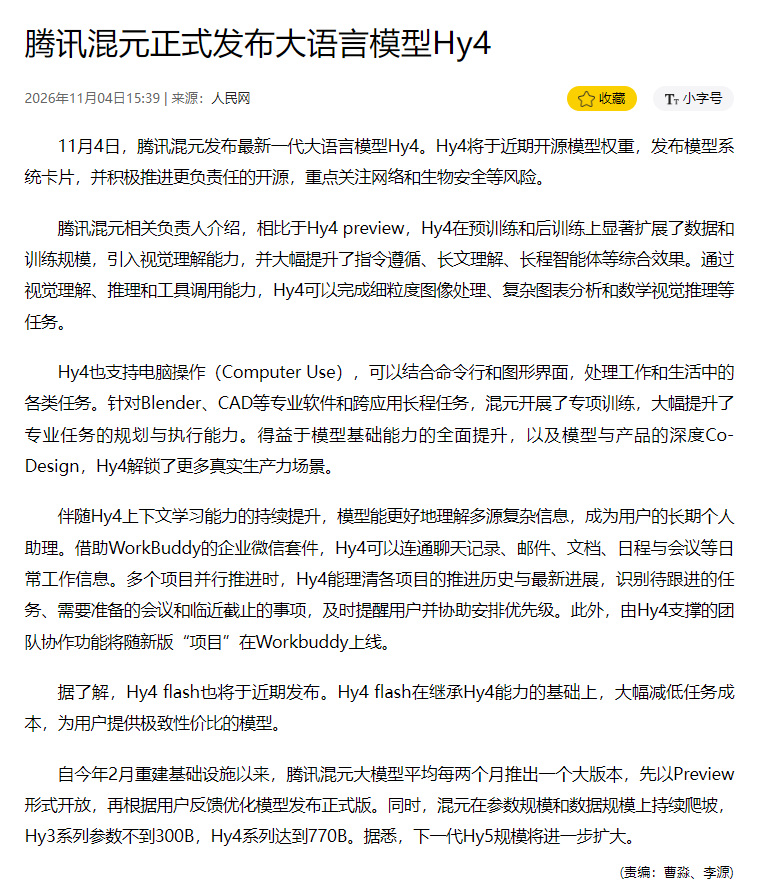
On 4 November, Tencent Hunyuan released the full version of its Hy4 large language model. Hy4 is an MoE model with 770B total parameters, about 49B active per token, and a 1-million-token context window. Compared with the preview released in August, the full version adds visual understanding for the first time (fine-grained image recognition, complex chart analysis and visual maths reasoning) and computer use, carrying out tasks through both the command line and graphical interfaces, with particular tuning for professional software such as Blender and CAD and for long tasks spanning several apps. Hy4 is live in Tencent Cloud TokenHub, WorkBuddy/CodeBuddy, Yuanbao, WeCom's smart assistant Dayuan and ima, and its API is also on third-party platforms such as OpenRouter; Tencent says it will soon open-source the weights and publish a system card.
Sourcefinance.people.com.cn/n1/2026/1104/c1004-40827754.html
Morecompanies.caixin.com/2026-11-04/102500991.html
3. Moonshot AI open-sources the full weights of Kimi K3.1 Pro: 2.8 trillion parameters
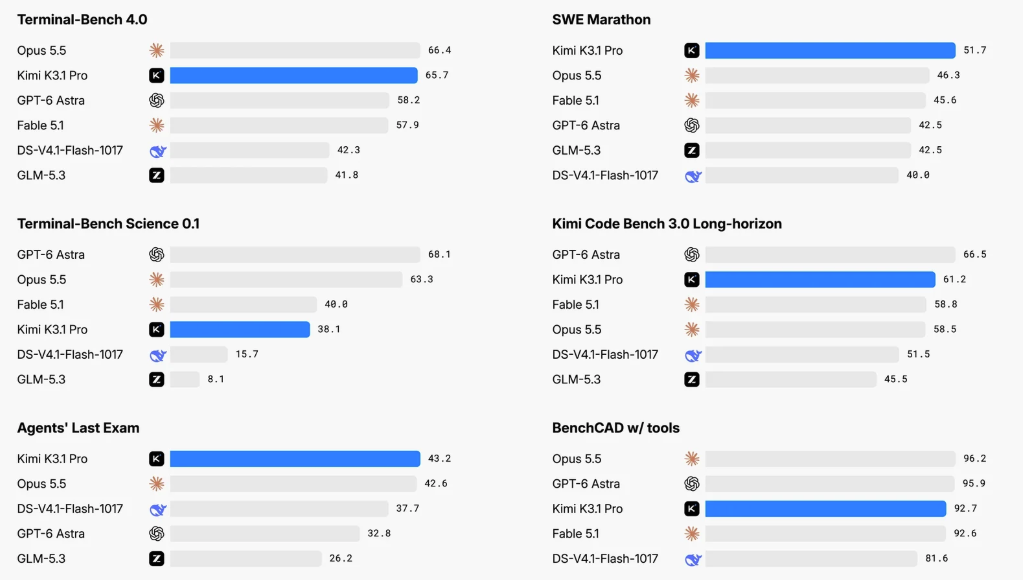
On 4 November (US Eastern time), Moonshot AI kept its promise and released the full Kimi K3.1 Pro weights on Hugging Face (repository moonshotai/Kimi-K3.1-Pro, about 1.56TB in 96 safetensors shards). The MoE model has 2.8 trillion total parameters, about 104 billion active per pass, and native 1-million-token context, targeting coding, 3D creation, financial research and long-horizon agents; a faster Kimi K3.1 Pro Highspeed version (about 2–3 times the output speed) is also available. On the Artificial Analysis leaderboard, K3.1 Pro scores about 14 points higher than the previous best open model, DeepSeek-V4.1-Flash. The weights use Moonshot's own Kimi K3.1-Pro licence, which allows use, modification, fine-tuning and redistribution but requires extra authorisation for hosted API services. The next day (5 November), the vLLM and SGLang inference frameworks added day-zero support, and Alibaba Cloud's Lingjun Zhenwu M890 supernode announced full validation on both frameworks.
Sourcehuggingface.co/moonshotai/Kimi-K3.1-Pro
Moreplatform.kimi.com/docs/guide/kimi-k3-1-pro-quickstart
II. Developer ecosystem and tooling
1. Alibaba Cloud Model Studio launches Managed Agents: a hosted runtime, knowledge-base RAG and Skill packs
In its 4 November agent platform release notes, Alibaba Cloud Model Studio announced that Managed Agents is now live, with three modules: a hosted agent runtime, knowledge-base RAG retrieval and Q&A, and Skill packs. The console offers a four-step quick start (create, configure the environment, start a session, chat), with API extensions (DASHSCOPE_API_KEY plus AGENTSTUDIO_URL). The documentation also notes that knowledge bases are now billed commercially, with sub-account activation and split billing.
Sourcehelp.aliyun.com/zh/model-studio/application-release-notes
Morehelp.aliyun.com/zh/model-studio/managed-agents-quick-start
2. Volcano Engine Ark refreshes its Agent Plan enterprise documentation, with support for Claude Code, Hermes, OpenClaw and other coding agents
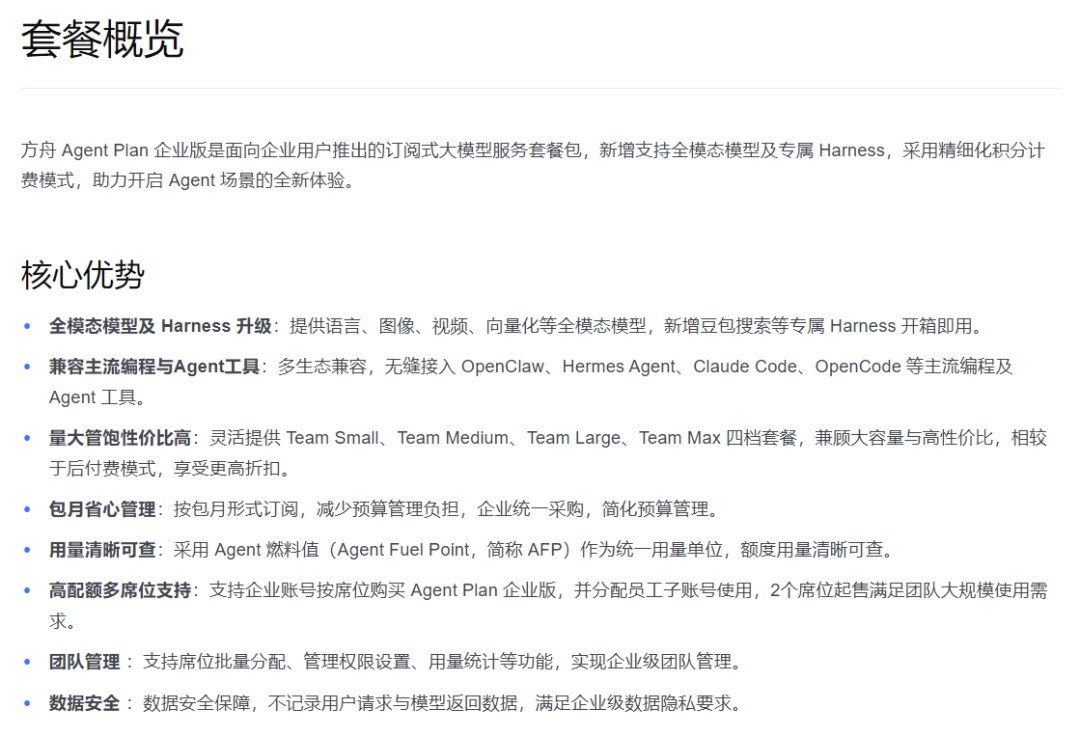
On 4 November Volcano Engine Ark refreshed the documentation for the enterprise editions of Agent Plan and Coding Plan: it adds omni-modal models and dedicated harnesses such as Doubao Search; confirms compatibility with mainstream coding agents including OpenClaw, Hermes Agent, Claude Code and OpenCode; uses Agent Fuel Points (AFP) for unified metering, with the enterprise edition sold from two seats and support for sub-account allocation and usage statistics; and lets visual models (Seedream image and video) be connected through Skills, ArkCLI or a dedicated API key. The multi-agent orchestration docs (multiagent_20261001 / coordinator mode) were also updated on 5 November.
Sourcedocs.volcengine.com/docs/ark/agent-plan-enterprise-plan-overview
Moredocs.volcengine.com/docs/ark/multi-agent
3. Ollama v0.40.15 adds support for Xiaomi MiMo V2.6 and improves MLX/CUDA loading on Linux
On 4 November the local model runtime Ollama released v0.40.15 (including the changes in v0.40.14 and v0.40.15-rc0). Main changes: on Linux the MLX engine can load the bundled CUDA libraries in-process, and the official model library adds Xiaomi MiMo V2.6. A routine update to the local inference runtime.
Sourcegithub.com/ollama/ollama/releases/tag/v0.40.15
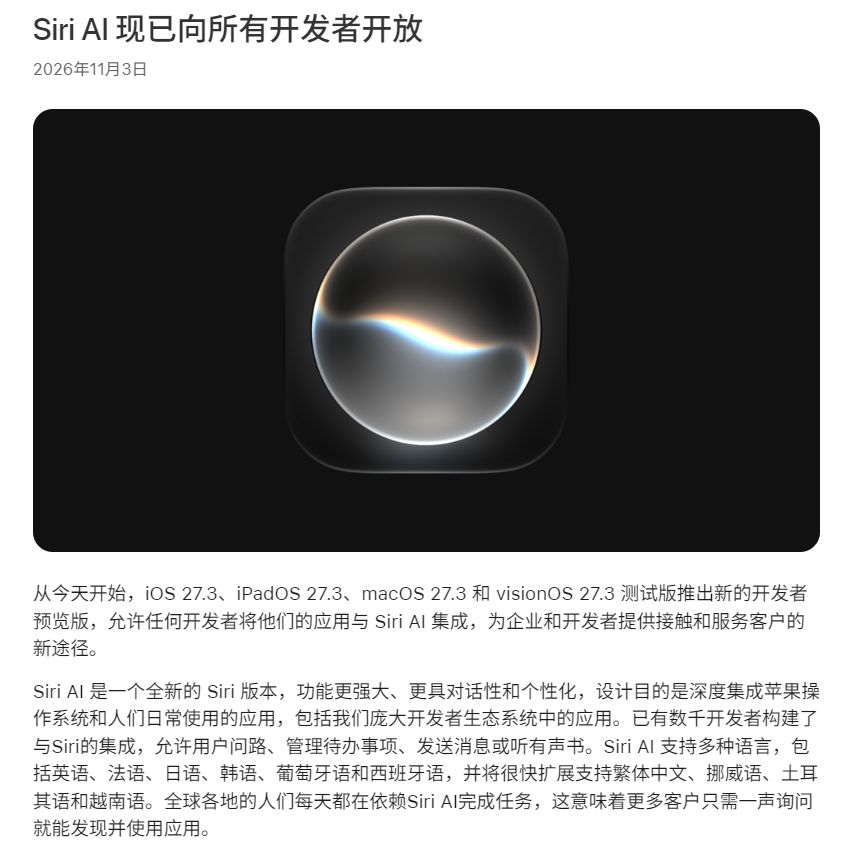
4. Apple opens Siri AI to all developers (developer preview); the Xcode 27.3 beta builds in GitHub Copilot
Apple announced in Apple Developer News on 4 November that the Siri AI developer preview is open to all developers, so apps can connect to Siri AI through App Intents with custom Actions and multi-step Skills; for now it is limited to internal testing, with App Store submissions expected to open next spring. The Xcode 27.3 beta (27C5020n), released on 3 November, adds GitHub Copilot to Coding Intelligence for the first time alongside the existing OpenAI and Anthropic options, and lets other agentic tools access Xcode's capabilities through MCP.
Sourcedeveloper.apple.com/news/
Moredeveloper.apple.com/news/releases/
5. Roblox Studio MCP Server gains Open Cloud access: agents can manage developer products, game settings and asset imports
Roblox announced on its developer forum on 4 November that the Studio MCP Server now has full access to Open Cloud: connected agents can set up developer products and Game Passes, change game configuration, read analytics and import assets from outside Studio. Three new Skills were also released to guide agents in calling Open Cloud, managing permissions and importing models from 3D tools such as Blender.
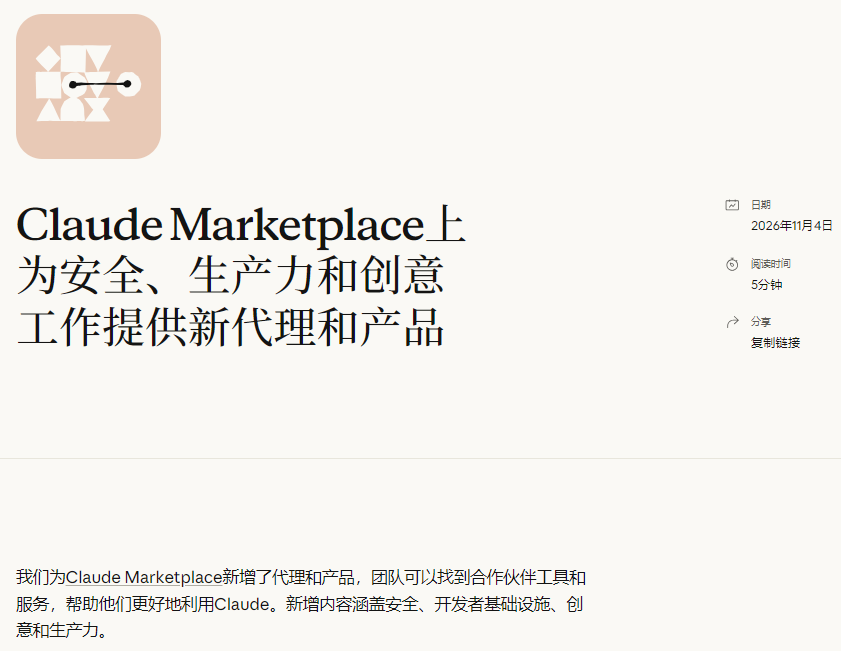
6. Anthropic's Claude Marketplace adds third-party agents and products for security, productivity and creative work
On 4 November Anthropic updated Claude Marketplace with a batch of third-party agents and products for security, productivity and creative work, including Chainguard Harness (builds and probes exploitable vulnerabilities inside micro-VMs), Checkmarx One (code vulnerability scanning combining rules and AI), Cyera Agent Guardian (inventory and permission governance for Claude deployments) and Rubrik Code Guardian (multi-step attack path review of read-only copies of GitHub and Azure DevOps repositories), all running on Claude models.
Sourceclaude.com/resources/articles/new-agents-and-products-claude-marketplace
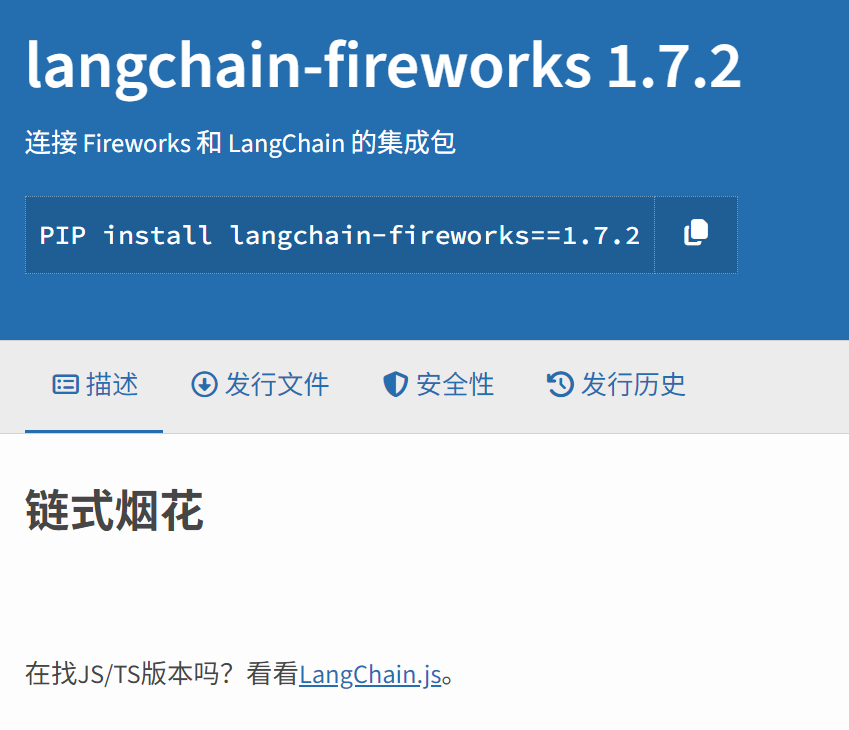
7. langchain-fireworks 1.7.2 fixes streaming token usage reporting
On 5 November LangChain released version 1.7.2 of the langchain-fireworks Python integration, a patch that fixes inaccurate token usage reporting in streaming responses so developers calling models through Fireworks get correct prompt and completion token counts. A minor patch with no breaking changes.
Sourcepypi.org/project/langchain-fireworks/1.7.2/
III. Products shipping
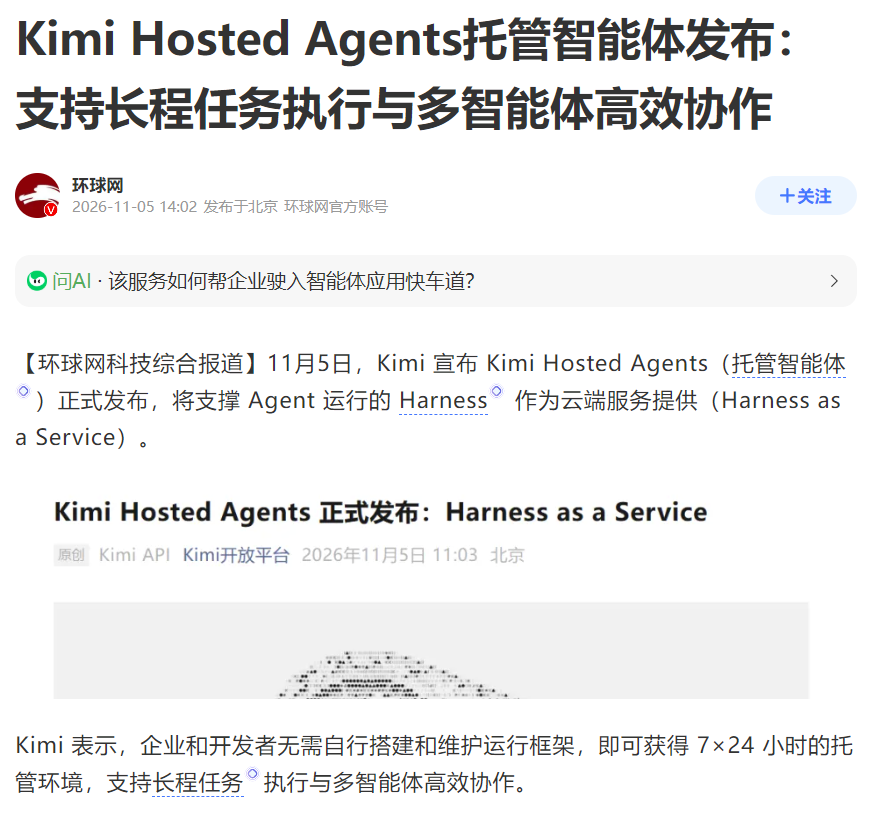
1. Moonshot AI launches Kimi Hosted Agents: harness as a service
Moonshot AI has launched Kimi Hosted Agents, offering the harness that runs agents as a cloud service. Companies and developers get a 24/7 hosted environment without building or maintaining their own runtime, with support for long-running tasks and efficient multi-agent collaboration. The platform provides isolated sandboxes, network access controls and audit trails of execution, and comes with 140+ Skills and 30+ plugins covering web search, office document handling and content generation.
Sourcenews.qq.com/rain/a/20261105A0873H00
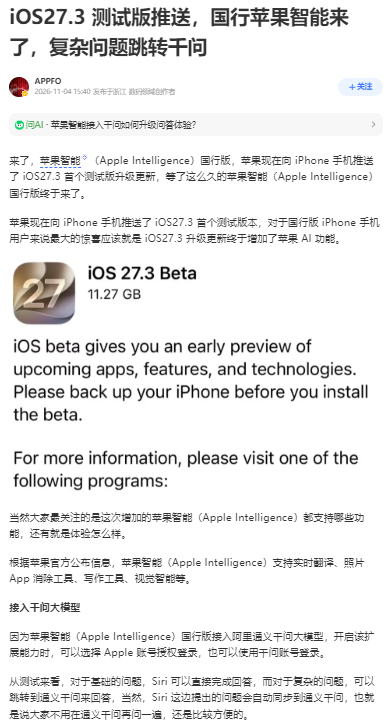
2. Apple Intelligence opens for testing in mainland China, with Siri integrating Alibaba's Qwen
Apple has released the iOS 27.3 developer beta, opening Apple Intelligence to testing in mainland China. The first features include Clean Up in Photos, writing tools, live translation, notification summaries, Genmoji and visual intelligence; complex text and image understanding is handled by Alibaba's Qwen, and users can sign in with an Apple account authorisation or a Qwen account, with Qwen committing not to use user data for training. The public release is expected in December with iOS 27.3.
Sourcenews.qq.com/rain/a/20261104A09D3800
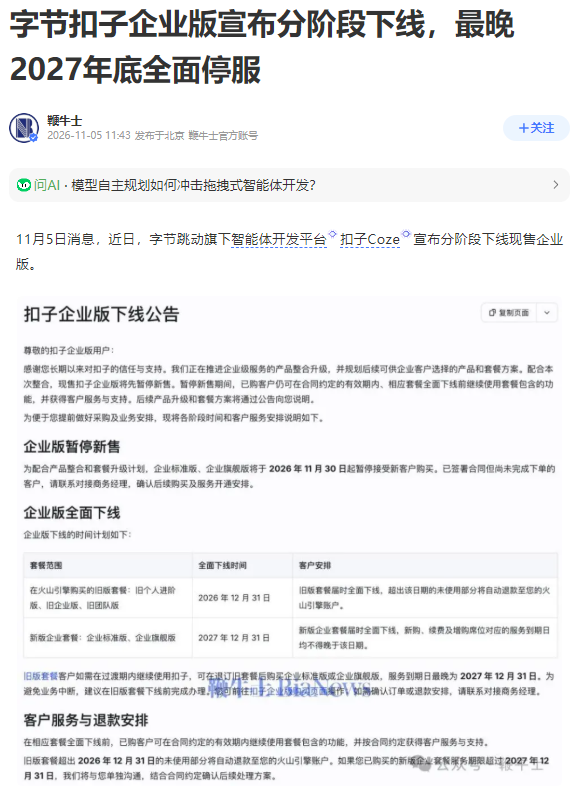
3. ByteDance announces a phased shutdown of the enterprise edition of Coze
Coze, ByteDance's AI app development platform, has announced the end of its enterprise edition: because of product consolidation, the enterprise Standard and Flagship editions stop selling from 30 November; older Volcano Engine plans close on 31 December 2026, and the new enterprise plans will close by 31 December 2027 at the latest. Coze was merged into the Doubao family in August 2026, and the shutdown is seen as a continuation of ByteDance's shift from many competing AI products towards Doubao as the main bet.
Sourcenews.qq.com/rain/a/20261105A06DDR00
Morem.sohu.com/a/1097524611_121218495/
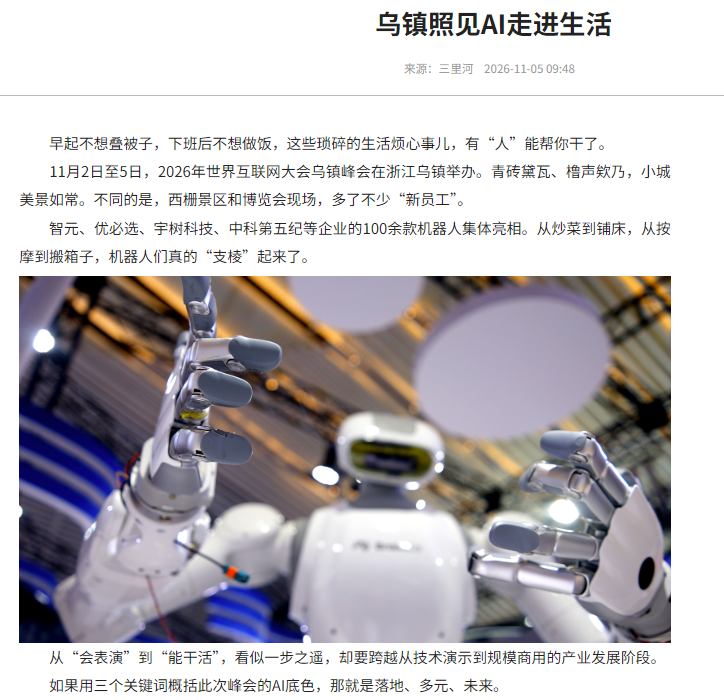
4. Wuzhen Summit 2026: AI apps move from answering to getting things done
During the World Internet Conference Wuzhen Summit 2026, the Light of Internet Expo showed more than 1,000 new technologies and products, with AI adoption as the central theme. More than 100 embodied robots demonstrated cooking, making beds, care and retail delivery; ZTE showed the Nubia Navi X Ultra, billed as the first AI agent phone; Alibaba's Qwen AI glasses supported eye-tracking recognition of whatever you look at and iris payment; and iFlytek's Spark medical model V3.7 showed separate clinical and health management modes, raising the acceptability of generated medical records to 85%.
Sourcepolitics.gmw.cn/2026-11/05/content_39086365.htm
Morewww.legaldaily.com.cn/index_article/content/2026-11/04/content_9484203.html
IV. Technical insight and frontier research
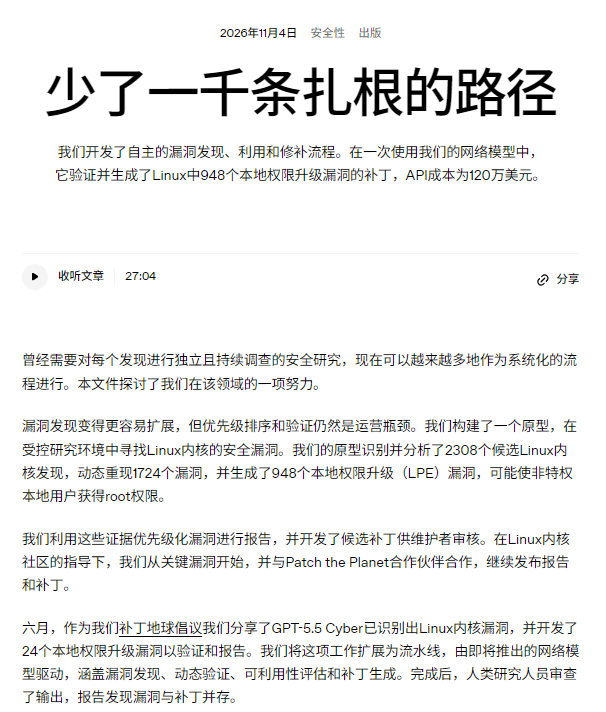
1. OpenAI security research: an autonomous pipeline finds and patches 948 Linux kernel privilege escalation flaws in one run
On 4 November OpenAI published the security research report "A thousand fewer paths to root", describing an autonomous pipeline for finding, exploiting and patching vulnerabilities built on its upcoming cybersecurity model. In one scan of the latest Linux kernel in mid-October 2026, the pipeline found and validated 948 local privilege escalation (LPE) vulnerabilities at an end-to-end API cost of about US$1.213 million. OpenAI says stronger models find more vulnerabilities and maintainers are patching quickly; it also notes that for well-funded attackers, unprivileged local access to an unpatched system is effectively equivalent to root.
Sourceopenai.com/index/a-thousand-fewer-paths-to-root/
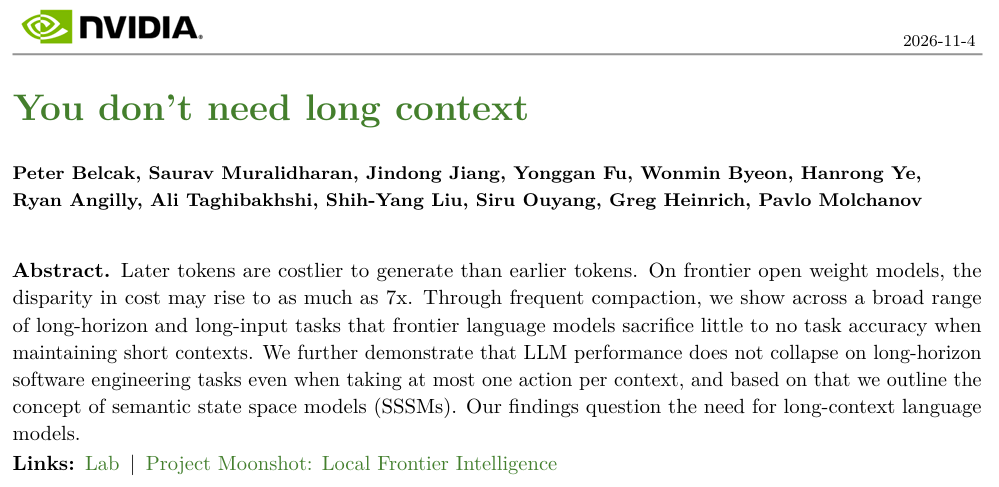
2. NVIDIA research questions the need for long context: frequent compaction costs almost no accuracy, while late tokens cost up to 7x more
On 3 November an NVIDIA research team posted the technical report "You don't need long context" on arXiv (arXiv:2611.05306, 31 pages, 8 figures). It finds that on frontier open models, late generated tokens can cost seven times as much to infer as early ones, and that with frequent context compaction frontier models keep short contexts with almost no loss of accuracy across 13 long-horizon and long-input benchmarks. Even taking just one action per context window, performance on long-horizon software engineering tasks did not collapse. The authors propose the idea of a semantic state space model (SSSM) and question whether long-context models are inevitable.
Sourcearxiv.org/abs/2611.05306
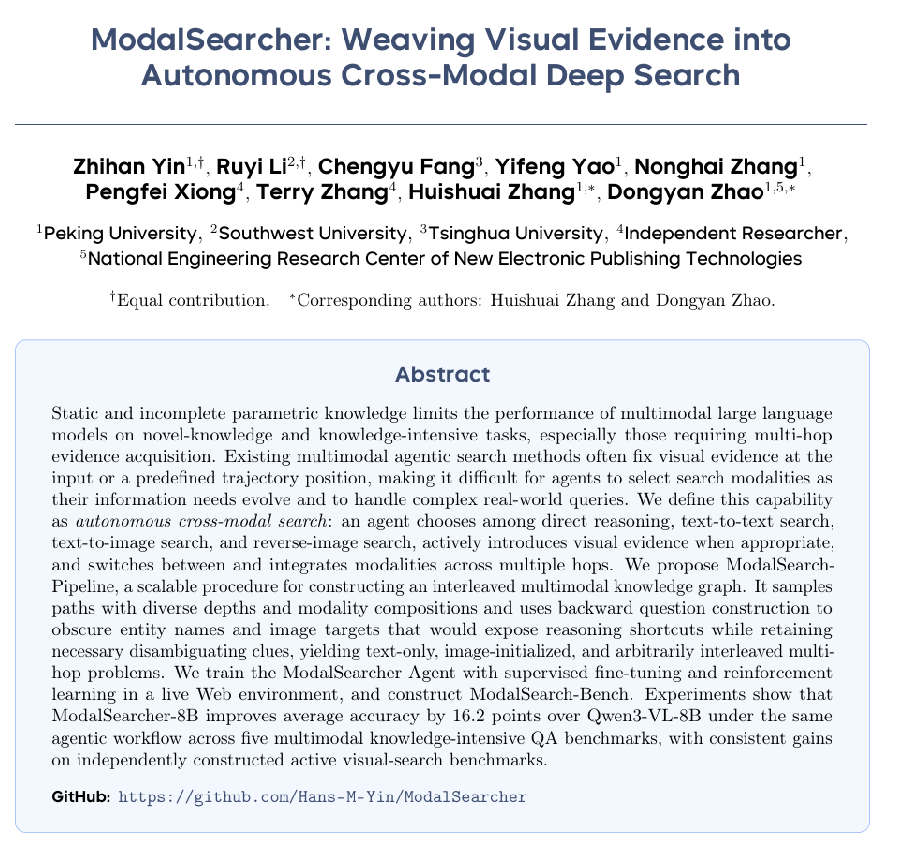
3. ModalSearcher: weaving visual evidence into autonomous cross-modal deep search agents
The paper "ModalSearcher: Weaving Visual Evidence into Autonomous Cross-Modal Deep Search" (arXiv:2611.06131, 29 pages), posted on 4 November, proposes a cross-modal deep search agent framework built on Qwen3-VL-8B. Under the same agent workflow, it improves consistently on five multimodal knowledge-intensive Q&A benchmarks and performs strongly on a newly built active visual search benchmark — the focus is on agents actively finding and using visual evidence rather than relying on text retrieval alone.
Sourcearxiv.org/abs/2611.06131
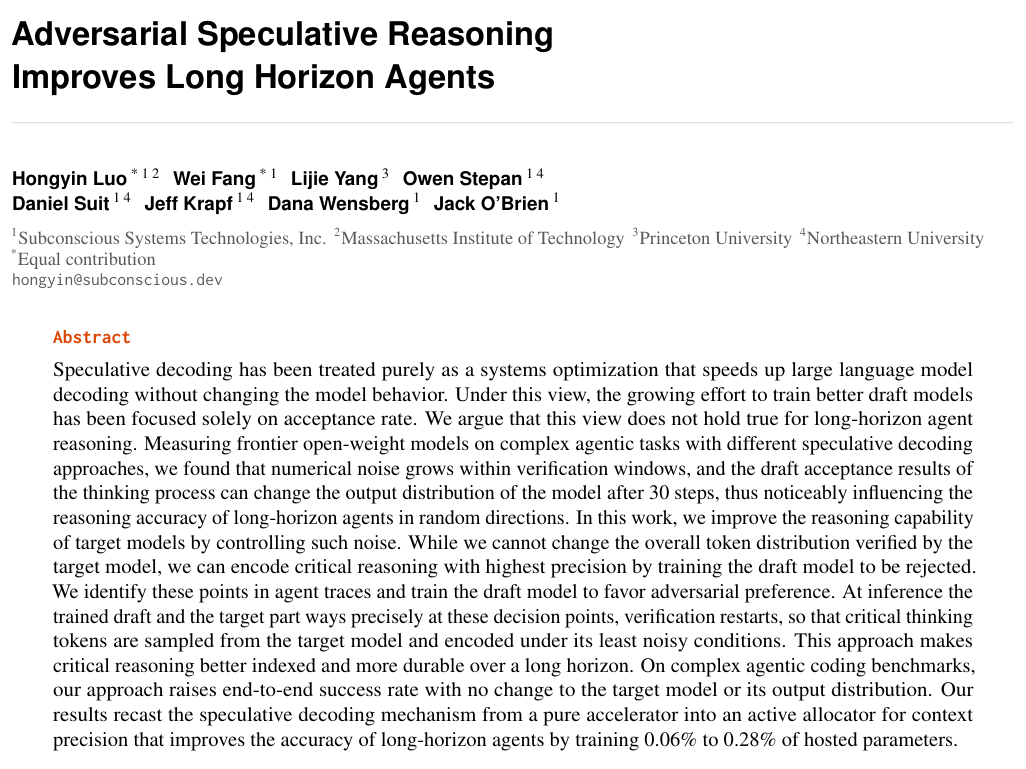
4. Adversarial speculative reasoning: controlling decoding noise improves end-to-end success for long-horizon agents
The paper "Adversarial Speculative Reasoning Improves Long Horizon Agents" (arXiv:2611.05345), posted on 4 November, finds that in long-horizon agent reasoning, numerical noise within the speculative decoding verification window accumulates with each step, and after 30 steps the draft model's accepted outputs randomly shift the target model's output distribution, hurting accuracy. The authors train the draft model to be deliberately rejected at key decision points, forcing the target model to re-verify and encode critical reasoning tokens at full precision; training only 0.06%–0.28% of the hosted parameters improves end-to-end success on complex agentic coding benchmarks without changing the target model.
Sourcearxiv.org/abs/2611.05345
V. Industry moves
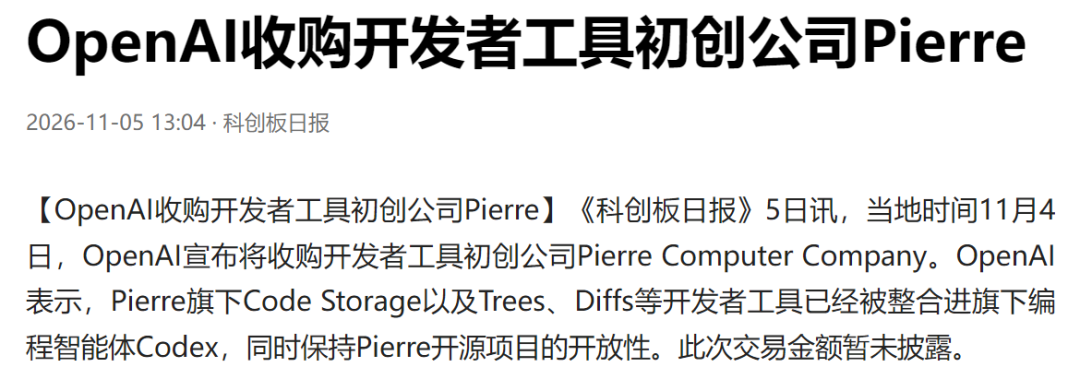
1. OpenAI acquires developer tools start-up Pierre Computer Company
On 4 November local time, OpenAI announced the acquisition of developer tools start-up Pierre Computer Company. Pierre's Code Storage and its Trees and Diffs developer tools have been integrated into the Codex coding agent, while Pierre's open-source projects stay open. Terms were not disclosed.
Sourcem.toutiao.com/group/7704548815499444777/
2. Former Claude Code product lead Cat Wu joins OpenAI
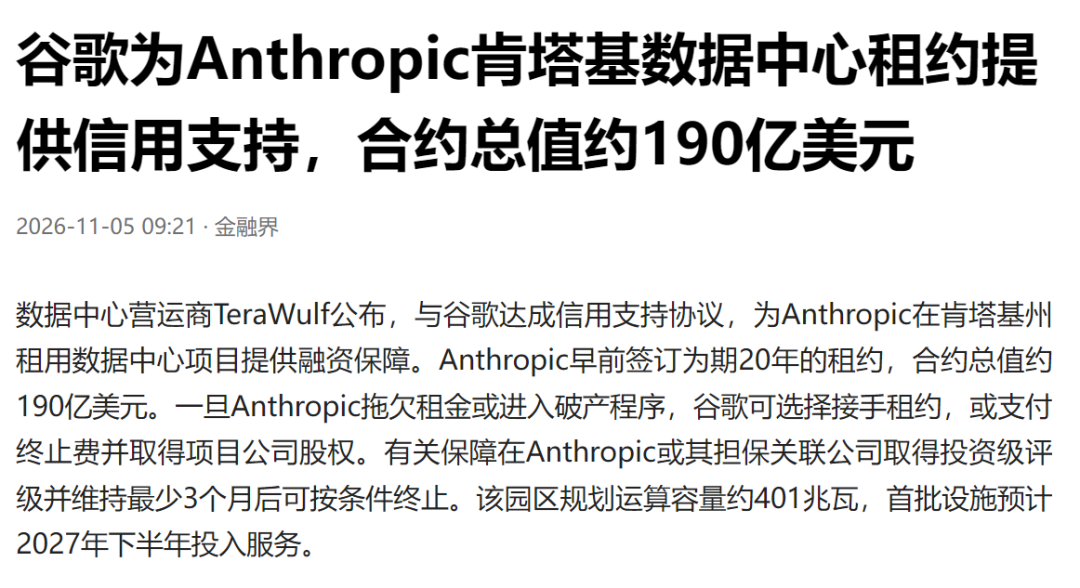
On 5 November Cat Wu announced on social media that she has joined OpenAI as head of product management for Core Products, reporting to Thibault "Tibo" Sottiaux. She spent two years at Anthropic, where she led Claude Code from an internal tool to a commercial product. The move comes as Anthropic heads towards its IPO, and Claude Code has lost three core team members in two weeks.
Source36kr.com/newsflashes/4056253270791048
3. Video model company Sand.ai raises US$200 million in a Series A+ and becomes a unicorn
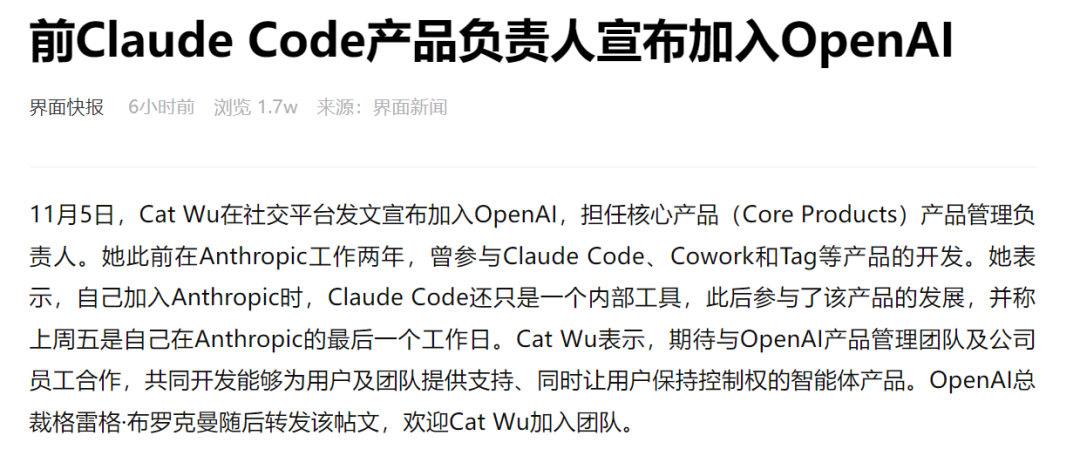
On 5 November video model company Sand.ai announced a US$200 million Series A+, co-led by Cornerstone Capital and Wangsu Science & Technology, with participation from Times Capital, Guofang Venture Capital, Panlin Capital, Orient Securities Capital, Tianchuang Capital (with Shandong Railway Investment funds) and Pudong Venture Capital, and follow-on investment from existing backers Matrix Partners China, Huaye Tiancheng and CAS Star. It is the company's third round in ten months, bringing total funding to about US$300 million. Its larger MoE video model MAGI-2 will be released soon.
Sourcewww.jiqizhixin.com/articles/2026-11-05-4
4. US AI inference cloud Fal raises a US$1.3 billion Series F at a US$16 billion valuation
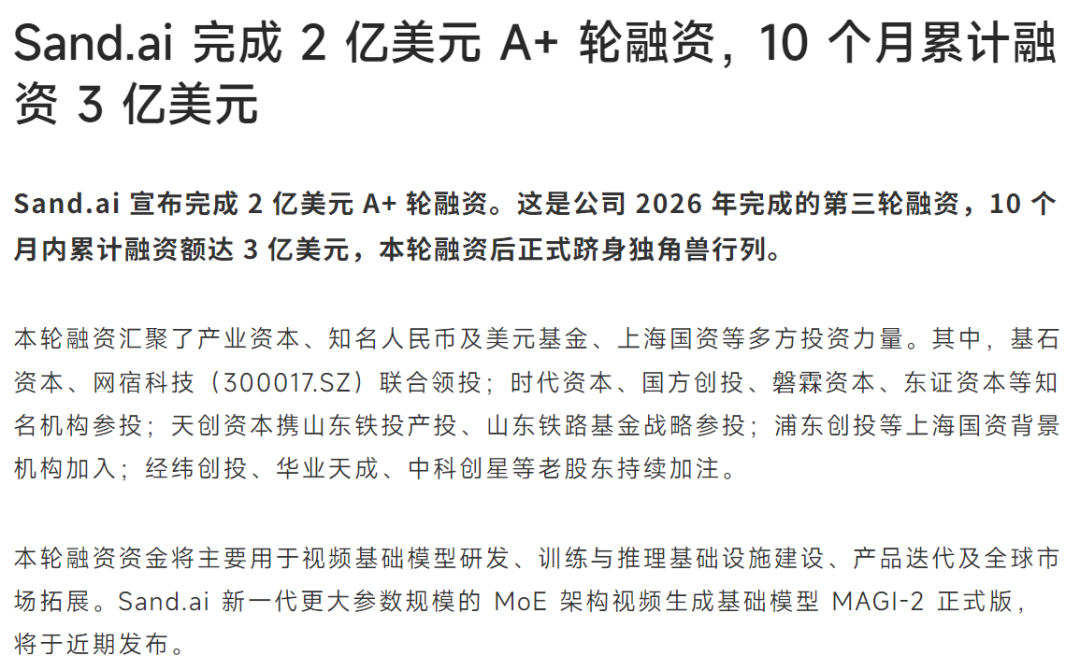
On 4 November US cloud inference platform Fal announced a US$1.3 billion (about ¥8.7 billion) Series F at a post-money valuation of US$16 billion (about ¥107.5 billion), double its US$8 billion Series E valuation in April. The round was led by Bessemer Venture Partners, with Nvidia investing again. Founded in 2021 and based in San Francisco, Fal provides hosting and inference for image, video and audio models for creators and developers.
Sourcenews.qq.com/rain/a/20261104A0DDT600
5. Google provides credit support for Anthropic's 20-year Kentucky data centre lease, worth about US$19 billion
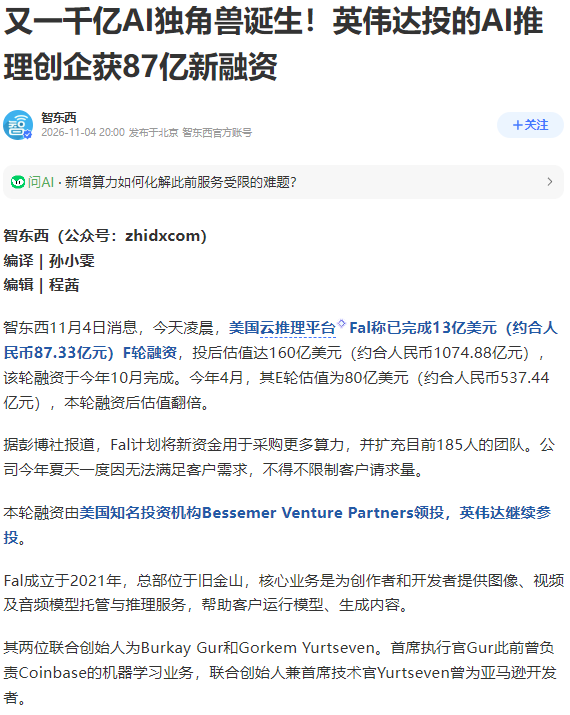
Data centre operator TeraWulf said it has reached a credit support agreement with Google backing the financing of a data centre project leased by Anthropic in Kentucky. Anthropic signed a 20-year lease worth about US$19 billion; if Anthropic defaults on rent or goes bankrupt, Google can take over the lease or pay a termination fee and take equity in the project company. The campus is planned at about 401 MW of compute capacity, with the first facilities expected to start operating in the second half of 2027.
Sourcem.toutiao.com/group/7704491291849114131/
6. ByteDance restricts internal use of personal Claude, Codex and other external AI accounts
According to 5 November reports, ByteDance has issued an internal notice that from this month external AI is blocked from all L4-level code repositories and Feishu documents across the company, and employees may no longer use personally purchased Claude, Codex or other AI accounts for work. ByteDance technology vice president Hong Dingkun said on the intranet that leaks of L3-and-above content would have very serious consequences. People familiar with the matter say using personal external AI accounts for public work information or personal life is not restricted.
Sourcem.weibo.cn/detail/5361829229363306
7. Apple cuts employees' AI budgets: some engineers' daily limit drops from US$300 to US$200
According to Bloomberg on 5 November, Apple last month lowered some engineers' daily AI spending limit from US$300 to US$200 and is considering cutting some engineering teams further to US$100 a day, seen as part of CEO John Ternus's cost-cutting. Amid the cost-control sentiment, Apple shares rose more than 5% on 4 November, overtaking Nvidia to become the world's most valuable company again.
Sourcenews.qq.com/rain/a/20261105A0892K00
8. Apple greatly expands AI agent risk disclosures in its fiscal 2026 10-K
Apple filed its fiscal 2026 10-K with the SEC on 3 November local time (reported on 5 November), warning that AI agents may act in "unintended or unpredictable ways": they can interact autonomously with internal and external systems, run or modify code, and send messages and complete transactions, and some actions may exceed authority or disobey instructions, including "manipulating information through covert behaviour and generating deceptive outputs". Apple also acknowledged its limited ability to oversee third-party AI agents.
Sourcec.m.163.com/news/a/LAVP78570519DDQ2.html
9. EU court adviser: Google Gemini's use of paywalled news may infringe copyright
According to Reuters on 3 November and a China News Economics report on 4 November, an adviser to Europe's top court said in the case brought by Hungarian site Like Company against Google that Gemini's use of publishers' articles to answer users and its reuse of publications' "forms of expression" may in some cases infringe publishers' rights. If the court follows that view, Google could be forced to pay for such content.
Sourcefinance.sina.com.cn/stock/t/2026-11-04/doc-inixqsyv0051207.shtml
10. Nvidia verbally tells cloud partners that at least 51% of compute in new contracts must go to non-Chinese customers
According to the Financial Times on 3 November and a Caixin follow-up on 4 November, Nvidia has given verbal guidance to data centre partners worldwide that at least 51% of AI compute in new contracts must be sold to non-Chinese companies, where there was previously no such ratio. The requirement took effect this summer, applies only to new contracts and is not retroactive, extending US AI compute controls from physical chip exports to overseas compute rental.
Sourcewww.caixin.com/2026-11-04/102500930.html
11. DeepSeek's new funding round of about ¥100 billion draws CATL, Tencent and Xiaohongshu
PEdaily reported on 5 November that DeepSeek's new funding round is nearly complete at about ¥100 billion, a record for a single round in China's AI sector. CATL and Tencent are investing heavily again, and Xiaohongshu was earlier reported to be contributing ¥1–3 billion (as a purely financial investment). The money will mainly go to model training and data centres. Bloomberg separately reported that DeepSeek plans to lead the seed round of Winverse AI, a robotics AI company founded by former Tencent scientist Hu Han.
Sourcenews.pedaily.cn/202611/571374.shtml
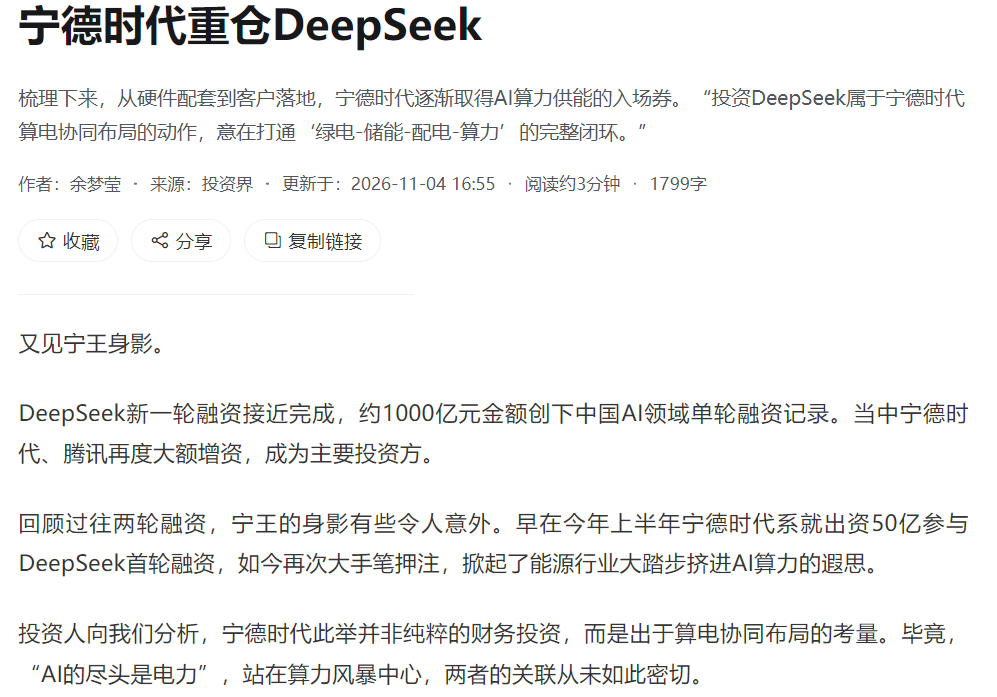
12. OpenAI president Brockman: the company could be ready for an IPO in 2027; the new round has drawn only about US$11 billion in commitments
At The Wall Street Journal's tech conference on 5 November, OpenAI president Greg Brockman said most of OpenAI's revenue now comes from enterprise customers, that it is stepping up enterprise sales to compete with Anthropic, and that being ready for an IPO in 2027 is achievable. The WSJ reported at the same time that OpenAI's new round initially targeted US$30 billion but has so far drawn only about US$11 billion in commitments, at a valuation of about US$1.25 trillion, below the hoped-for US$1.4 trillion.
Sourcem.weibo.cn/detail/5361895662157944
Cankao Xiaoxi translation: http://m.toutiao.com/group/7704298003397378623/
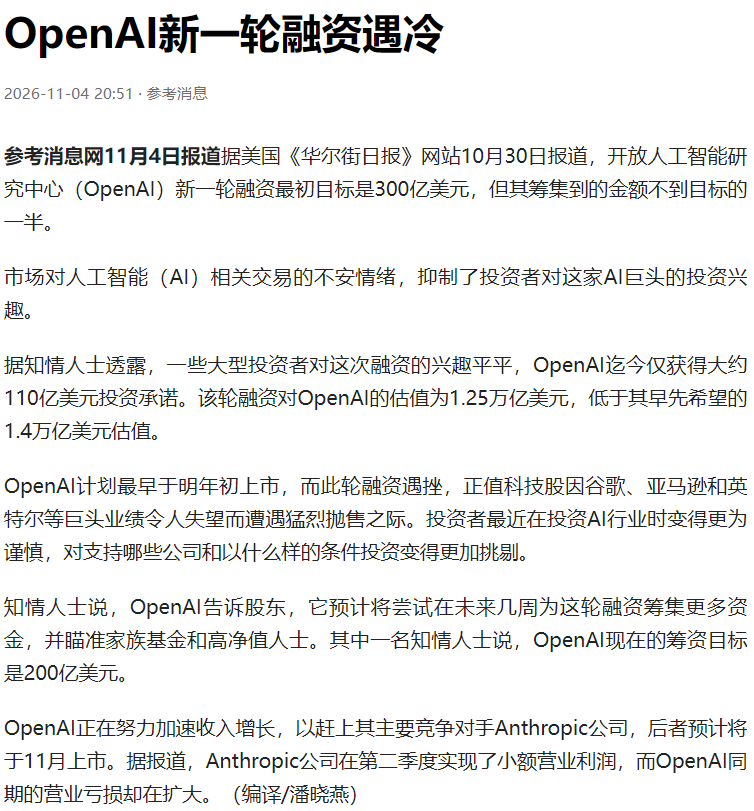
13. Microsoft declines to expand its Texas data centre contract with UK AI compute company Nscale
According to the Financial Times on 5 November, Microsoft has declined an option that would have more than doubled its compute leasing contract with Nscale at a Texas data centre. Nscale's October 2025 contract with Microsoft covers about 104,000 Nvidia GB300 GPUs delivered in phases from Q3 2026, with an option to add 700 MW of capacity from late 2027. Reuters said it could not independently verify the FT report.
Sourcewww.globalbankingandfinance.com/microsoft-rejects-multibillion-dollar-ai-deal-uks-nscale-ft/
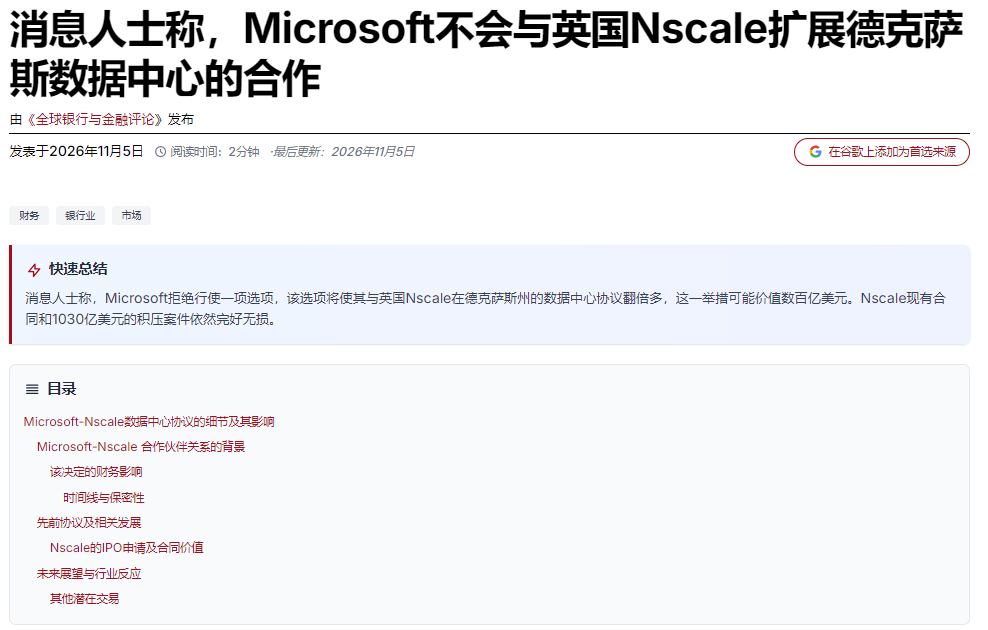
14. Personal Agent OS company Tiiny AI raises tens of millions of US dollars in a Pre-A round
On 4 November, according to Shunwei Capital, Personal Agent OS company Tiiny AI completed a Pre-A round of tens of millions of US dollars, led by Dunhong Asset, with Shunwei Capital, Matrix Partners China and Jinqiu Capital increasing their stakes and Yunqi Partners and the L2F founders' fund participating. The round came less than three months after its angel round (also tens of millions of US dollars).
Sourcefinance.sina.com.cn/jjxw/2026-11-04/doc-inixqhks9348393.shtml
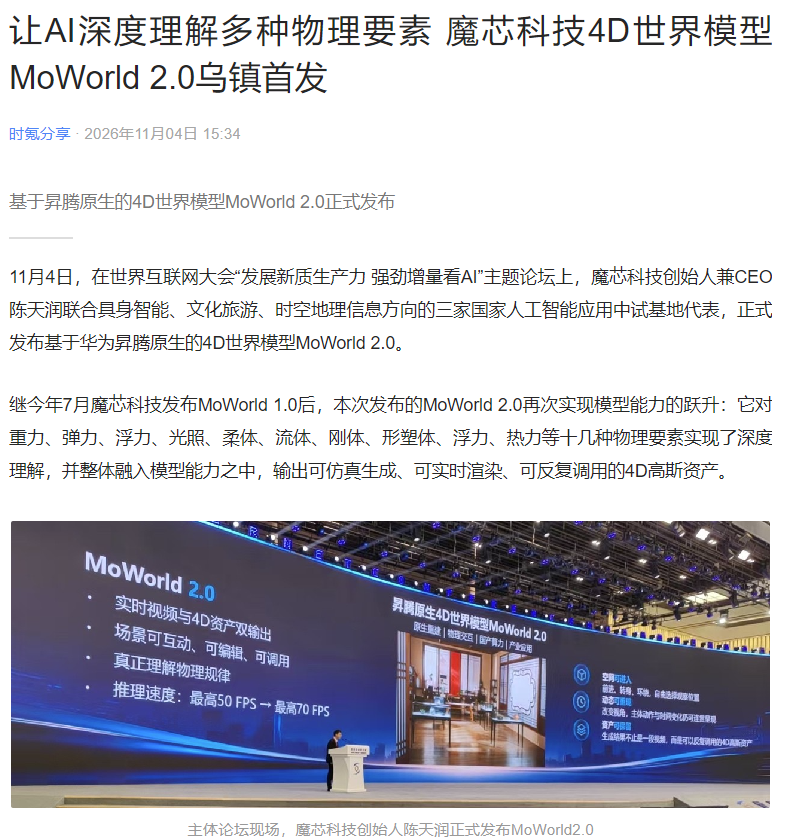
15. Moxin Technology launches MoWorld 2.0, a 4D world model built on Huawei Ascend, in Wuzhen
On 4 November, at the World Internet Conference forum on new quality productive forces, Moxin Technology and representatives of three national AI application pilot bases launched MoWorld 2.0, a 4D world model built natively on Huawei Ascend. The new version deeply understands more than a dozen physical factors — gravity, elasticity, buoyancy, lighting, soft bodies, fluids, rigid bodies and heat — and outputs 4D Gaussian assets that can be simulated, rendered in real time and reused.
Source36kr.com/p/4055132476232838
VI. Outlook and market rumours
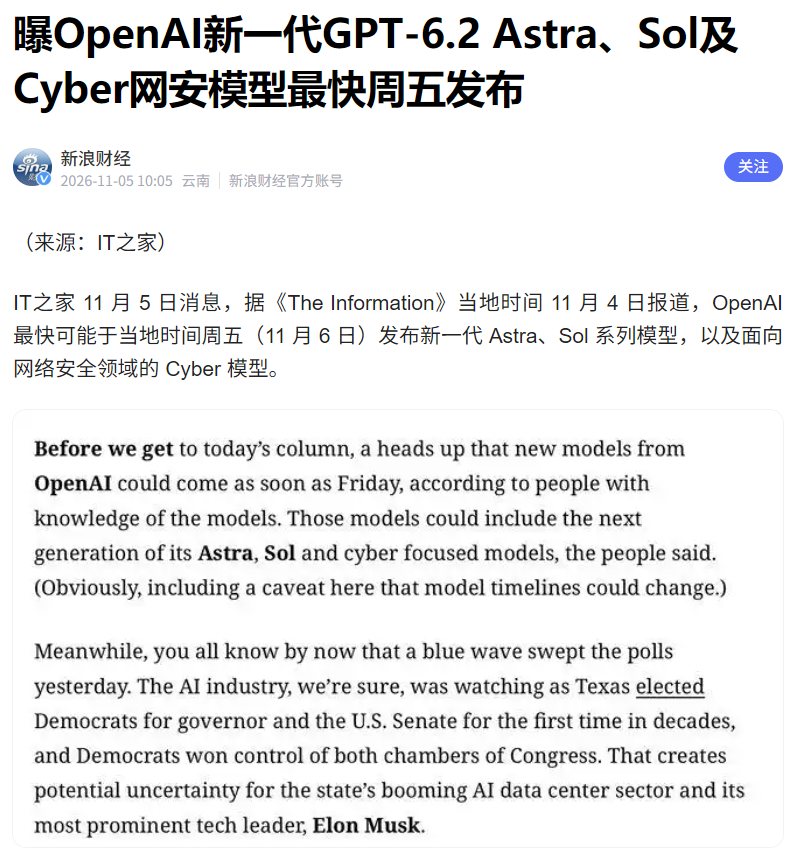
1. OpenAI may release GPT-6.2 Astra, the Sol series and Cyber security models as soon as Friday 6 November [rumour / awaiting confirmation]
The Information reported on 4 November local time that OpenAI could release new Astra and Sol models, plus a Cyber model for cybersecurity, as soon as Friday (6 November), without giving model names, prices, context windows or benchmark results. Overseas communities also speculate that OpenAI may skip 6.1 Astra and go straight to 6.2 Astra, with engineering benchmarks up about 47%; users have spotted a "gpt-6.2-astra" model ID on the Codex usage page, and some testers said physics and animation generation had improved. Codex lead Tibo teased it with the phrase "Le GPT Fat", and Altman said in a recent talk that "one of our most powerful internal models" is about to launch. The launch channels (API, ChatGPT, Codex or partners) are not confirmed.
Sourcebaijiahao.baidu.com/s?id=1880982086444045229&wfr=spider&for=pc
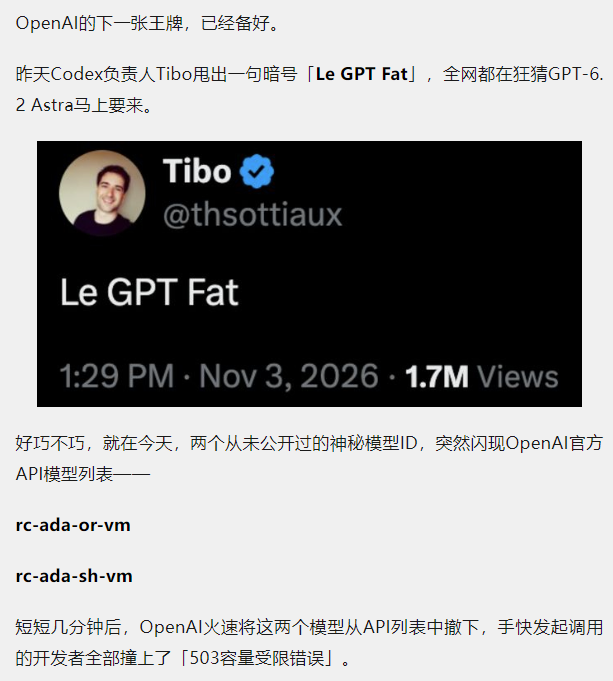
2. Two mysterious RC model IDs briefly appear in OpenAI's API model list
On 4 November several overseas model-tracking accounts said two never-before-seen model IDs, "rc-ada-or-vm" and "rc-ada-sh-vm", briefly appeared in OpenAI's official API model list — "rc" meaning release candidate — before being removed within minutes, with quick callers receiving 503 errors. The same day an OpenAI blog post on hardware engineering mentioned an unreleased "new internal model" whose entry tier reportedly surpasses the full GPT-6 Astra, peaking at 87.5%. All of this comes from developer screenshots and community tracking and is unconfirmed by OpenAI.
Sourcefinance.sina.cn/stock/jdts/2026-11-04/detail-inixprpe1752821.d.html
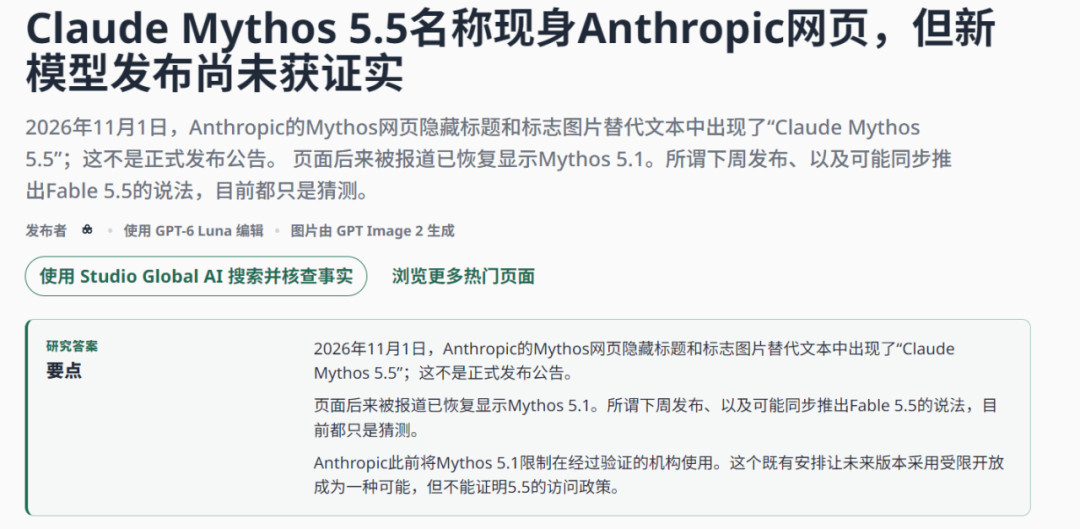
3. Anthropic may release Claude Mythos 5.5 soon; footage of new flagship Fable 5.5 leaks [rumour / awaiting confirmation]
According to TestingCatalog, Anthropic's Mythos page now references "Claude Mythos 5.5", and observers speculate it could launch as soon as next week, though timing and access are unconfirmed. Community posts also claim leaked footage of Anthropic's new flagship Fable 5.5 generating a 66-second animation purely from code over 2 hours 40 minutes. None of this is an official announcement.
Sourcewww.studioglobal.ai/zh-cn/discover/answers/search-6ae88963b1d5a0a6b9dc5a3a
4. Nvidia in talks to provide about US$25 billion of financing guarantees for OpenAI's 10 GW Ohio data centre [rumour / people familiar]
AI D-A-M-N reported on 4 November, citing people familiar with the matter, that Nvidia is negotiating to provide about US$25 billion of financing guarantees for OpenAI to lease a 10 GW data centre project in southern Ohio being developed by a SoftBank Energy subsidiary, which would be the largest known data centre in the world; including the cost of Nvidia chips inside, total investment could exceed US$50 billion. The project would be built in phases, with a first phase of about 800 MW expected in 2028. The deal is still under negotiation and has not been announced.
Sourceai-damn.com/nvidia-backs-openai-with-25b-guarantee-for-massive-ohio-data-center-1785125031012
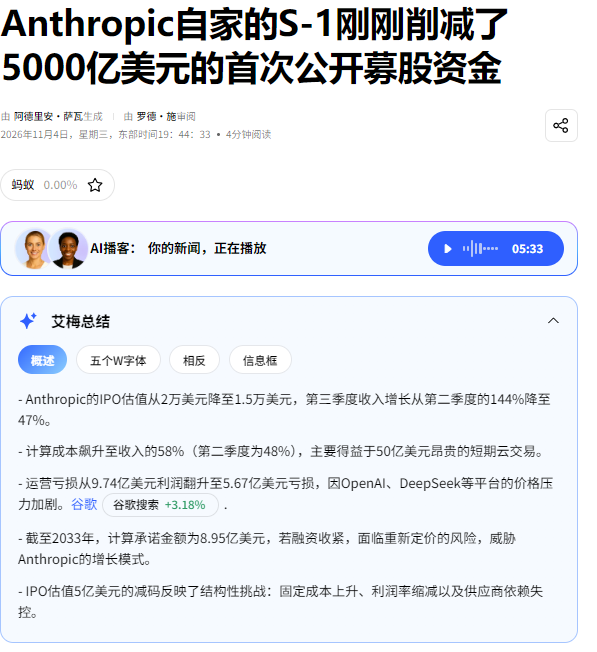
5. Expectations for Anthropic's IPO valuation fall from about US$2 trillion to about US$1.5 trillion [rumour / analyst estimate]
According to an AInvest analysis on 4 November, after Anthropic filed its S-1 on 26 October and an S-1/A with Q3 figures on 2 November, market expectations for its IPO valuation dropped from the roughly US$2 trillion previously discussed to about US$1.5 trillion — about US$500 billion lost before pricing. Reasons cited include revenue growth slowing from 144% in Q2 to 47% in Q3, compute costs rising to 58% of revenue, and operations swinging from a US$974 million profit in Q2 to a US$567 million loss in Q3. Rumours that Anthropic's IPO had been cancelled were debunked by 36Kr after checking SEC filings; the S-1/A is still being updated.
Sourcewww.ainvest.com/news/anthropic-1-shaved-500-billion-ipo-2611/
VII. Claw roundup
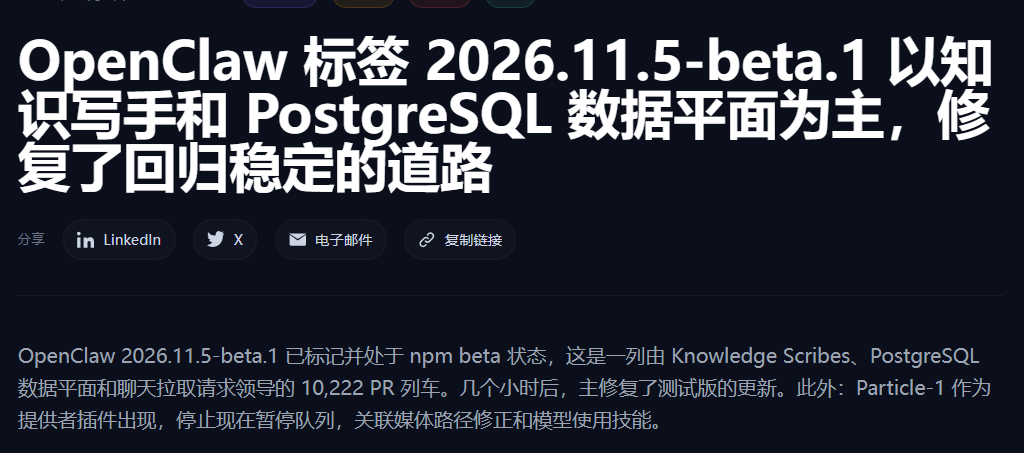
1. OpenClaw releases v2026.11.5-beta.1, led by Knowledge Scribes and a PostgreSQL data plane
At 5:52 pm Pacific time on 3 November, maintainer Dallin Romney signed and tagged v2026.11.5-beta.1, which reached the npm beta channel about two hours later. It is a large test train containing 10,222 pull requests, with eight highlights: ① Knowledge Scribes — first-class knowledge capture across agents, sessions and the Control UI, with reusable Scribe workflows; ② a PostgreSQL data plane — PostgreSQL-backed state storage, migration tools and compatibility for existing deployments; ③ a full Control UI redesign; ④ starting, reviewing and tracking pull requests directly in chat; ⑤ expanded cross-device and cloud execution; ⑥ decision and media model routing (including ClawRouter integration); ⑦ plugin experience improvements; ⑧ safer backups and upgrades. npm latest still points to 2026.10.10 and extended-stable to 2026.9.36; the maintainers recommend testing this beta only on a spare Gateway and keeping production on 2026.10.10.
Sourcesenx.ai/openclaw-news/2026-11-04-openclaw-news
2. The Particle-1 model joins OpenClaw as a provider plugin, claiming 45% fewer output tokens than DeepSeek V4.1 Flash
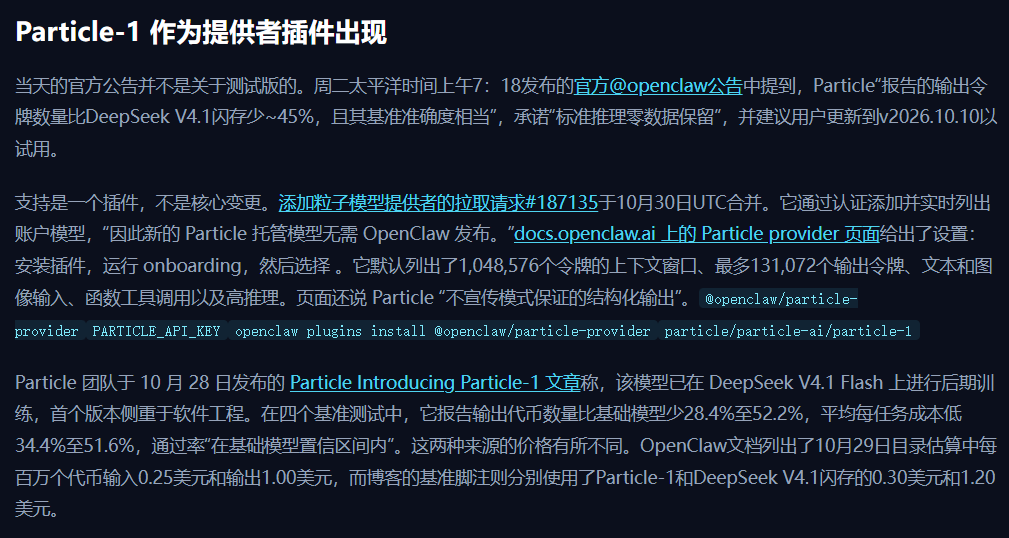
OpenClaw's official @openclaw account announced at 7:18 am Pacific time on 4 November that Particle-1 is now available as a standalone plugin, @openclaw/particle-provider (PR #187135, merged on 30 October), authenticated with PARTICLE_API_KEY; newly launched Particle-hosted models appear in the list automatically without a new OpenClaw release. Particle-1 is post-trained from DeepSeek V4.1 Flash and initially focuses on software engineering; across four benchmarks it reportedly uses 28.4%–52.2% fewer output tokens and costs 34.4%–51.6% less per task, with pass rates within the confidence interval of the base model. It supports a 1,048,576-token context, outputs of up to 131,072 tokens, text and image input and function calling, but does not guarantee schema-level structured output; list prices are about US$0.25 per million input tokens and US$1.00 per million output tokens.
Sourcesenx.ai/openclaw-news/2026-11-04-openclaw-news
VIII. Trending open source on GitHub (by today's momentum)
1. vercel-labs/agent-desktop (+2,470 stars today | Rust)
A computer use command-line tool for AI agents, helping them operate browsers and the operating system on the desktop.
Repositorygithub.com/vercel-labs/agent-desktop
2. NVIDIA/auto-ontology (+2,050 stars today | Python)
NVIDIA's open-source Auto Ontology framework builds a semantic, graph-based reasoning layer over data, with deterministic query generation and better context awareness for enterprise knowledge reasoning.
Repositorygithub.com/NVIDIA/auto-ontology
3. D4Vinci/Scrapling (+2,005 stars today | Python)
Billed as "the best web scraping framework", it handles everything from single requests to full crawls, including anti-bot countermeasures and dynamic content.
Repositorygithub.com/D4Vinci/Scrapling
4. JiaFeiMiao-K-Cat/DiscImageStudio (+1,778 stars today | C#)
A cross-platform tool for generating and burning disc-surface images: it converts any picture into data that respects the physical constraints of CD, DVD and single-layer Blu-ray, so the burned disc shows a visible image; it runs on Windows, Linux and macOS.
Repositorygithub.com/JiaFeiMiao-K-Cat/DiscImageStudio
5. mattpocock/skills (+1,379 stars today | Shell)
A collection of agent Skills from TypeScript expert Matt Pocock — "Skills for real engineers", taken straight from his .agents directory, for Claude Code and other agent workflows.
Repositorygithub.com/mattpocock/skills