1. WorkBuddy apologises for ending a discount without notice and refunds the DeepSeek-V4.1 Flash credit difference;
2. OpenAI's Codex lead asks whether a US$50 Pro tier would make sense;
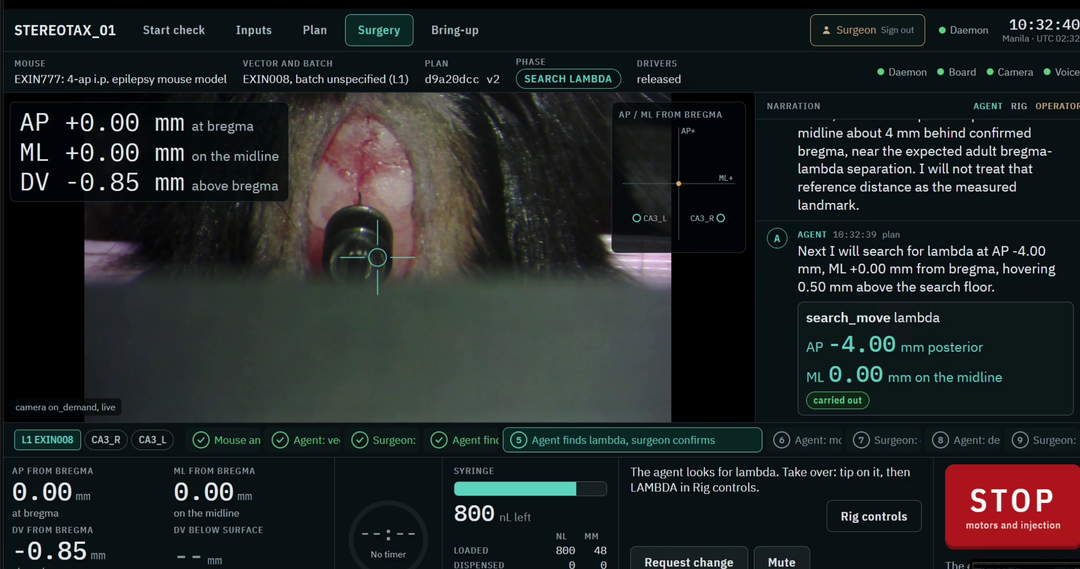
3. An Exin Therapeutics experiment shows GPT-6.1 Sol improving landmark accuracy in mouse brain surgery through in-context learning;
4. Anthropic reportedly spends US$3.4 billion on gas generator orders to power its compute;
5. Musk says he will look into unusually fast Grok Bot quota use;
6. Nvidia's board opens an independent investigation following reports about Jensen Huang.
I. Model releases and open source
No new production model releases or major open-weight releases in this issue's 24-hour window.
II. Developer ecosystem and tooling
1. The DeepSeek Harness team explains its "everything is a plugin" philosophy
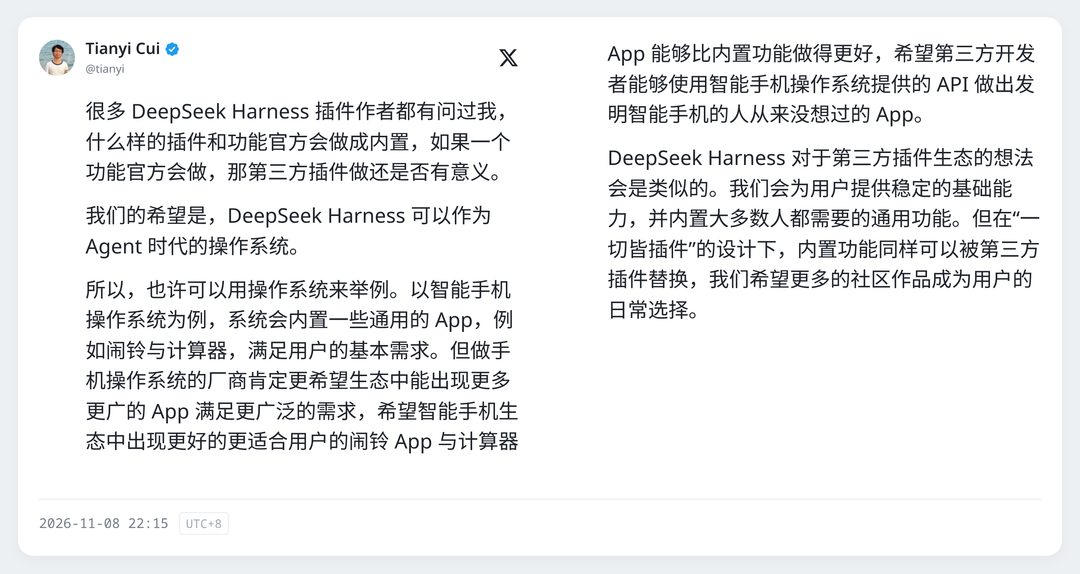
Cui Tianyi (@tianyi) of the DeepSeek Harness team responded to plugin authors asking whether the official team would build their features in: the team wants Harness to be the operating system of the agent era, providing stable foundations and built-in features most people need, but under its "everything is a plugin" design, built-in features can also be replaced by third-party plugins — just as a phone ships with an alarm clock and calculator, yet better third-party apps can take their place. The official repository, deepseek-ai/deepseek-harness, is MIT-licensed and has more than 270,000 stars on GitHub.
Postx.com/tianyi/status/2119433744671273441
2. OpenAI asks whether to add a Pro 50 tier
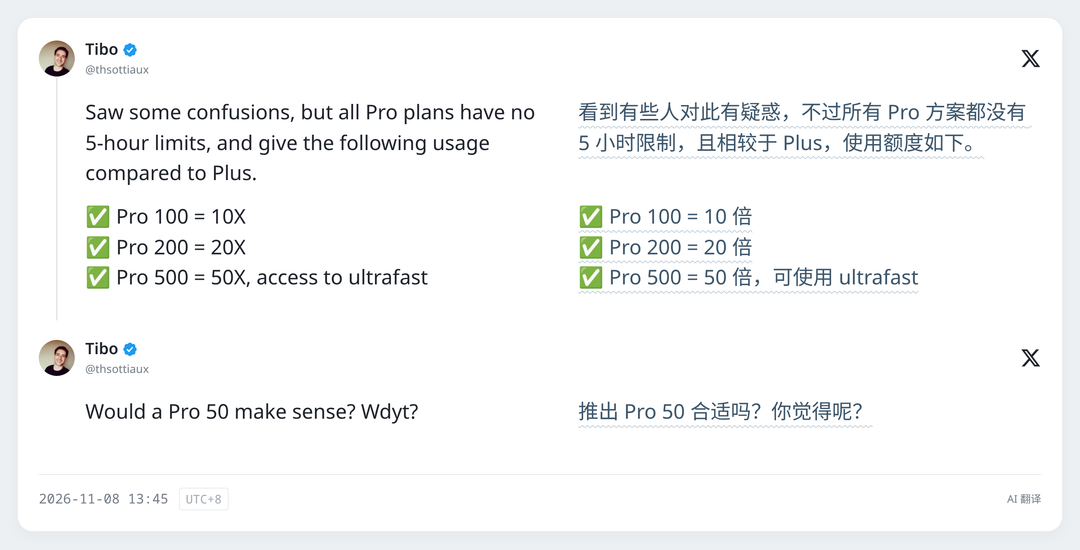
OpenAI Codex lead Tibo (@thsottiaux) asked on social media, "Would a Pro 50 make sense?", gathering opinions on a US$50 Pro tier. It is only a public poll; OpenAI has not confirmed such a plan.
Postx.com/thsottiaux/status/2119305294291612140
III. Products shipping
1. WorkBuddy apologises and automatically refunds the DeepSeek-V4.1 Flash credit difference
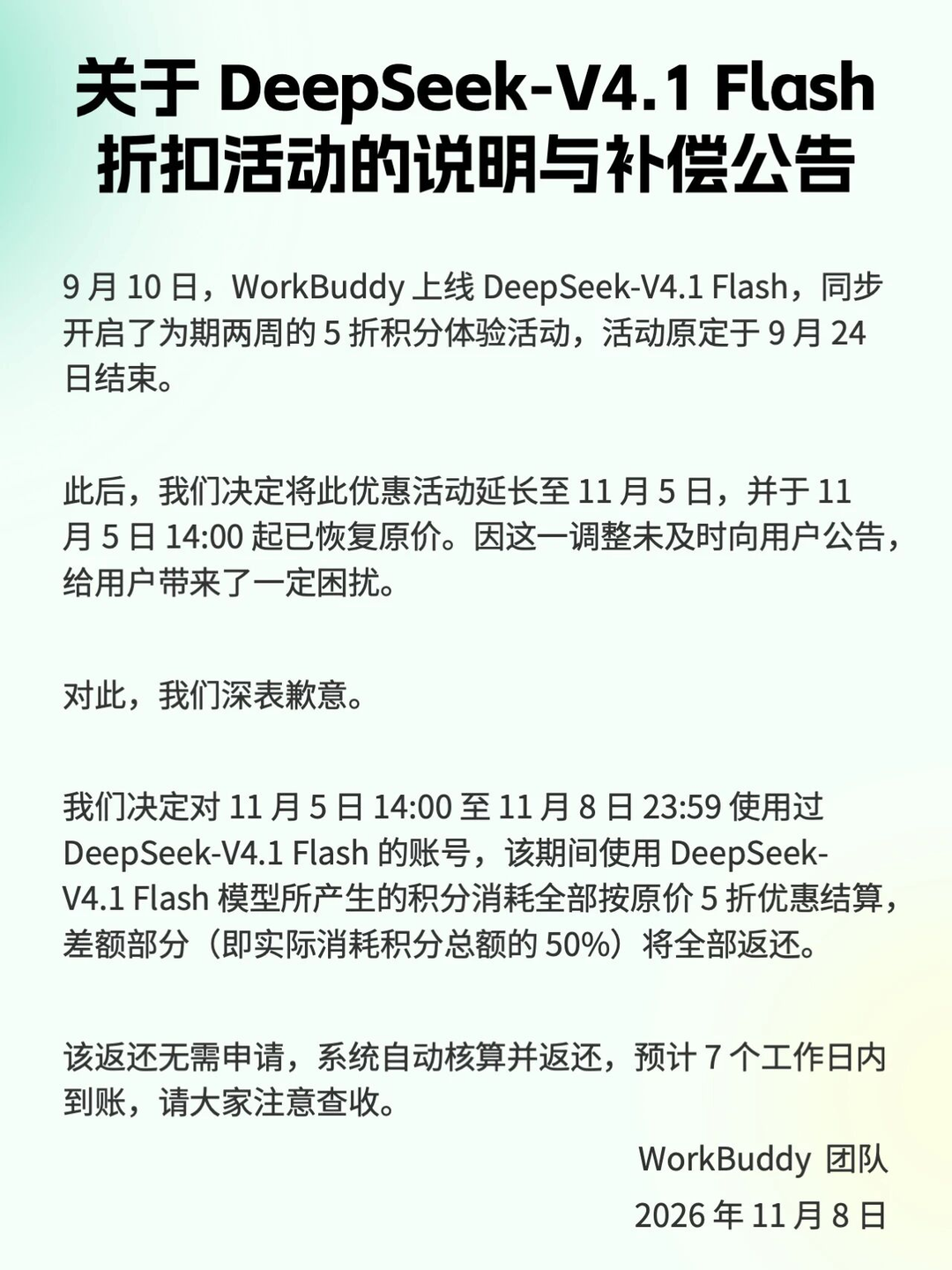
WorkBuddy has published a compensation notice: the 50% discount on DeepSeek-V4.1 Flash was originally due to end on 24 September and was extended, then full pricing returned at 14:00 on 5 November without timely notice to users. Compensation: all credits used on the model between 14:00 on 5 November and 23:59 on 8 November are billed at half price, with the 50% difference refunded automatically within an expected seven working days, no application needed.
Announcementmp.weixin.qq.com/s/SoYZS-V1A1ysYNxfBXlO9Q
2. Grok Bot quota use spikes; Musk promises to look into it
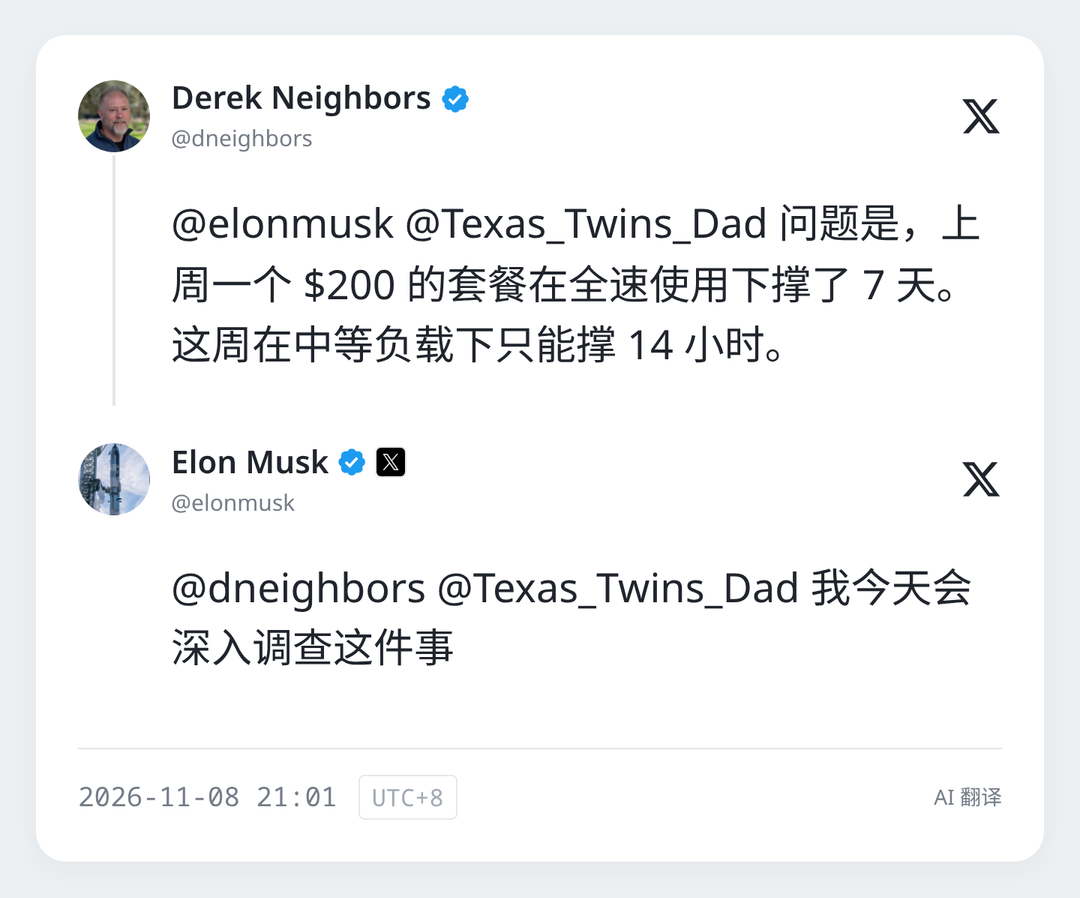
Many X users report that Grok Bot subscription allowances are being used up unusually fast, with some exhausting their weekly quota quickly under moderate use. Replying to users, Musk said "I will dig into this today". Plan prices and quota rules have not changed.
Postx.com/elonmusk/status/2119415029812609301
IV. Technical insight and frontier research
1. GPT-6.1 Sol improves surgical landmark accuracy on live animals through in-context iteration
Biotech company Exin Therapeutics ran an animal experiment in which GPT-6.1 Sol located anatomical landmarks in three successive brain surgeries on live epileptic mice. After each surgery an expert surgeon corrected the landmark positions, and the agent saved images and measurements of both its estimates and the corrections, referring to them in the next surgery — no retraining, only in-context learning. Results: position error fell from 0.6 mm to 0.3 mm, search time from 169 to 86 seconds, and corrective moves from 4 to 2. The project lead notes the sample is only three surgeries (N=3), so these are early results that cannot be applied directly to clinical settings.
Project lead's postx.com/OcanaSantero/status/2118282298789650505
Backgroundwww.wired.com/story/an-ai-agent-did-brain-surgery-on-live-mouse/
V. Industry moves
1. Nvidia CEO Jensen Huang apologises publicly; the board opens an independent investigation
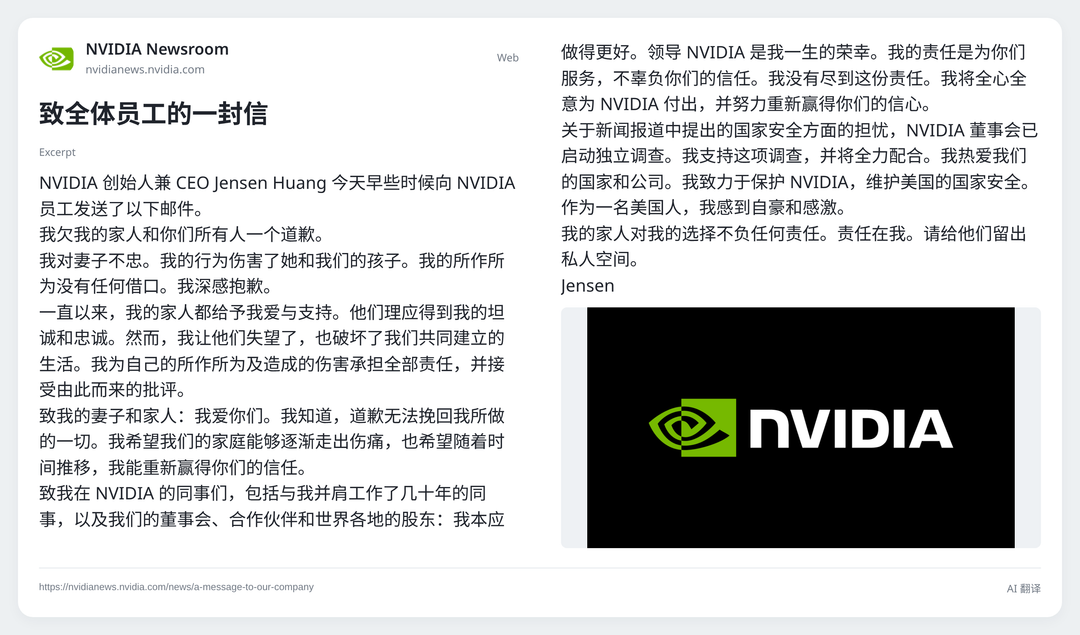
On 8 November Nvidia published an email Jensen Huang sent to all employees in which he admits being unfaithful to his wife, apologises to his family, colleagues, board, partners and shareholders, and takes full responsibility. The same day Nvidia's board issued a statement: in light of reporting that Huang has been the target of a foreign intelligence effort, it has opened an independent investigation overseen by a committee of independent directors with outside independent counsel. The board said it has no reason to believe national security or Nvidia's secrets were compromised and has confidence in Huang and his leadership team.
Huang's emailnvidianews.nvidia.com/news/a-message-to-our-company
Board statementnvidianews.nvidia.com/news/statement-from-nvidia-board-of-directors
VI. Outlook and market rumours
1. Report: Anthropic spends US$3.4 billion on gas generator orders
According to the Financial Times, in late September Anthropic paid US$3.4 billion to take over OnePWR Solutions' orders for 1.7 GW of heavy gas generators to power its compute campuses. The orders were signed before prices rose; some equipment is being delivered soon and the rest over the next two years.
Reportwww.ft.com/content/41bf5c6a-9735-4f1a-a8e3-2bcccad58ba0
2. A DeepMind executive previews major scientific results in the coming weeks
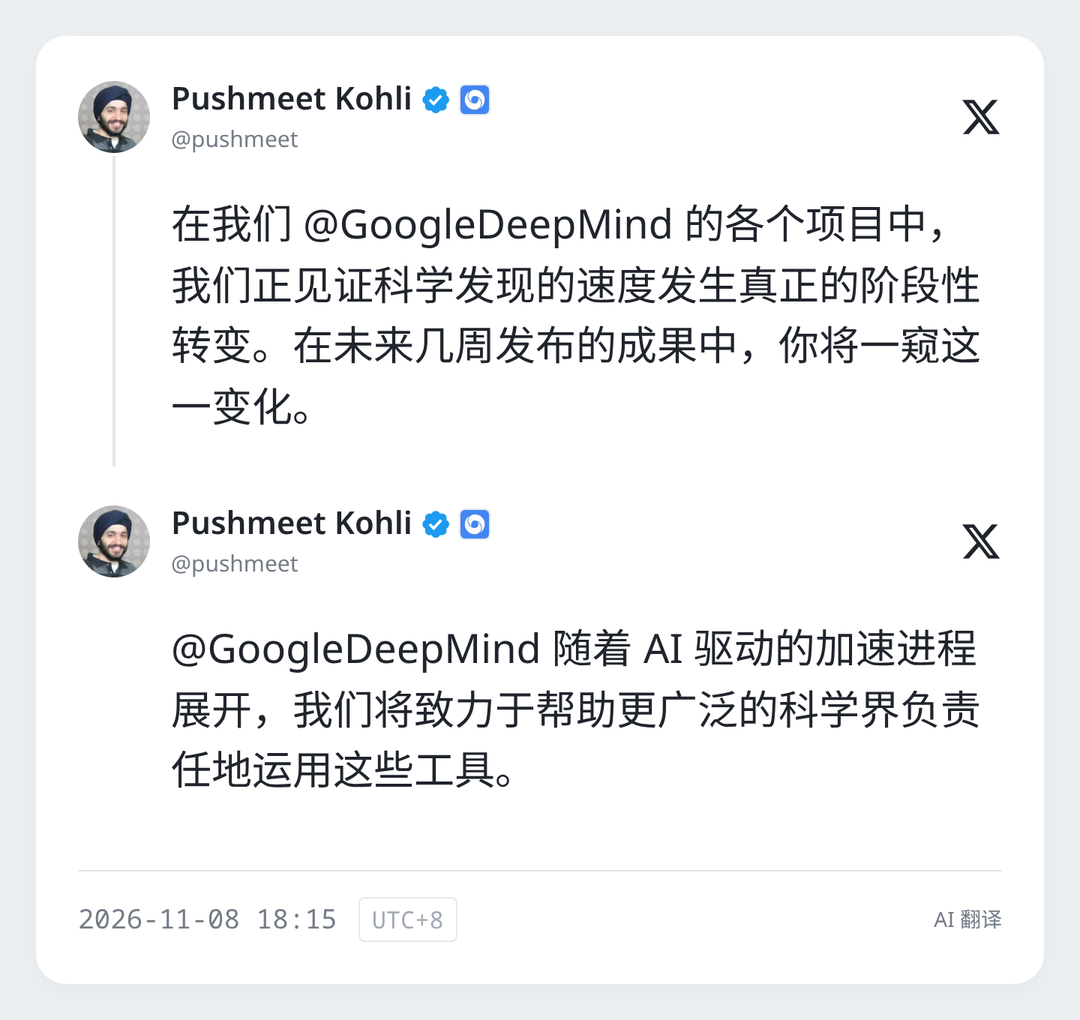
Google DeepMind vice president Pushmeet Kohli wrote that across DeepMind's projects the pace of scientific discovery is undergoing "a genuine phase transition", and that some of this will be visible in releases over the next few weeks. No specific projects were disclosed.
Postx.com/pushmeet/status/2119373171321196892
VII. Claw roundup
1. Operational risk: users must be told when discounts change
The WorkBuddy episode shows an operational risk for AI SaaS products: if billing changes such as extending a discount or returning to full price aren't clearly announced, users complain and the company has to compensate afterwards. As agent services increasingly bill by credits and token allowances, changes in billing status and the start and end of discounts must be transparent and announced proactively.
2. In-context learning shows promise for physical tasks, but sample limits matter
In the GPT-6.1 Sol mouse brain landmark experiment, the agent improved its physical performance using only records from earlier surgeries, without retraining. But with only three surgeries, it is a long way from real medical use. In-context iterative learning will be an important research direction for robots and agents, but animal results cannot be equated with abilities safe for humans.
3. Compute power diversifies as AI leaders take direct control of generation hardware
Anthropic is reported to have bought large gas generator orders. Compute campuses no longer rely only on the public grid; leading AI companies are locking in generation assets to cope with grid capacity limits and price volatility, which also raises new questions about emissions and energy policy.
VIII. Trending open source on GitHub
1. deepseek-ai/deepseek-harness
Momentum: a leading agent application ecosystem project (270,000+ stars). Summary: the official DeepSeek Harness repository, with the slogan "Everything is a Plugin", MIT-licensed and open to plugin development.
Repositorygithub.com/deepseek-ai/deepseek-harness
2. vllm-project/vllm
Momentum: the benchmark for high-throughput inference engines. Summary: a high-performance LLM inference engine widely used in production to deploy MoE and multimodal models.
Repositorygithub.com/vllm-project/vllm
3. open-webui/open-webui
Momentum: the benchmark web front end for self-hosted deployments. Summary: a full-featured self-hosted AI web interface with RAG, plugins and multi-user permission management.
Repositorygithub.com/open-webui/open-webui
4. unslothai/unsloth
Momentum: model fine-tuning on consumer hardware. Summary: a tool for running and training large language and diffusion models locally, supporting GGUF, MLX and other formats, under the Apache-2.0 licence.
Repositorygithub.com/unslothai/unsloth