1. Anthropic open-sources FlashProve, a prototype for cryptographically verifiable inference;
2. Apple opens Siri AI integration to all developers from the iOS 27.3 beta;
3. Inference provider Fal raises US$1.3 billion at a US$16 billion valuation;
4. The World Internet Conference in Wuzhen focuses on the open-source AI ecosystem;
5. Morgan Stanley's CEO says global AI capital spending could reach US$10–15 trillion over the next decade;
6. Google Threat Intelligence warns about LLM-Jacking attacks that hijack model quotas.
I. Model releases and open source
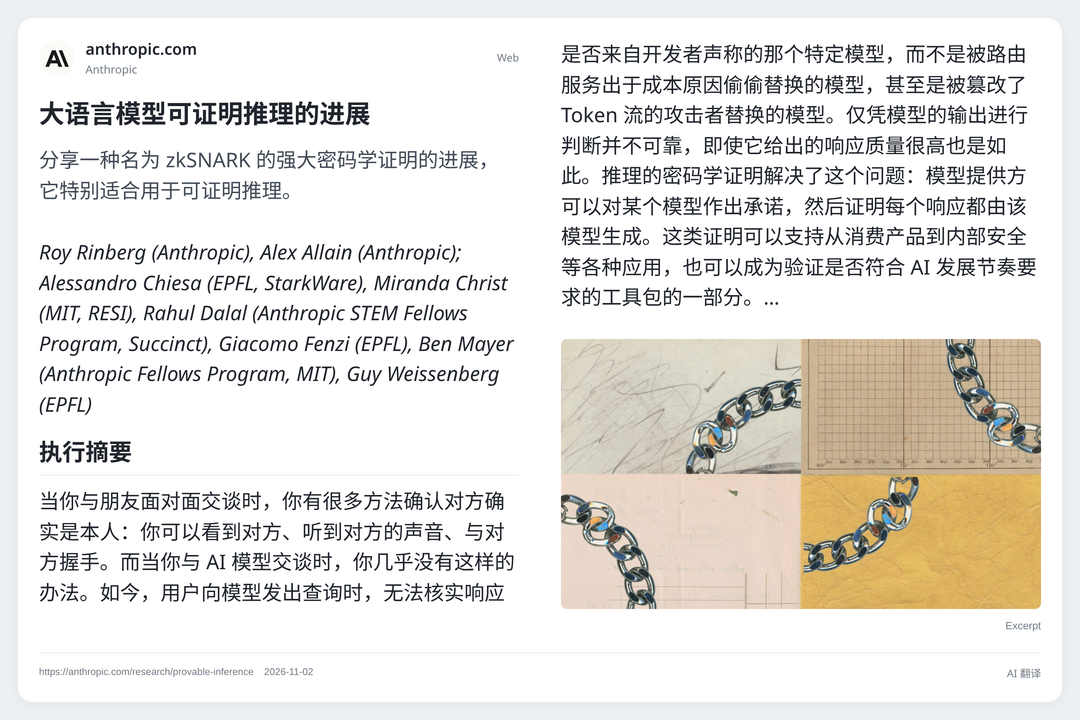
1. Anthropic open-sources FlashProve, a prototype for cryptographically verifiable inference
Anthropic has open-sourced FlashProve, a prototype for cryptographically verifiable inference: with a cryptographic proof and a commitment to the model weights, anyone can verify that a reply really came from a given model version without access to the weights. The prototype runs full-size Llama 4 Maverick with a 1,024-token context on a single NVIDIA H100; a proof averages about 18.78MB and can be checked on an ordinary CPU in seconds. In the official measurements, generating proofs is roughly 71–93 times slower than standard vLLM prefill; the repository is marked as an unmaintained research prototype, not for production use.
Repositorygithub.com/anthropics/FlashProve
2. DeepSeek open-sources dsh-superagent, a Super-agent research prototype
DeepSeek has open-sourced dsh-superagent, a research prototype accompanying its article "Exploring Super-agent Design: Towards a More Autonomous Agent System". It is a proactive coding agent built on DeepSeek Harness: it listens to GitHub (and optionally Feishu), and when an authorised team member asks for work it opens a separate session and directory for each task and replies in the original conversation, for example with a pull request; a web panel shows what needs a person. DeepSeek says it is a reference-only research prototype, not an official product, and some designs in the article are not yet implemented; the licence is MIT.
Repositorygithub.com/deepseek-ai/dsh-superagent-prototype
II. Developer ecosystem and tooling
1. Apple opens Siri AI integration to all developers (from the iOS 27.3 beta)
Apple announced on 3 November that, starting with the iOS 27.3, iPadOS 27.3, macOS 27.3 and visionOS 27.3 betas, a new developer preview lets any developer connect their app to Siri AI through App Intents, so users can trigger custom actions in natural language, with new Skills for multi-step requests. Siri AI currently supports English, French, Japanese, Korean, Portuguese, Spanish and other languages, and will soon add Traditional Chinese, Norwegian, Turkish and Vietnamese.
Announcementdeveloper.apple.com/news/
Documentationdeveloper.apple.com/documentation/appintents
2. AWS publishes an OBO delegated-authentication approach for Bedrock AgentCore
AWS has published a Machine Learning Blog post on implementing ServiceNow On-Behalf-Of (OBO) token exchange with Amazon Bedrock AgentCore Gateway: the user's identity passes through AgentCore Gateway to downstream business systems, so an AI agent accesses enterprise SaaS with the user's own identity and permissions instead of a shared high-privilege account, preserving least privilege and per-person auditing.
Sample codegithub.com/aws-samples/sample-bedrock-agentcore-identity-obo-token-exchange
III. Products shipping
1. Anthropic adds invisible text watermarks to Claude output under the EU AI Act's transparency rules
Anthropic has signed the EU AI Act's Article 50(2) Code of Practice on transparency of AI-generated content and explained in its help centre how it is implementing it: text generated by supported Claude models carries an imperceptible watermark, and generated files carry C2PA Content Credentials. New models launched in the EU on or after 2 August 2026 support marking from day one, and earlier models are being added (Opus 4.7 and Sonnet 4.6, for example, are already on the supported list). The watermark travels with copied text and may survive some editing. Watermark detection is in private preview, with access available on application to regulators, media, fact-checkers and companies that need to verify compliance.
Help centresupport.claude.com/en/articles/16266773-how-claude-marks-ai-generated-content
2. Baidu upgrades Wenxin Search and its Search AI API
Baidu has upgraded Wenxin Search and its Search AI API to cover more scenarios; in the app it upgraded four features — the ERNIE assistant, AI Lens, GUI interaction and interactive AI apps — with the ERNIE assistant moving from one-off answers to a task mode that keeps iterating. See Baidu AI Cloud for prices.
Product pageai.baidu.com/tech/searchai
IV. Technical insight and frontier research
1. Analysing the risk of LLM-Jacking quota hijacking
Google's Threat Intelligence team has published a report on the LLM-Jacking attack chain: attackers steal companies' API keys through vulnerabilities, phishing or leaked code, consume large token quotas and resell the inference capacity through grey-market channels. Telltale signs include bursts of short batch jobs, IP addresses in unusual regions and heavy use outside business hours. The risk is that alert thresholds for leaked keys are often loose and many small companies lack usage anomaly detection. Recommendations: set rate limits, add token usage alerts per workload, rotate keys regularly and disable access to models you don't need.
Google Threat Intelligence report: https://cloud.google.com/blog/topics/threat-intelligence/llmjacking-monetizing-compromised-cloud-models/
Overvieweguweb.jp/ai/81691
2. Weighing up FlashProve's verifiable inference
Generating FlashProve proofs is dozens of times slower than ordinary inference, so for now it only suits small-batch, high-trust use cases, not large-scale production. A cryptographic proof can confirm that output came from the intended model version, but it does nothing against prompt injection, jailbreaks or alignment flaws; it solves provenance, not a model's inherent safety risks.
3. What dsh-superagent suggests: agents move from one conversation to staying on the job
dsh-superagent keeps an agent resident in a team's GitHub (and Feishu), taking on work according to rules the team writes, running each task in its own session and speaking only when a person must decide or a result is ready. Its guiding principle is to take as little human attention as possible and deliver as much value as possible — a sign of agents moving from single conversations to staying on the job.
V. Industry moves
1. AI inference provider Fal raises US$1.3 billion at a US$16 billion valuation
US cloud inference platform Fal has announced a US$1.3 billion Series F at a post-money valuation of US$16 billion, double the US$8 billion valuation of its Series E in April; the round was led by Bessemer Venture Partners, with Nvidia investing again. Founded in 2021 and based in San Francisco, Fal provides hosting and inference for image, video and audio models for creators and developers.
Reportnews.qq.com/rain/a/20261104A0DDT600
2. Morgan Stanley CEO: global AI capital spending could reach US$10–15 trillion over the next decade
Morgan Stanley CEO Ted Pick said that over the next 7–12 years the largest cloud providers could spend US$800 billion to US$1 trillion a year on AI, putting total AI capital spending over the next decade at US$10–15 trillion, and that AI investment is still at an early stage.
Reportm.163.com/dy/article/LASMQND405199NPP.html
3. World Internet Conference Wuzhen Summit 2026 focuses on building the open-source AI ecosystem
The World Internet Conference Wuzhen Summit held an AI dialogue with a round table including representatives of DeepSeek, Qwen and MiniMax. The shared view: open source is a mechanism for faster iteration, not a marketing pose, and building the open-source ecosystem has to balance safety governance, intellectual property and real-world adoption to make AI widely accessible.
Reportm.weibo.cn/detail/5361460591988065
4. AMD results: data centre revenue up 97% year on year
AMD reported its third quarter of 2026 on 3 November: record quarterly revenue of US$13.4 billion, with data centre revenue of US$8.5 billion, up 97% year on year, driven by demand for EPYC processors and the launch of Instinct MI450 Series GPUs.
Resultsir.amd.com/news-events/press-releases/detail/1303/amd-reports-third-quarter-2026-financial-results
VI. Outlook and market rumours
1. OpenAI's latest funding round reportedly falls short of expectations
Media reports say OpenAI's new funding round is falling short of expectations. According to The Wall Street Journal, the round initially targeted US$30 billion but has so far drawn only about US$11 billion in commitments, at a valuation of about US$1.25 trillion, below the US$1.4 trillion it had hoped for (see the 5 November issue). These are media reports and OpenAI has not confirmed them.
Sourcem.toutiao.com/group/7704298003397378623/
VII. Claw roundup
1. Cryptographically verifiable inference reaches the prototype stage — provenance is not safety
Open-sourcing FlashProve marks verifiable inference moving out of the lab. Cryptographic proofs answer whether output came from a particular model, but they cannot fix alignment flaws or jailbreak vulnerabilities inside the model. Companies shouldn't treat them as a security silver bullet; they need to be combined with input filtering, output checks and access control.
2. Agents move from acting when called to staying on the job — permissions and identity become key
DeepSeek's dsh-superagent prototype keeps an agent resident in a team's tools taking on work proactively, while AWS's OBO approach lets agents reach business systems with the user's own identity and permissions. The more autonomously agents act, the clearer it must be whom they represent and what they may do: least privilege, per-person auditing and human approval for critical actions will become baseline requirements for deploying agents in business.
VIII. Trending open source on GitHub
1. anthropics/FlashProve
Momentum: newly trending in verifiable inference (about 900 stars). Summary: Anthropic's open-source research prototype for zero-knowledge proofs of AI inference, proving a reply came from a committed model without revealing its weights; proving is expensive and the repository is marked unmaintained, not for production use.
Repositorygithub.com/anthropics/FlashProve
2. deepseek-ai/dsh-superagent-prototype
Momentum: DeepSeek's newly open-sourced agent research prototype. Summary: a proactive coding agent built on DeepSeek Harness that stays in GitHub, takes on work by rule and opens pull requests; described as a research prototype, under the MIT licence.
Repositorygithub.com/deepseek-ai/dsh-superagent-prototype
3. aws-samples/sample-bedrock-agentcore-identity-obo-token-exchange
Momentum: sample code for agent delegated authentication. Summary: an official AWS sample implementing OBO token exchange for Bedrock AgentCore agents, passing the user's identity along the agent call chain without sharing credentials.
Repositorygithub.com/aws-samples/sample-bedrock-agentcore-identity-obo-token-exchange
4. vllm-project/vllm
Momentum: the benchmark for high-throughput inference engines. Summary: a high-performance LLM inference engine widely used in production to deploy MoE and multimodal models.
Repositorygithub.com/vllm-project/vllm
5. open-webui/open-webui
Momentum: the leading web front end for self-hosted deployments. Summary: a full-featured self-hosted AI web interface with RAG, plugins and multi-user permission management.
Repositorygithub.com/open-webui/open-webui