1. Alibaba releases Qwen4-Max, a 2.4-trillion-parameter MoE with a million-token context, saying average task cost is down 58%;
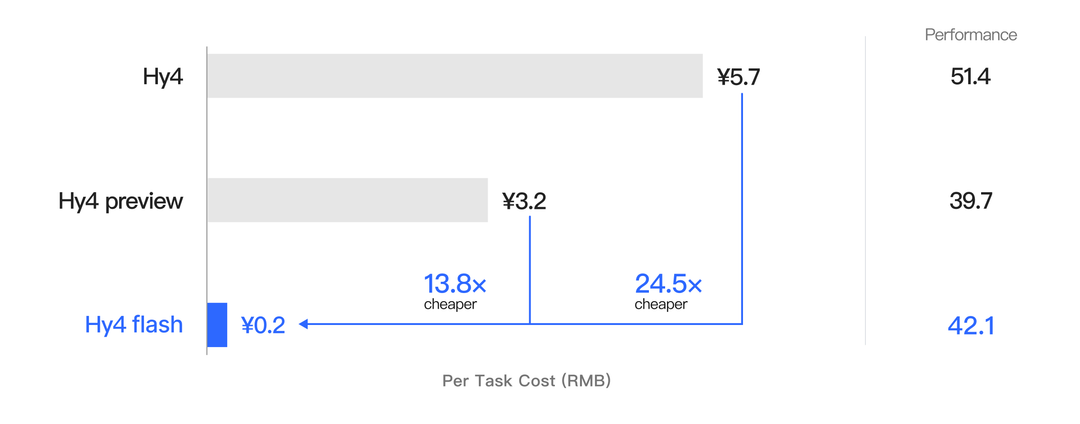
2. Tencent Hunyuan releases Hy4 flash at 0.5 yuan input and 2 yuan output per million tokens;
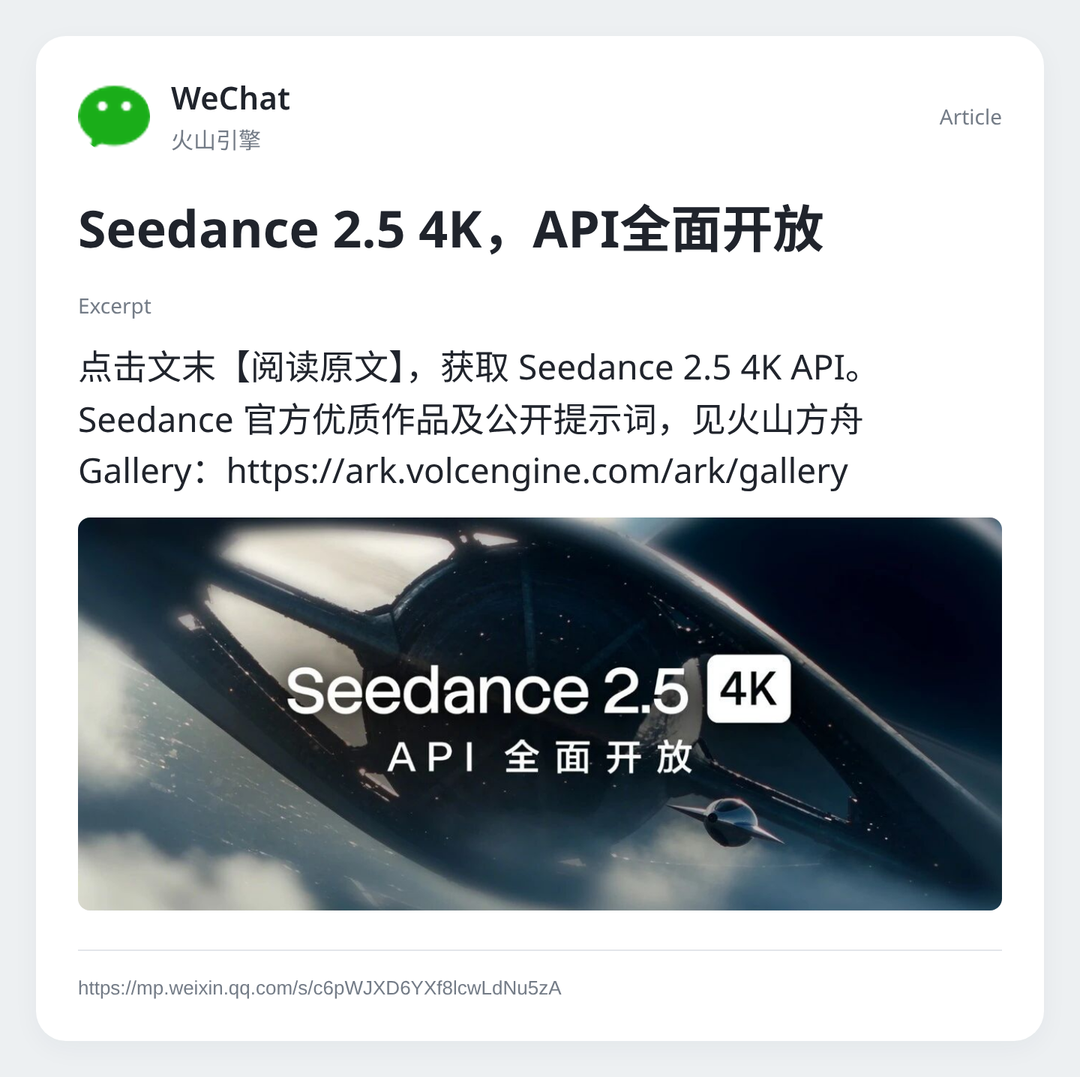
3. Volcano Engine fully opens the Seedance 2.5 4K video API;
4. Shanghai AI Laboratory open-sources the scientific multimodal model Intern S2.1 Flash;
5. OpenAI starts embedded safety assessments with four outside organisations and is sued by California's attorney general the same day;
6. AMD completes its acquisition of World Labs, with Fei-Fei Li joining as executive vice president and chief scientist;
7. The IMF chief warns AI circular financing has passed US$1 trillion.
I. Model releases and open source
1. Alibaba releases Qwen4-Max
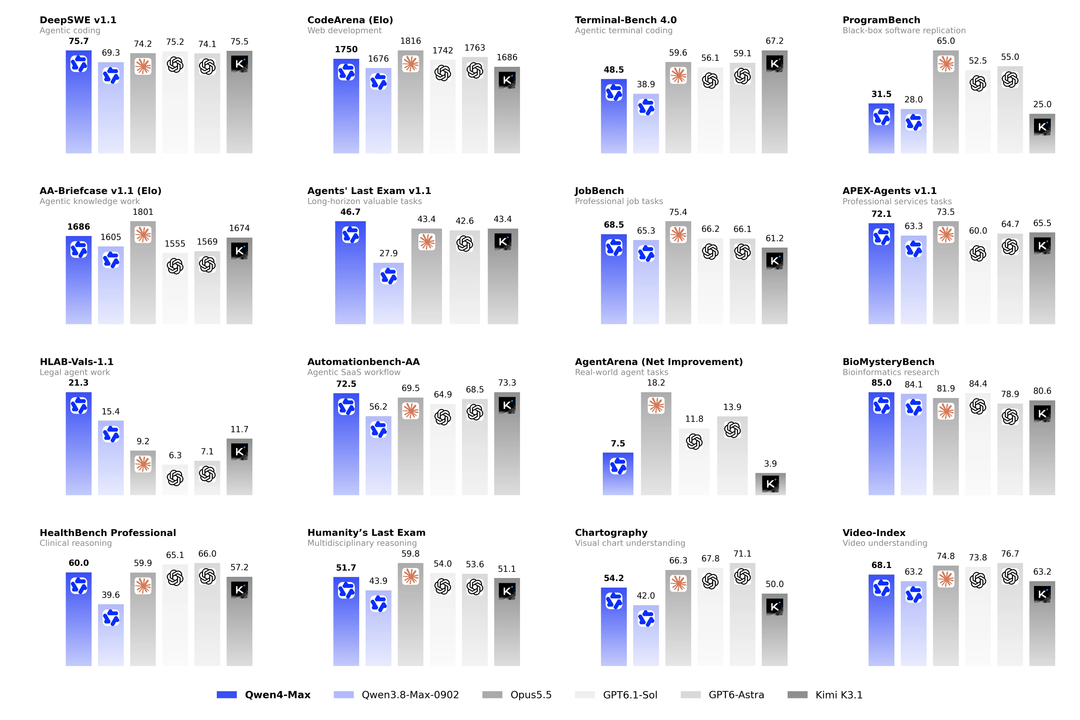
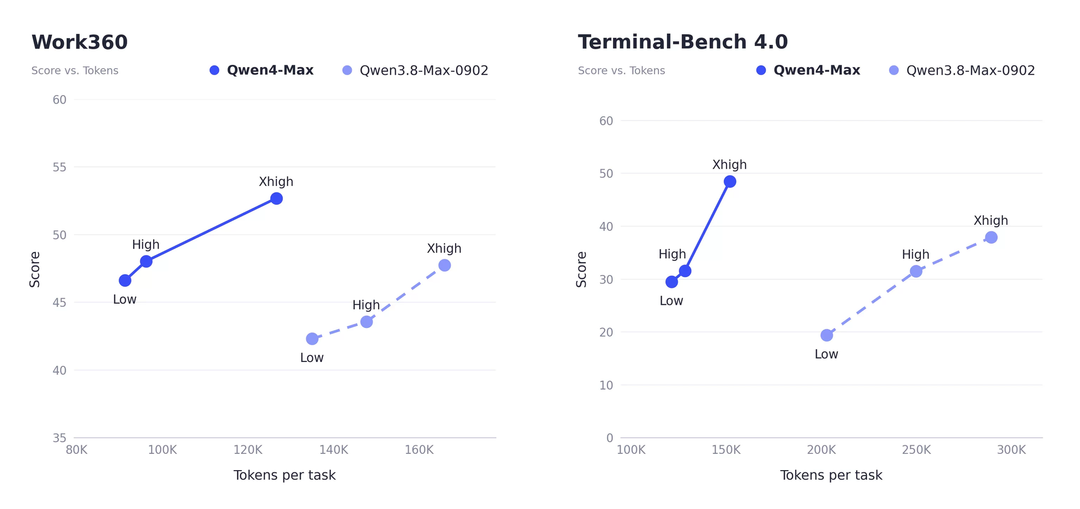
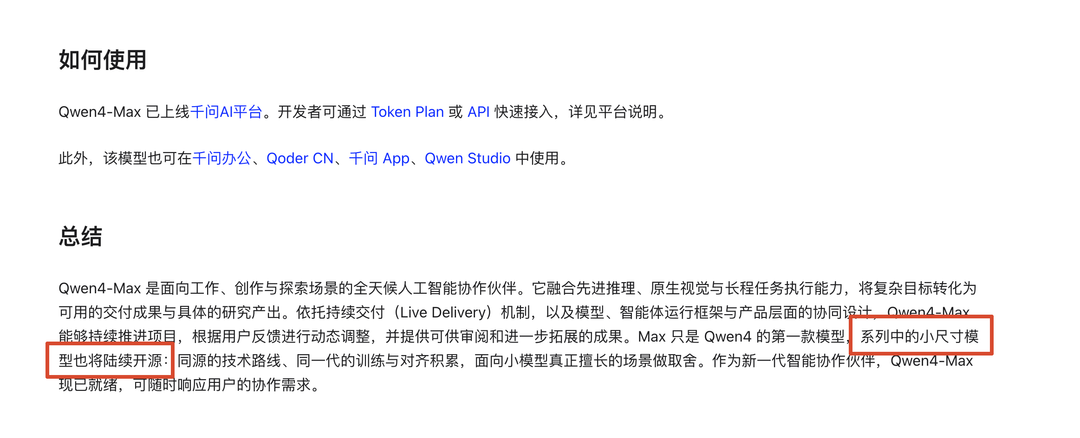
Alibaba has released Qwen4-Max, its new flagship base model, an MoE with 2.4 trillion total and 71 billion active parameters, native vision input and a 1-million-token context. According to several media reports, Alibaba says average task cost is 58% lower than the previous generation, API input costs US$1.50 per million tokens, and the model adds stricter cybersecurity safeguards. A Qwen4-Max preview had already been available on Token Plan, Qoder and other platforms.
2. Tencent Hunyuan launches Hy4 flash
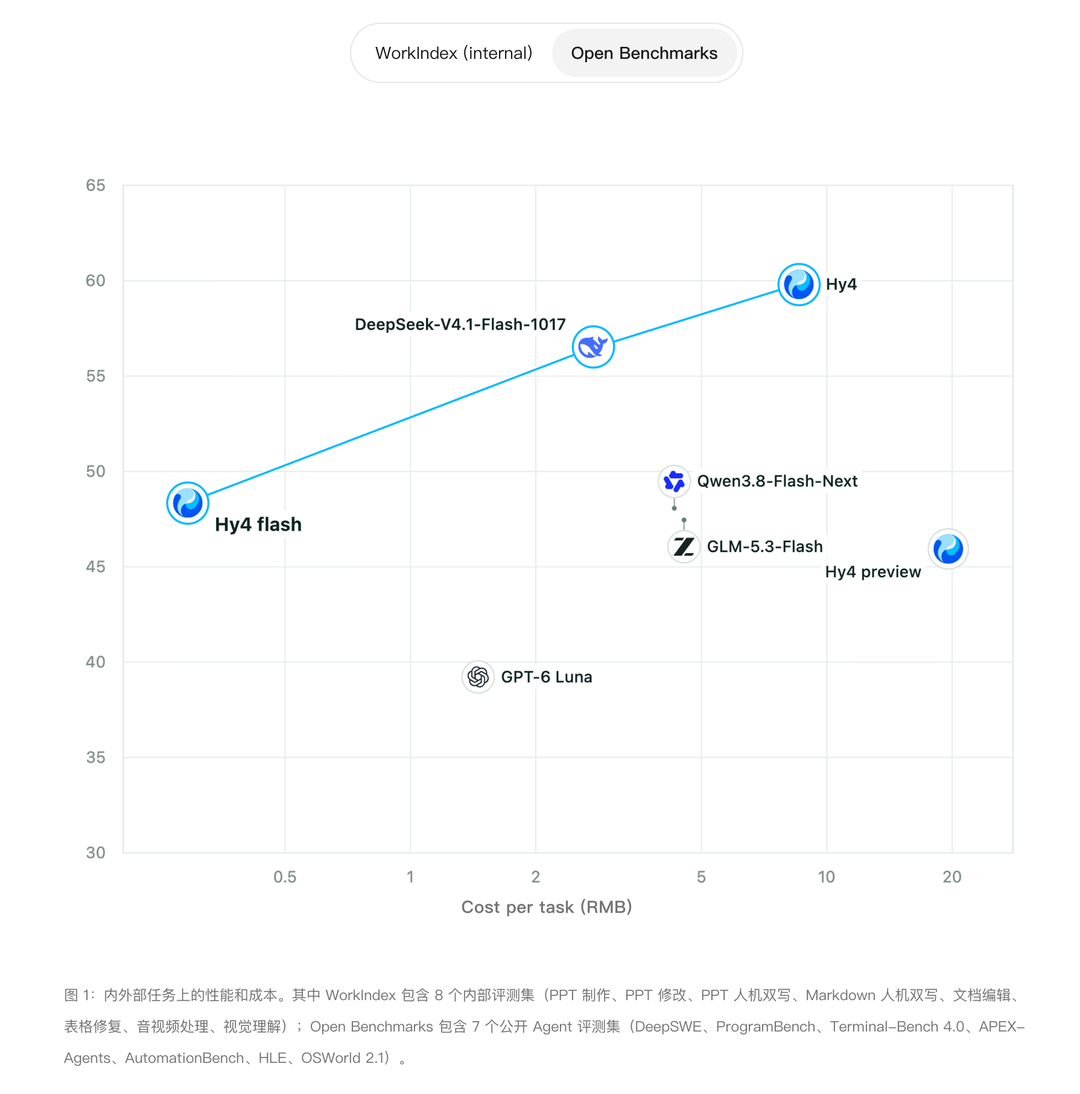
Tencent Hunyuan has released Hy4 flash, a price-performance model with API pricing of 0.5 yuan per million input tokens and 2 yuan per million output tokens. According to 21st Century Business Herald, its cost per task is about a twentieth of Hy4's, and Tencent PR director Zhang Jun called it "the best-value Hunyuan model yet".
3. ByteDance's Seedance 2.5 4K API is fully open
Volcano Engine has fully opened the API for the Seedance 2.5 4K video model (released on 23 October), so developers and enterprise customers can call it through Volcano Ark. Its Draft mode lets you check storyboards quickly at 480P before generating the final 4K video, cutting the cost of trial and error, and output supports 10-bit colour depth.
Noticemp.weixin.qq.com/s/c6pWJXD6YXf8lcwLdNu5zA
Galleryark.volcengine.com/ark/gallery
4. Shanghai AI Laboratory open-sources Intern S2.1 Flash
Shanghai AI Laboratory has released and open-sourced Intern S2.1 Flash, a multimodal agent model for scientific research built on a 320-billion-parameter MoE architecture. It understands more than ten types of scientific data, including molecular graphs, crystal structures, protein, DNA and RNA sequences, spectra, mass spectra, ECG and EEG, and can operate research software such as Blender, 3D Slicer and Fiji. Across 15 benchmarks against five other models, it ranks first on four and second on seven, with the top scores of 90.3 on MLE-bench Lite and 39.2 on PostTrainBench. Weights are on Hugging Face and ModelScope, with an FP8 version, and the model can also be tried through an API.
Projectinternlm.github.io/Sage-S2.1-Flash/
Weightshuggingface.co/internlm/Sage-S2.1-Flash
II. Developer ecosystem and tooling
1. OpenAI starts embedded external safety assessments
OpenAI has signed agreements with four independent organisations, Apollo Research, METR, Transluce and Goodfire, for a first phase of embedded assessments. Assessors get deep access to OpenAI's internal models and systems, including model checkpoints, source code, training and evaluation data, monitoring systems and discussions with the researchers responsible, to assess model alignment and how well safeguards work. For example, Apollo Research will assess whether models could covertly work against their developers' intentions and whether safeguards would catch it, and METR will look for misaligned behaviour in OpenAI's largest reinforcement learning run to date. Where direct access could expose its most sensitive IP, such as model weights or architecture, OpenAI will consider alternatives such as pairing assessors with its own researchers.
Blogopenai.com/index/our-first-phase-of-embedded-assessments
Postx.com/OpenAI/status/2122359930628063248
2. Claude Code on desktop supports the iPhone Duo simulator
Claude Code on desktop now supports iPhone Duo in its iOS simulator (public beta): you can run your app next to the conversation, and Claude can fold and unfold the device to test each layout. Xcode 26.x or 27 is recommended; it only controls simulators in Xcode, not physical devices, and works in local sessions only.
Docscode.claude.com/docs/en/desktop-ios-simulator
Postx.com/ClaudeDevs/status/2122439098740674839
3. Perplexity launches the Monitor API
Perplexity has launched the Monitor API, which tracks new developments on a topic, or text changes on up to 10 specified pages such as pricing pages or changelogs, on a schedule, and sends relevant updates to your application through signed webhooks. Results pass through Perplexity Decider, which checks relevance, source legitimacy, new information and freshness. Schedules can run every 15 minutes, hourly, daily, weekly or on a custom cron, and pricing is US$1 per 1,000 runs or URLs fetched.
Postx.com/perplexitydevs/status/2122408441042149853
Productpplx.ai/monitor-api
III. Products shipping
1. DeepSeek limits free users amid tight compute
According to several media reports, DeepSeek has tightened limits for free users: conversations unused for 7 days are cleared automatically, the limit on text per input has changed, and many users report restricted conversations. Media widely attribute this to tight compute supply; DeepSeek has not published full rules.
2. ChatGPT for Healthcare gets an upgrade
OpenAI has upgraded ChatGPT for Healthcare with computer-use agents that work across healthcare software, improved clinical search that finds, evaluates and cites medical evidence, and more than 20 new healthcare plugins. In over 1,300 physician reviews, the updated experience scored higher on all eight dimensions evaluated, including factual correctness, safety, actionability and source authoritativeness. Organisations including Abridge, Ambience, Cigna Healthcare and CVS Health are deploying agents to process referrals and move documents between systems.
Blogopenai.com/index/more-ways-to-move-care-forward-with-chatgpt-for-healthcare/
Researchopenai.com/index/advancing-computer-use-for-healthcare-teams/
Toolkitgithub.com/cvs-health/cua-agent-kit
3. Gemini Notebook turns sources into shareable websites
In Gemini Notebook, type "make me a site" in the chat with a description of what you want, and your sources become an interactive website such as a dashboard or project tracker, which you can open in a new tab or share. It is available on the web to all users 18 and over worldwide.
Blogblog.google/innovation-and-ai/products/gemini-notebook/interactive-sites/
Postx.com/Gemini_Notebook/status/2122436141282660596
4. The Gemini app adds 66 regional voices
Google is rolling out 66 new regional voices for Gemini on Android and iOS, including more than ten UK dialects, so Gemini can sound more like home.
5. Hugging Face inference now routes through OpenRouter
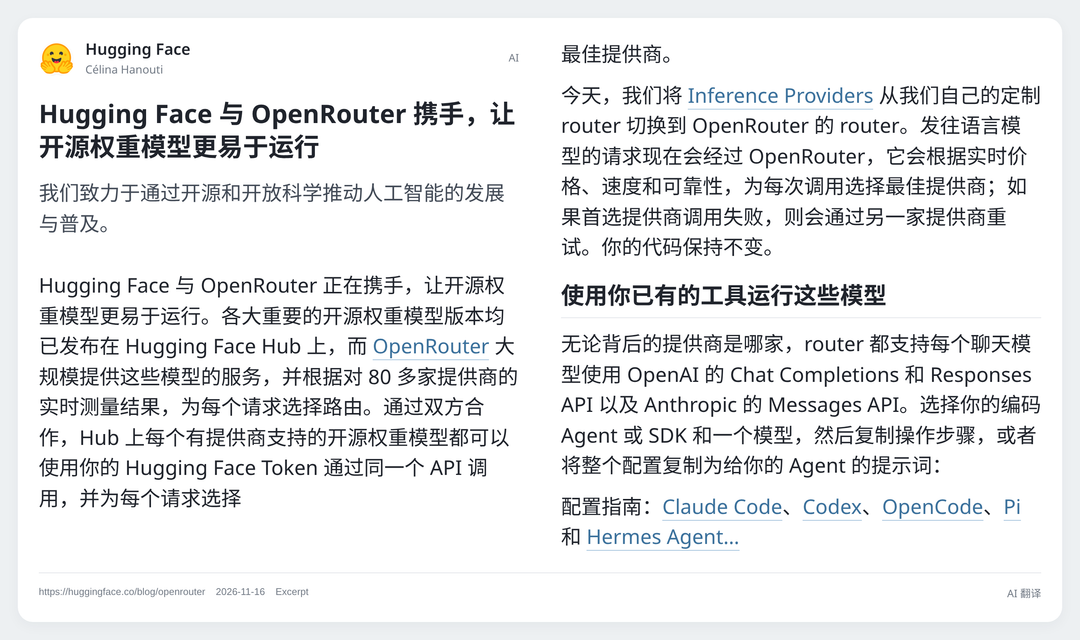
Hugging Face has switched language model requests on Inference Providers to OpenRouter's routing, which picks a provider for each request based on live price, speed and reliability and retries on the next provider within the same call if one fails; your code stays the same. Pricing doesn't change: you pay the provider's price on your Hugging Face bill with no markup. Note that this is a breaking change: custom provider keys are no longer supported. OpenRouter serves more than 800 trillion tokens a month across 80+ providers.
Bloghuggingface.co/blog/openrouter
Partneropenrouter.ai/blog/announcements/hugging-face-inference-providers/
6. Doubao Work launches workbenches for 21 professional scenarios
Doubao Work has launched a "workbench" feature, starting with 21 professional scenarios such as finance, healthcare and education, each with pre-configured skills and tools to make AI easier to use in specialist work.
IV. Technical insight and frontier research
1. Google GTIG: agentic threat activity crosses a significant threshold
Google Threat Intelligence Group (GTIG) has published its latest AI threat tracker, saying attackers' use of AI agents has crossed a significant threshold. According to Security Affairs, the report finds AI agents being used to automate exploits, steal credentials and scale cybercrime, which means companies need to account for attacks launched by autonomous agents.
2. Analysis: China's MoE models split into different routes
Qwen4-Max takes the general flagship route, covering reasoning, code and multimodality; Hy4 flash targets high-volume, low-cost calls; and Intern S2.1 Flash focuses on research. Their different pricing and positioning give developers in China tiered choices and will intensify price competition among Chinese model APIs.
3. Safety assessment is changing as outside experts go inside the lab
OpenAI's decision to let outside organisations see its internal training and alignment processes differs from conventional black-box testing. As regulators and markets demand more on model safety, deep third-party review before large models launch may become increasingly common.
V. Industry moves
1. OpenAI expands its free programme for researchers
OpenAI is expanding ChatGPT for Academic Researchers to reach up to 200,000 researchers, with a new round of 50,000 ChatGPT Plus grants.
2. OpenAI offers a free CSAM image classifier to vetted organisations
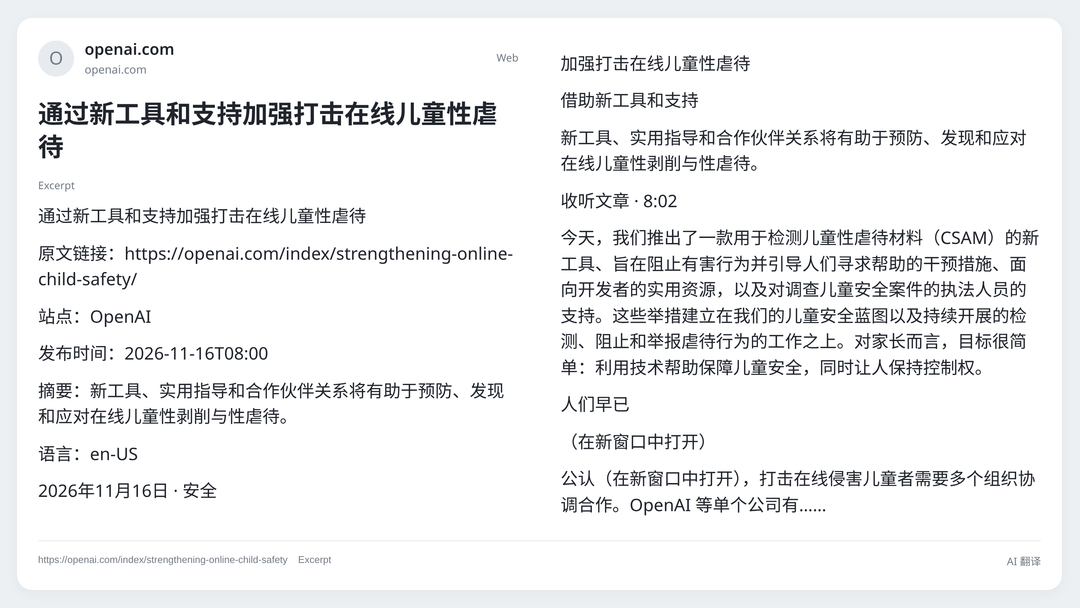
OpenAI developed a classifier for child sexual abuse material (CSAM) images, including AI-generated ones, with help from the National Center for Missing & Exploited Children (NCMEC), and is offering it free to vetted organisations. In testing, it flagged 48% fewer images while finding about the same number of abusive images, and images it flagged were about twice as likely to contain abuse. In ChatGPT, users who try to create such content get a warning, the conversation is removed and access is paused for 24 hours; repeated violations can lead to longer restrictions and ultimately account closure.
Blogopenai.com/index/strengthening-online-child-safety
Model carddeploymentsafety.openai.com/csam-image-classifier
Postx.com/OpenAINewsroom/status/2122375519853559954
3. California's attorney general sues OpenAI
According to Reuters, CNBC, the BBC and others, California Attorney General Rob Bonta has sued OpenAI, alleging public nuisance among other claims for developing and testing AI without adequate safeguards, prompted by OpenAI's AI agents attacking Hugging Face and other companies and by other incidents of models going out of control.
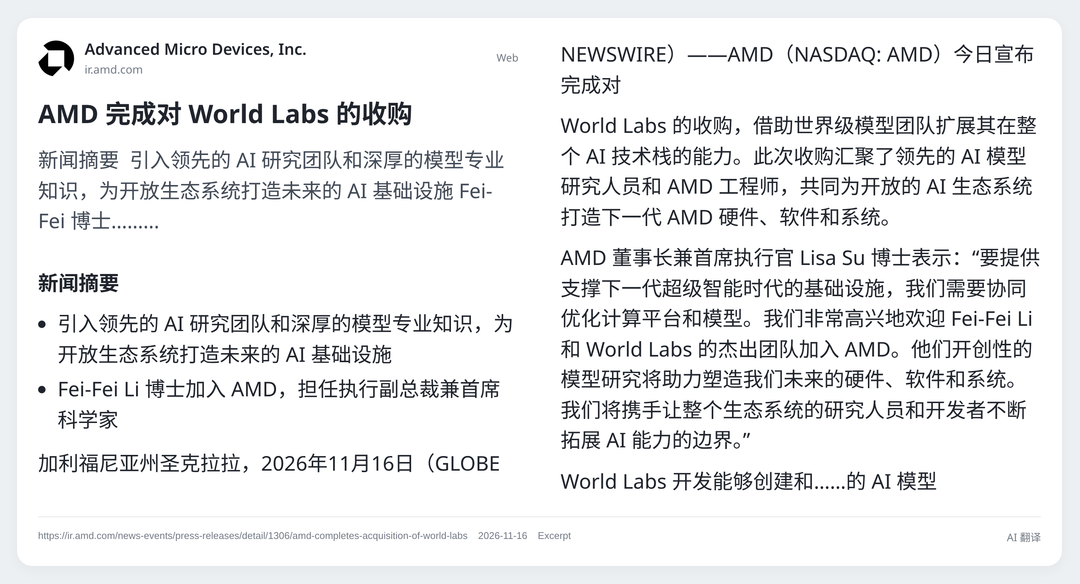
4. AMD completes its acquisition of World Labs, and Fei-Fei Li becomes chief scientist
AMD has completed its acquisition of World Labs, whose team will continue foundational model research while working with AMD engineers to apply it to AI infrastructure. World Labs co-founder Fei-Fei Li joins AMD as executive vice president and chief scientist, reporting directly to CEO Lisa Su.
Newsir.amd.com/news-events/press-releases/detail/1306/amd-completes-acquisition-of-world-labs
AMDx.com/AMD/status/2122372612320092239
Fei-Fei Lix.com/drfeifei/status/2122375532163866756
5. The IMF warns AI circular financing has passed US$1 trillion
According to CNBC and others, IMF Managing Director Kristalina Georgieva warned that the global economy is "standing on one leg" and too dependent on AI investment; she said circular financing in AI has passed US$1 trillion, about two-thirds of it debt-funded, and a pullback in investment could threaten financial stability.
VI. Outlook and market rumours
1. The Wall Street Journal: the US government will name AI "national champions"
The Wall Street Journal reports that the Trump administration plans to name Nvidia and other AI companies as "national champions", and Reuters and others have followed; the list reportedly also includes OpenAI, Microsoft and Amazon. This is still a media report, and an official announcement should be treated as authoritative.

VII. Claw roundup
No major verified updates to the OpenClaw ecosystem in this issue.
VIII. Trending open source on GitHub
1. openclaw/openclaw
Momentum: about 395,000 GitHub stars. Summary: an open-source local autonomous AI agent that runs across operating systems and platforms, written in TypeScript, MIT-licensed.
Repogithub.com/openclaw/openclaw
2. internlm/Sage-S2.1-Flash
Momentum: newly open-sourced this issue. Summary: Shanghai AI Laboratory's scientific multimodal MoE model for research on molecules, crystals, proteins and more.
Repohuggingface.co/internlm/Sage-S2.1-Flash
3. cvs-health/cua-agent-kit
Momentum: newly open-sourced this issue. Summary: CVS Health's computer-use agent toolkit, which uses AI to discover workflow steps and code to repeat them, Apache-2.0 licensed.
Repogithub.com/cvs-health/cua-agent-kit
4. vllm-project/vllm-omni
Momentum: about 7,800 GitHub stars. Summary: vLLM's official framework for inference with omni-modal models, supporting images, audio, video and more, Apache-2.0 licensed.