1. Claude Code desktop upgrades parallel multi-session work and adds idle-session compaction;
2. SpaceXSI releases Grok Voice 3.0, an end-to-end voice model that tops evaluations and automates 70% of Starlink customer service;
3. Ant Group's Bailing open-sources the Ling-3.1-flash model, and Kunlun Tech open-sources the Matrix-Game 4.0 real-time game engine;
4. Anthropic's third-quarter revenue reaches US$16.8 billion, and it acquires security company OPAQUE and opens a Singapore office;
5. OpenAI publishes a retirement schedule for the GPT-4 family, and AI agent adoption among EU businesses accelerates.
I. Model releases and open source
1. TypeSafe AI updates Jev to 1.14 with experimental image and long-context features
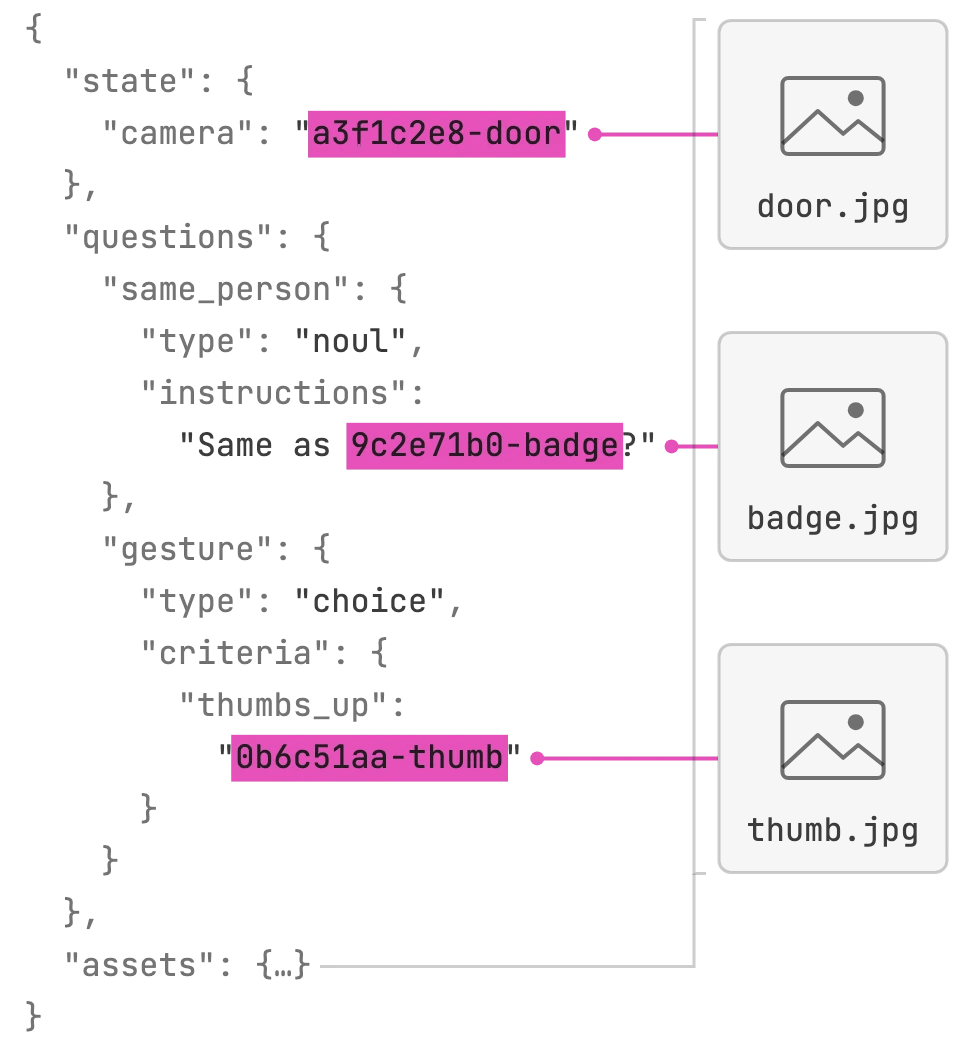
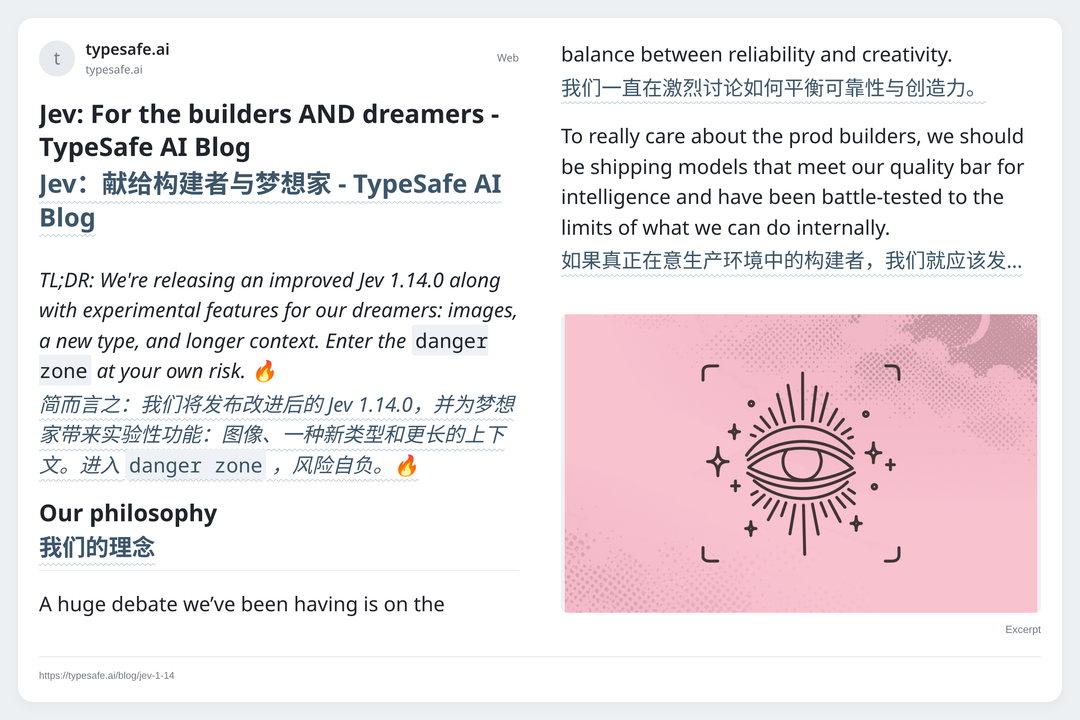
TypeSafe AI has released Jev 1.14, opening experimental features through the jev-preview channel, including image input, a box type for object localisation and long context. They must be switched on explicitly with the danger zone flag in the API request header, and TypeSafe warns they are not yet reliable enough for production.
Images can be embedded in state, question instructions or judging criteria, supported in both Jev 1.13 and 1.14; the box type for object localisation is 1.14-only and returns a single bounding box per question.
With long context enabled, both a single request and a single question are limited to 262K tokens, with some loss of speed and accuracy. Pricing is unchanged from 1.13: US$0.042 per million input tokens, with output free.
Blog: https://typesafe.ai/blog/jev-1-14 Post: https://x.com/CompleteSkeptic/status/2110488924309348860
2. SpaceXSI releases Grok Voice 3.0, an end-to-end voice model
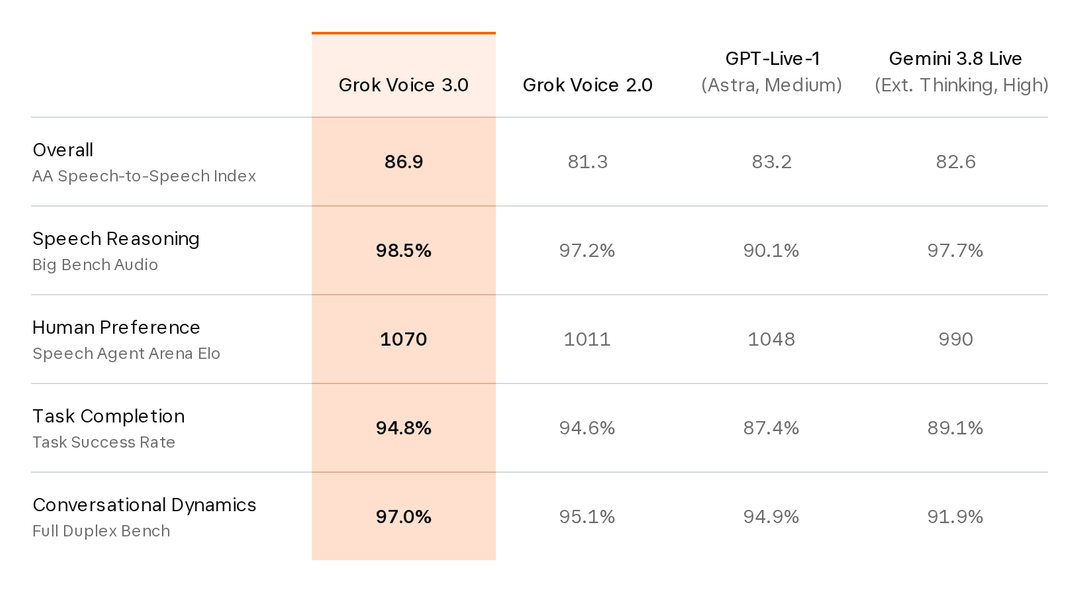
SpaceXSI has released Grok Voice 3.0, an end-to-end voice model available through the Voice Agent API at the previous price of US$0.08 per minute; apps using grok-voice-latest have switched automatically. SpaceXSI says the model ranks first on the Artificial Analysis Speech to Speech index with 86.9 points and responds in under a second. Starlink customer service now handles 20,000 calls a day automatically, about 70% of them without human involvement.
Announcement: https://x.ai/news/grok-voice-3 Post: https://x.com/Tesla/status/2102430656349544590
3. Ant Group's Bailing open-sources the Ling-3.1-flash model
Ant Group's Bailing team has open-sourced Ling-3.1-flash, with about 56 billion total parameters, about 25 billion active per token and up to 1 million tokens of context. Weights and technical documentation are on Hugging Face and ModelScope. For local deployment, using MXFP4 expert weights and block-FP8 dense layers shrinks the weights from about 534 GB to about 292 GB, and a tested Hopper configuration needs 4 GPUs instead of 8.
Post: https://x.com/AntLingAGI/status/2110390124743970952 Weights: https://huggingface.co/inclusionAI/Ling-3.1-flash
4. Kunlun Tech releases and open-sources the Matrix-Game 4.0 real-time game engine
Kunlun Tech has released and open-sourced Matrix-Game 4.0, a real-time game generation system in which a game engine maintains state and interaction rules while a video model turns simplified geometry into detailed rendered frames in real time. In Kunlun's tests the system runs at 480p and 60 FPS on a single NVIDIA RTX 5090, with end-to-end key-press-to-first-frame latency under 150 ms. The release includes inference code, a browser demo, game source code, and model weights and game assets for three scenes — a medieval castle, ancient Egypt and city racing — but not the training code or training data.
Page: https://matrix-game-v4-0.github.io/page/ Repository: https://github.com/SkyworkAI/Matrix-Game.git Weights: https://huggingface.co/Skywork/Matrix-Game-4.
II. Developer ecosystem and tooling
1. Claude Code desktop update improves parallel multi-session work
Anthropic has updated the Claude Code desktop app, focusing on startup speed, splitting up work and seeing status when running several sessions in parallel. The new session screen opens recent folders in one click, and users can set a local folder, an SSH host or cloud storage as the working environment and start sessions directly in it, with a separate worktree configurable for each folder. When the user asks for parallel tasks, Claude starts a nested session for each one and automatically brings the results back into the main session when they finish. Follow-up work Claude suggests can be run as a separate session in one click, and /btw side questions open in their own tab while the main session keeps running. The sidebar shows each session's running state and pending items in real time, and each session keeps an up-to-date to-do list and a recap card for the turn. Users get it by updating the desktop app and starting a new session.
Postx.com/ClaudeDevs/status/2110445844675838148
2. Claude Code adds automatic compaction for idle sessions
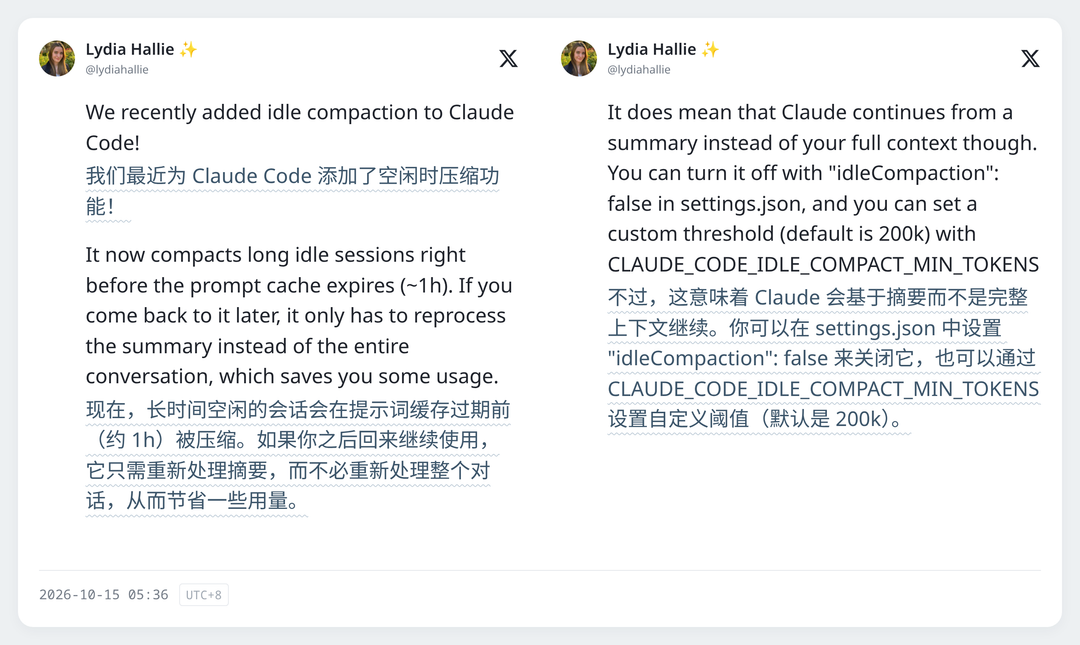
Anthropic has added automatic compaction of idle sessions to the Claude Code terminal: by default, a conversation that has reached 200K tokens and sat idle for about 54 minutes is compacted into a summary before the one-hour prompt cache expires. When the user returns, only the summary needs to be reprocessed to continue, saving tokens, though Claude then continues from the summary rather than the full context. Users can adjust the minimum token count that triggers compaction or turn it off; configuration requires v2.1.290 or later.
Postx.com/lydiahallie/status/2110484840256819380
3. OpenCode Go adds Gemini 4 Argon with a limited-time doubled allowance
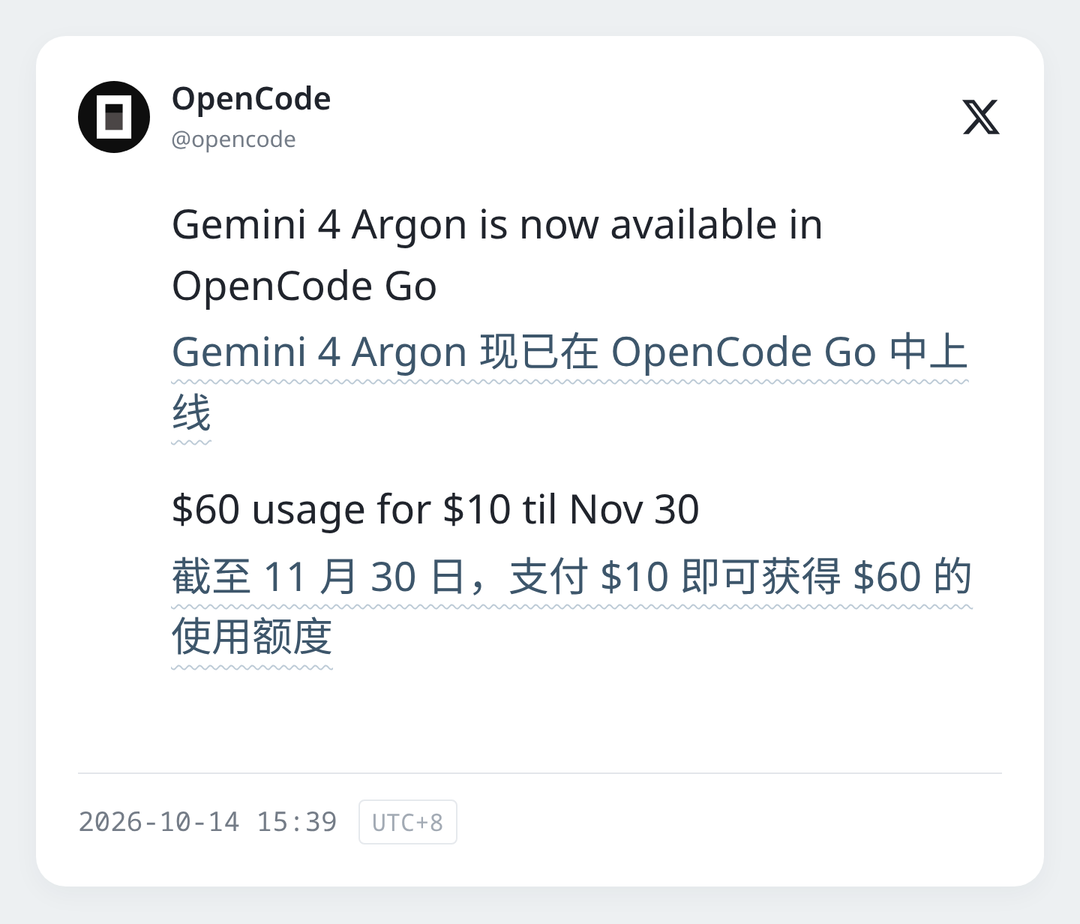
OpenCode Go now offers the Gemini 4 Argon Contributor model. The US$10-a-month Go plan includes US$60 of monthly usage for the model, doubled from US$30 for a limited time until 30 November. Usage is still subject to time-based limits: 20% of the monthly allowance per 5 hours and 50% per week. The docs note that user prompts and model responses may be used to train future Google models, and this version does not offer zero data retention.
Post: https://x.com/opencode/status/2110274311043072352 Plan: https://opencode.ai/go

4. Qoder International cuts its top tier to 20% of price at night
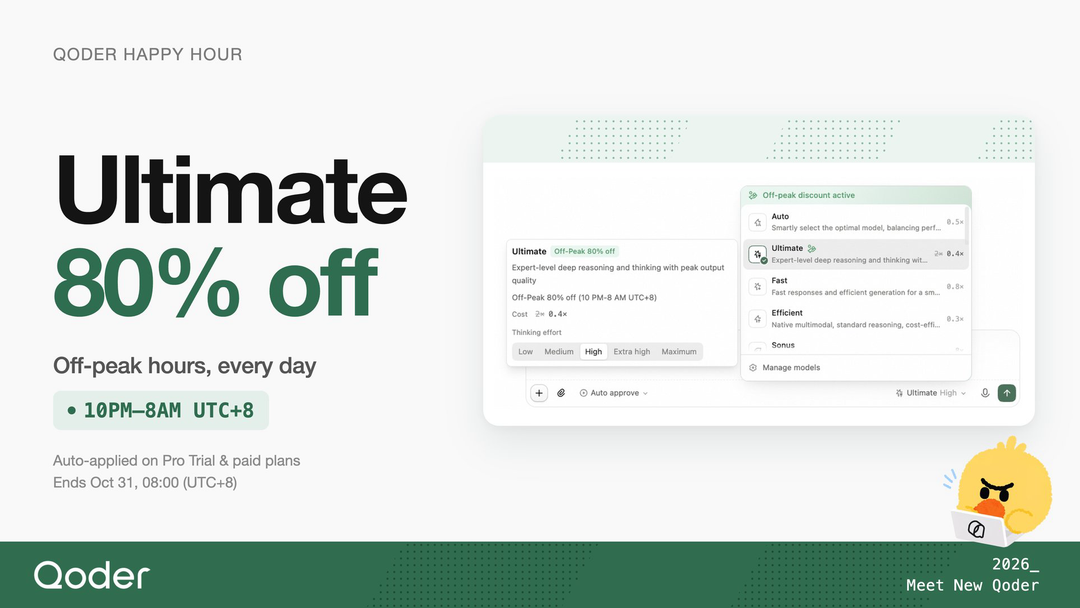
Qoder International has added a night-time discount to its top model tier: from 14 to 30 October, between 22:00 and 08:00 Beijing time each day, the credit multiplier drops from 2x to 0.4x — 20% of the normal price. The offer applies to Pro Trial users and paying users, with separate rules for Service Accounts. Qwen3.8-Flash stays free all day, and the night-time discounts for Qwen3.8-Max and Qwen3.7-Plus are unchanged. First-time individual subscribers to Pro and Pro+ still get double credits in the first month — 4,000 and 12,000 respectively — and the 1,000-credit renewal bonus continues.
Details: http://docs.qoder.com/events/offpeakrate Post: https://x.com/qoder_ai_ide/status/2110394577148674119
5. OpenAI publishes the retirement schedule for the GPT-4 family
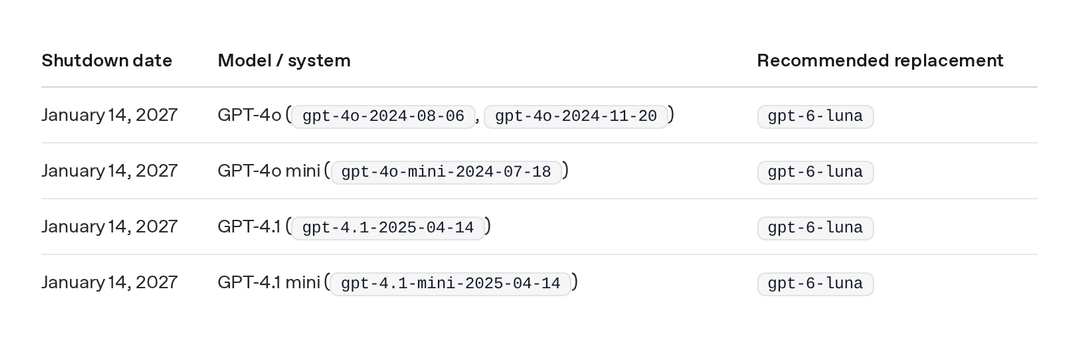
OpenAI's API deprecations page says four models — GPT-4o, GPT-4o mini, GPT-4.1 and GPT-4.1 mini — will be retired on 14 January 2027, and recommends migrating to gpt-6-luna. Fine-tuned versions of these models will be retired along with their base models.
Deprecations: https://developers.openai.com/api/docs/deprecations
6. Claude Platform opens OpenTelemetry tracing in public beta
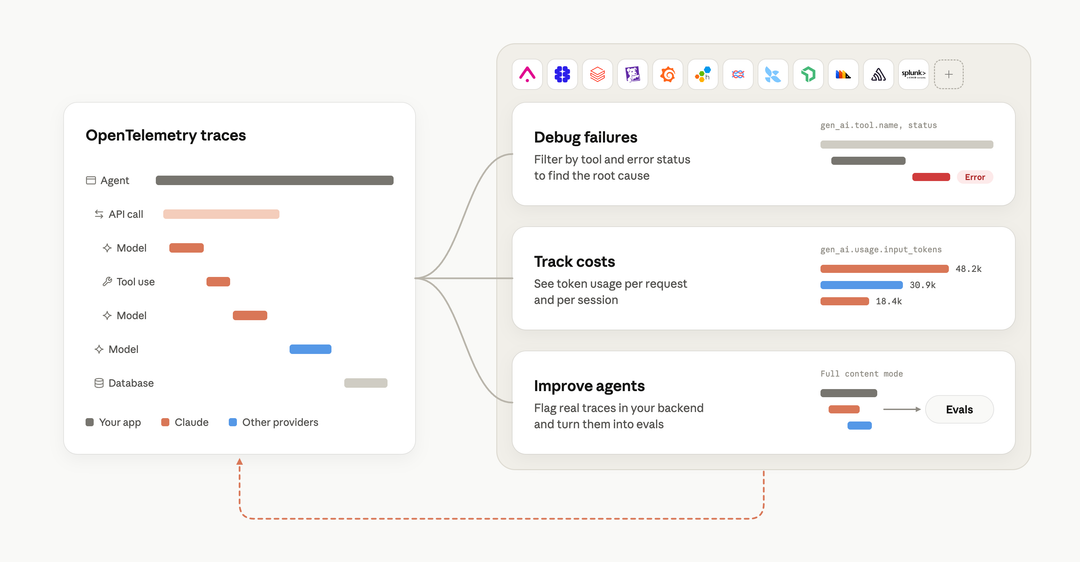
Anthropic says OpenTelemetry observability tracing on the Claude Platform is in public beta, sending run traces from the Messages API, Claude Managed Agents and the Claude SDK to users' existing monitoring systems. Traces cover model calls, tool use and agent sessions, with metrics such as latency and token usage, for troubleshooting failures and latency and building evaluations from real traffic. Data can go to any tool that supports a standard OTLP endpoint. API tracing requires an administrator to configure the destination in the Claude Console, and SDK tracing is configured in code. By default only metadata is exported; developers can choose a full-content mode that includes prompts and responses.
Overview: https://claude.com/resources/articles/agent-observability-on-the-claude-platform Docs: https://platform.claude.com/docs/en/manage-claude/opentelemetry Post: https://x.com/ClaudeDevs/status/2110421732029063352
III. Products shipping
1. Doubao Work adds data import and sync
Doubao Work now has a "data import and sync" feature that brings in task preference instructions, skills, connectors, working memory, projects and past conversations from supported products such as ChatGPT, Claude Code and Trae Work. Users can migrate locally stored content; imported conversations keep their original context and can be continued directly, and for sources that support automatic sync, users can turn syncing on as needed. Also new: "continue in a new conversation", message annotations and a conversation summary sidebar, for opening a new conversation with context carried over, adding notes to a reply and viewing tasks and outputs in one place.
Announcement: https://www.doubao.com/product/work
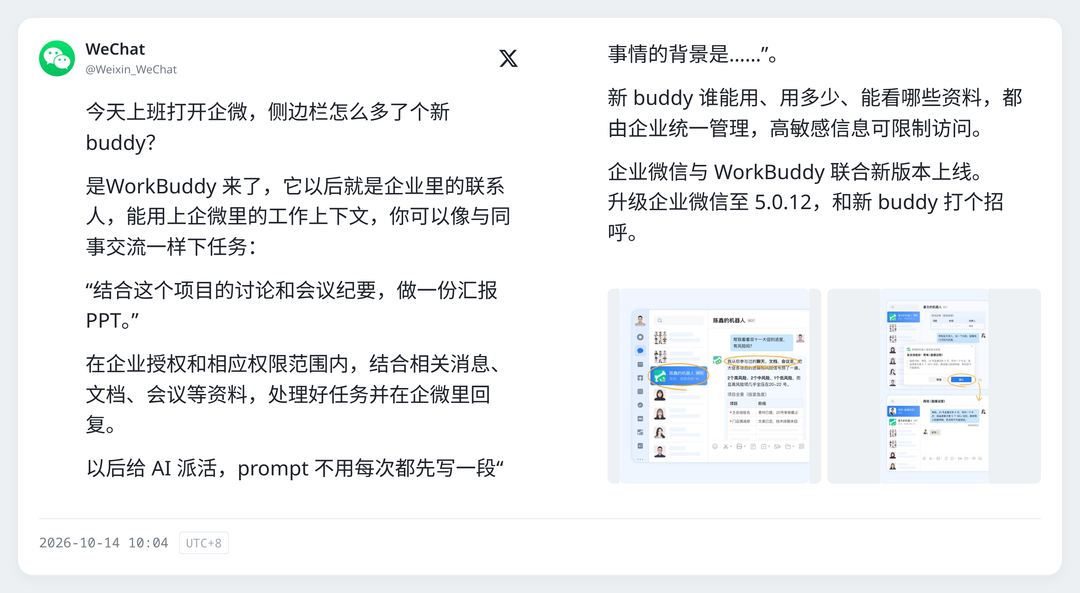
2. WeCom adds WorkBuddy, callable from the sidebar in one click
WeCom and WorkBuddy have released a joint update: after upgrading to WeCom 5.0.12, users can call the WorkBuddy assistant directly from the sidebar and handle tasks using the context of work messages, documents and meetings. WorkBuddy works within the company's authorisation and the relevant permissions. Users can sign in to WorkBuddy with their WeCom account, pick documents and files from WeDrive to work on, and upload the results to WeDrive in one click. Companies can centrally manage who uses it, how much, and which material it can access, and can restrict access to highly sensitive information.
Pagework.weixin.qq.com/nl/index/workbuddy

3. Doubao phone assistant gradually opens automated operation of third-party apps
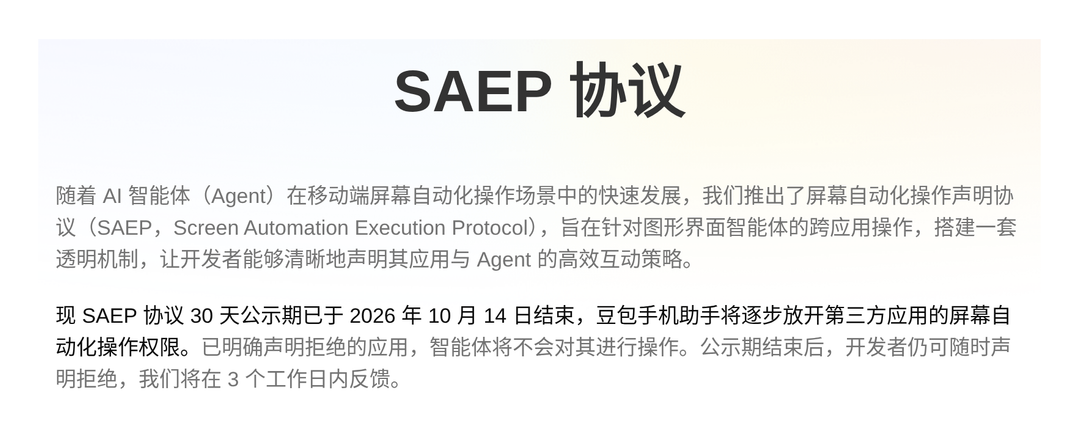
The Doubao phone assistant says the 30-day public notice period for its Screen Automation Engagement Protocol (SAEP) has ended and it will gradually allow automated screen operation of third-party apps. App developers can declare whether they accept or prohibit agent operation, and apps that have explicitly refused will not be operated; developers can still opt out at any time after the notice period, and the assistant will respond within three working days. About 150 apps have explicitly refused automated operation so far, including core apps such as WeChat, Taobao, Meituan and Xiaohongshu.
Detailso.doubao.com/developer
IV. Technical insight and frontier research
1. Swarmchasers reports Tencent Cloud agent tests bypassing Amap's anti-scraping
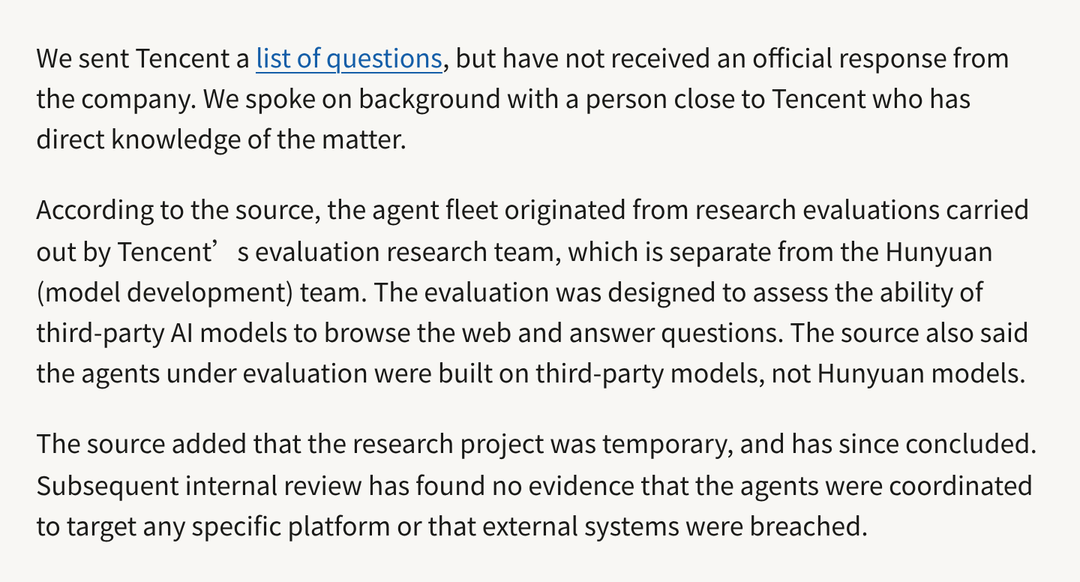
Independent research group Swarmchasers reports that a batch of AI agents running in Tencent Cloud sandboxes made more than 2,600 attempts to extract data from Amap, Alibaba's mapping service, trying to get around anti-scraping measures, using API credentials exposed in public code and accessing pre-production servers; some attempts retrieved data. A person close to Tencent said the work was a temporary project by Tencent's evaluation research team testing third-party models' ability to answer questions online, unrelated to the Hunyuan team or Hunyuan models, and has ended; a subsequent internal review found no evidence of agents coordinating against a specific platform or of external systems being breached.
Report: https://swarmcha.se/posts/chinese-agent-fleet-full-report Coverage: https://www.bloomberg.com/news/articles/2026-10-14/tencent-linked-by-researchers-to-rogue-ai-that-targeted-alibaba
2. AA-Robotics benchmark launches, with GPT-6 Astra on top
Artificial Analysis has released AA-Robotics v0.1, a research preview benchmark that evaluates frontier LLMs acting as coding agents to control a six-axis robotic arm on physical tasks. The first edition has eight tabletop tasks, all tested zero-shot. GPT-6 Astra ranks first with 69.4, followed by GPT-6.1 Sol at 64.6 and Gemini 4 Argon at 55.3. Models took about 30 minutes per task on average, with average cost per task ranging from US$1.93 to US$16.36. Artificial Analysis says even the best frontier models take about 100 times as long as a human and cost about 10 times as much, so they are not yet suitable for production at scale.
Benchmark: https://artificialanalysis.ai/articles/aa-robotics Post: https://x.com/ArtificialAnlys/status/2110500262628806787
3. Anthropic shares US election conversation analysis and safeguards
Anthropic has published an analysis of conversations by US Claude.ai users and its safeguards for the midterm elections. In about 250,000 conversations in a recent week, about 5.75% involved politics, public policy or social issues and about 0.51% involved elections or voting; requests asking directly who to vote for were very rare. Later in October Claude will give US users official voting information from Democracy Works directly, and on election night and afterwards it will show the latest official results. Anthropic has also added classifiers that detect multi-step election abuse, strengthened detection of abuse linked to foreign state actors, and stepped up cyber protection for election infrastructure and campaigns.
Announcement: https://www.anthropic.com/news/2026-us-midterms Coverage: https://www.reuters.com/world/us/anthropic-add-us-voting-information-claude-before-midterms-2026-10-14/
4. OpenAI report: AI agent adoption among EU businesses is accelerating
An OpenAI economic research report shows EU businesses are quickly widening how they use AI agents, moving from asking AI questions to having it carry out whole tasks from planning to execution. In the sample, Codex and ChatGPT Work already account for more than half of output tokens among EU ChatGPT Enterprise customers, and since May weekly active users of the two tools at EU small and medium-sized businesses have grown more than eightfold, with growth in every member state. Usage varies widely by country: the two tools' share of output tokens in sampled companies ranges from 22% in Slovenia to 85% in Lithuania.
Report: https://openai.com/index/the-eus-next-chapter-in-ai-is-agentic Post: https://x.com/OpenAI/status/2110442001749659890
V. Industry moves
1. Anthropic's third-quarter revenue reportedly reaches US$16.8 billion, with a profit
Bloomberg, citing people familiar with the matter, reports that Anthropic told an investor meeting its third-quarter revenue reached US$16.8 billion and it was profitable on an adjusted basis. Second-quarter revenue was US$11.6 billion, putting quarter-on-quarter growth at 45%. The meeting was for prospective investors as Anthropic moves towards an IPO. The figures have not been officially confirmed.
Coverage: https://www.bloomberg.com/news/articles/2026-10-14/anthropic-revenue-jumps-to-16-8-billion-in-quarter-before-ipo Coverage: https://www.channelnewsasia.com/business/anthropic-pre-ipo-meet-thinking-caps-surging-revenue-no-human-extinction-6460776
2. Anthropic acquires enterprise AI security company OPAQUE
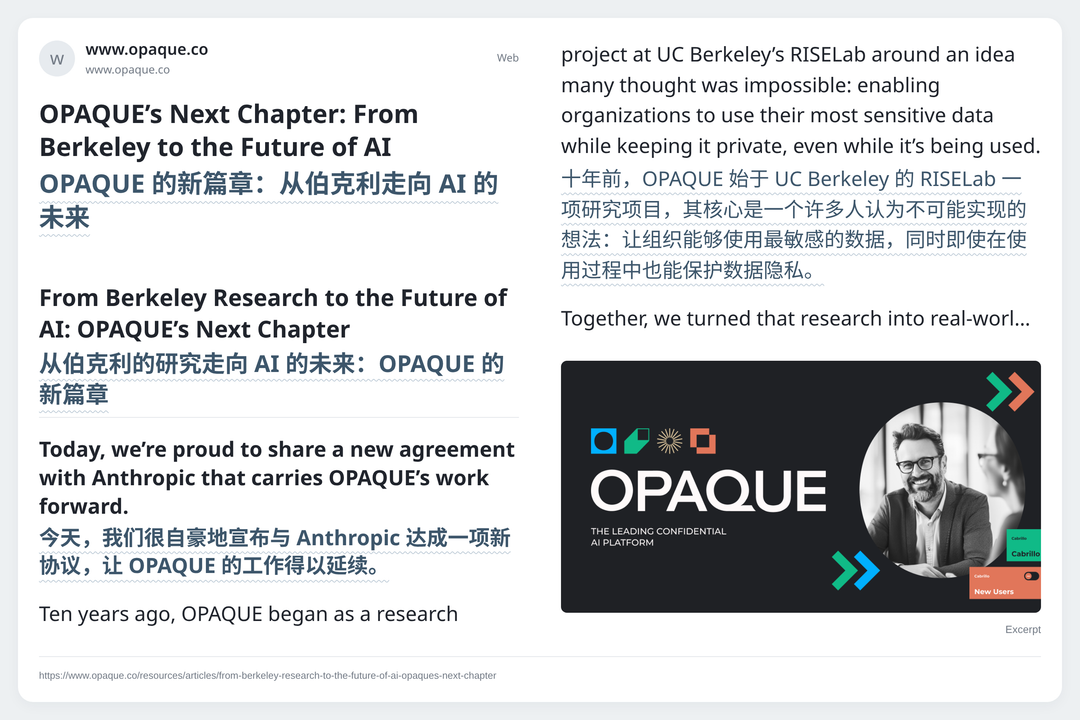
Anthropic has acquired OPAQUE, an enterprise AI security company, in a technology licence plus acquihire deal on undisclosed terms. OPAQUE co-founder and CTO Rishabh Poddar and several team members are joining Anthropic. OPAQUE specialises in confidential computing, using hardware-enforced protection to let organisations run AI workloads on sensitive data and cryptographic evidence to verify what AI systems and agents run, where they run and which policies they follow.
Announcement: https://www.opaque.co/resources/articles/from-berkeley-research-to-the-future-of-ai-opaques-next-chapter
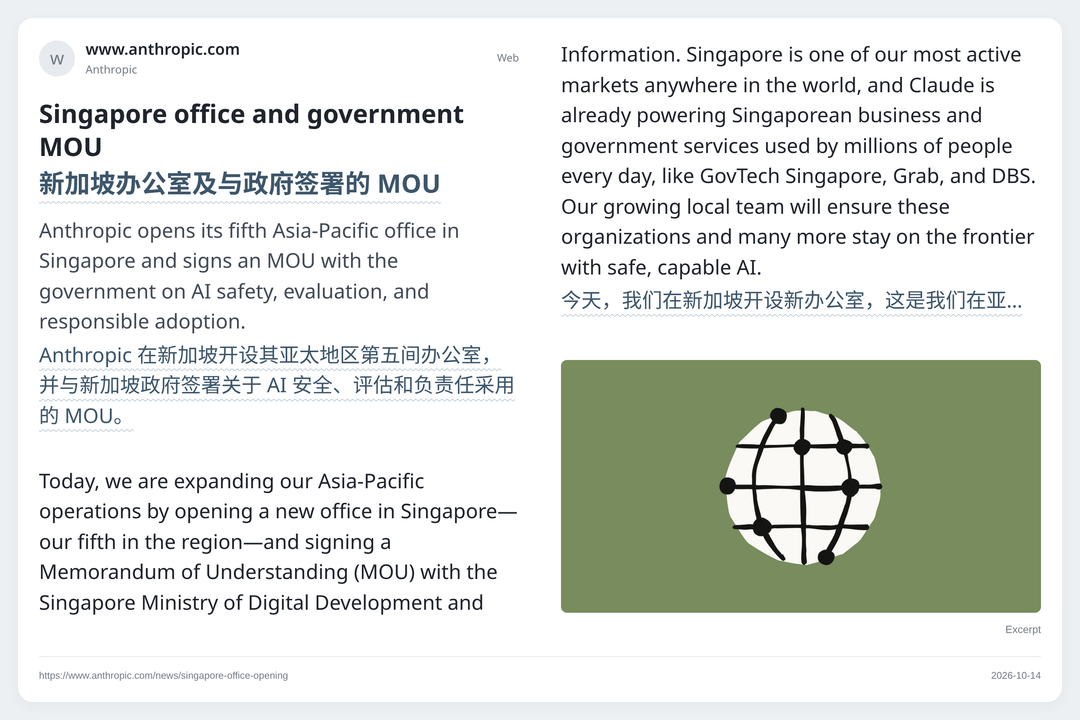
3. Anthropic opens a Singapore office and signs a memorandum of understanding
Anthropic has opened an office in Singapore, its fifth in Asia-Pacific, and signed a memorandum of understanding with Singapore's Ministry of Digital Development and Information. The two will work together on AI safety and model evaluation and on research into AI adoption and its impact, promoting responsible AI adoption across the public and private sectors. Anthropic plans technical exchanges on model evaluation, testing standards and incident response, will share research and data, and will support local AI skills, adoption by small and medium-sized businesses, and capability building for public servants.
Announcement: https://www.anthropic.com/news/singapore-office-opening
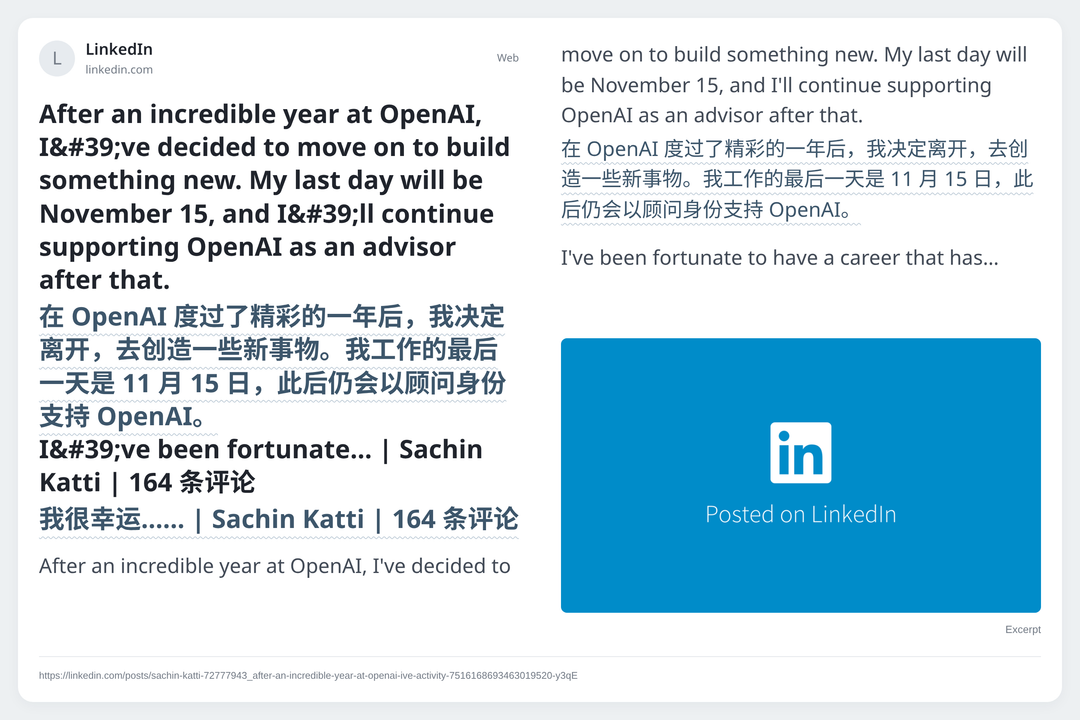
4. OpenAI infrastructure head Sachin Katti to leave in November
Sachin Katti, head of infrastructure at OpenAI, will leave on 15 November and continue to support OpenAI as an adviser; he plans to start a new venture. An OpenAI spokesperson confirmed that compute CTO Uday Ruddarraju will take over and lead the whole compute organisation. Katti says that over roughly the past year the team brought double-digit gigawatts of new compute capacity online through multiple projects.
Post: https://www.linkedin.com/posts/sachin-katti-7277943_after-an-incredible-year-at-openai-ive-activity-7516168693463019520-y3qE Coverage: https://www.cnbc.com/2026/10/14/openais-sachin-katti-to-leave-infrastructure-role-stay-on-as-advisor.html
5. Google to provide models and compute to European researchers
Google DeepMind and Google Cloud will give up to 200 leading European researchers direct access to frontier models along with US$3 million in compute credits. Supported scientific tools include AlphaFold 3, WeatherNext, AlphaGenome, AlphaEvolve and AlphaEarth Foundations; some frontier models will be provided through the EU's RAISE initiative to support AI science in the EU and close Europe's research compute gap.

6. Google awards US$36 million in AI research funding to 17 organisations
Google announced that through the Google.org "AI for Science" Impact Challenge it is giving a total of US$3.6 million to 17 selected organisations to use AI to speed up research in health and life sciences, climate resilience and environmental science. The selected organisations can join the six-month Google.org Accelerator, with engineering support, technical mentoring and Google Cloud credits.
Announcement: https://blog.google/company-news/outreach-and-initiatives/google-org/impact-challenge-ai-science-recipients/

7. Modal raises a US$750 million Series D, with annualised revenue above US$1 billion
AI infrastructure company Modal has raised a US$750 million Series D led by Accel at a post-money valuation of US$15.75 billion, and announced annualised revenue above US$1 billion. It says usage has tripled in the five months since its Series C and the business has grown more than fifteenfold year on year; Kleiner Perkins and all existing investors took part.
Blog: https://modal.com/blog/1-billion-annualized-run-rate-series-d Coverage: https://www.axios.com/pro/enterprise-software-deals/2026/10/14/modal-accel-ai-infrastructure

8. Chinese-market iPhones gain filings for several large models
Network access licence records for several Chinese-market iPhones now include large-model filing numbers for Apple Intelligence, Tongyi Wanxiang and Tongyi Qianwen. The update covers iPhone 15 Pro and Pro Max and later models, including iPhone Air and the foldable iPhone Duo. iPhone 15 and iPhone 15 Plus were not updated, matching the iPhone models that support Apple Intelligence.
Coveragewww.ithome.com/0/076/939.htm
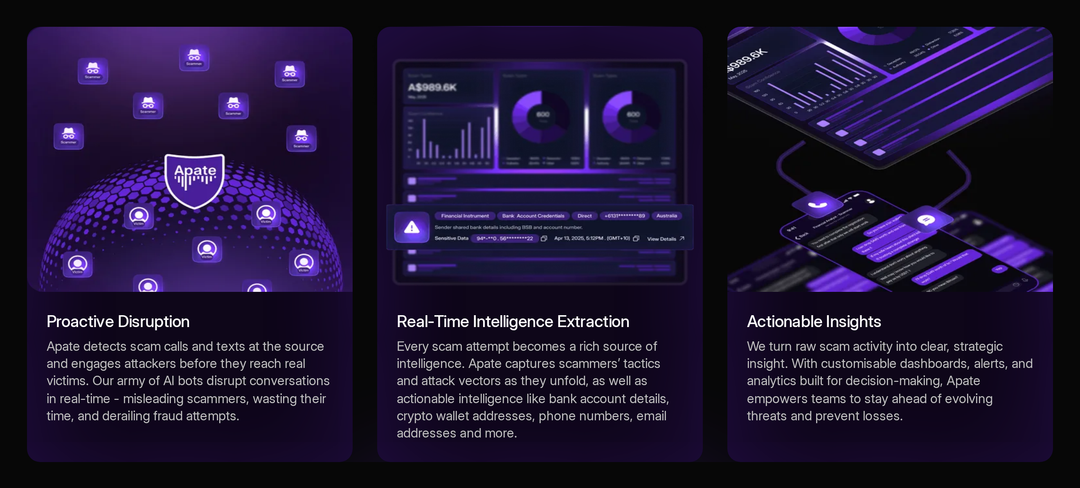
9. Apate.ai deploys thousands of AI agents to gather anti-scam intelligence
Australian startup Apate.ai has deployed thousands of AI agents that pose as potential victims to string scammers along. By answering scam calls, replying to suspicious messages and emails, visiting phishing links and joining social media groups, they collect information such as bank accounts, crypto wallet addresses and malicious websites for clients including banks, telecom operators and government agencies. The company says its agents have held 2.5 million conversations, using up about 17 years of scammers' time. Clients can assign tasks to gather information on specific scam campaigns.
Site: https://apate.ai/ Coverage: https://techcrunch.com/2026/10/14/apate-sends-ai-agents-undercover-to-get-scammed-so-they-can-gather-fraud-intelligence/
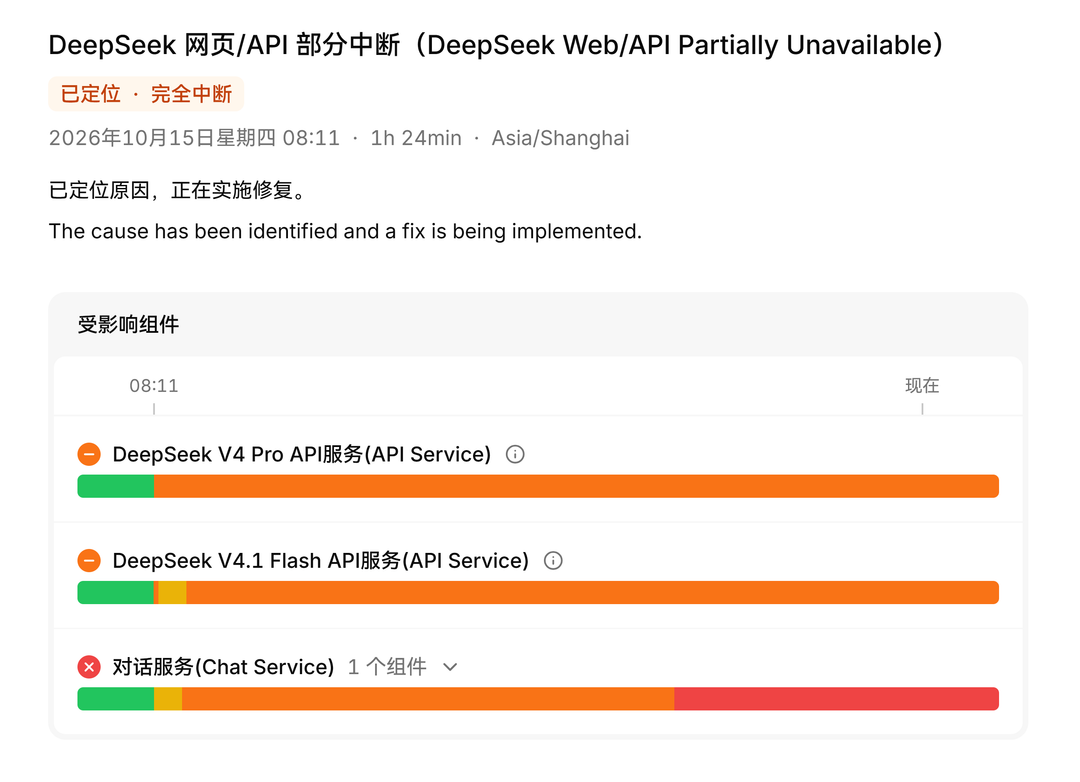
10. DeepSeek web and API hit by a partial outage
DeepSeek's status page shows a partial outage of its web app and API on the morning of 14 October; the cause was identified and a fix was being rolled out. Affected components included the DeepSeek V4 Pro API and the DeepSeek V4.1 Flash API.
Statusstatus.deepseek.com/incidents/7116348214287
VI. Outlook and market rumours
1. OpenAI reportedly in talks to acquire security firm Trail of Bits
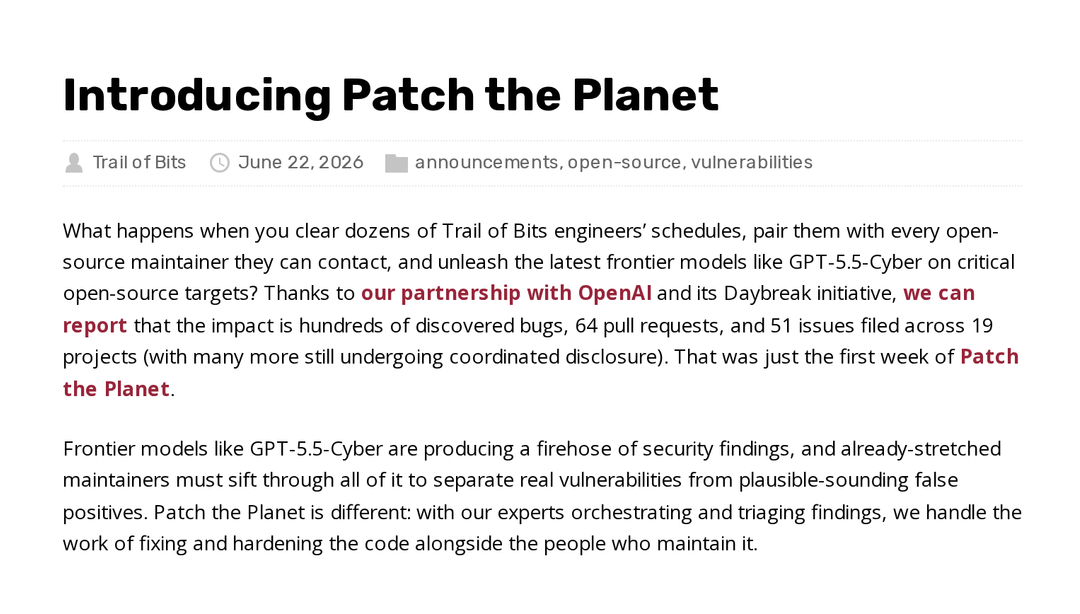
The Information, citing people familiar with the matter, reports that OpenAI is in early talks to acquire cybersecurity firm Trail of Bits; the price has not been set. Trail of Bits does security research and engineering, finding and fixing vulnerabilities in open-source software. The two have already worked together on Patch the Planet, a software patching programme that combines AI-assisted research with human review to help open-source projects verify vulnerabilities, develop patches and test them.
Coveragetheinformation.com/articles/openai-early-talks-buy-security-startup-trail-bits
2. DeepSeek reportedly leads a seed round in a robotics AI startup
Bloomberg, citing people familiar with the matter, reports that DeepSeek has agreed to lead a seed round of tens of millions of US dollars in robotics AI startup Winverse AI at a post-money valuation of about US$400 million; other investors include Meituan's Long-Z Investments. Winverse AI was founded only months ago by a former Tencent scientist and is building AI brains for robots. The information has not been officially confirmed.
VII. Claw roundup
1. Permission governance for on-device agents becomes standardised, balancing safety and experience
The Doubao phone assistant gradually opening automated operation of third-party apps with a clear opt-out mechanism, and WeCom adding WorkBuddy to its sidebar with matching permission controls, show permission governance for on-device agents becoming standardised. From apps declaring their own permissions and platform-level tiered controls to centralised enterprise permission management, agent capabilities are opening up within clear boundaries that protect data, balancing experience and safety so on-device agents can roll out healthily.
2. Multi-session and idle compaction improvements keep raising agent efficiency
Claude Code's parallel multi-session improvements and automatic compaction of idle sessions raise the efficiency of coding agents along two lines: parallel task scheduling and dynamic resource compaction. Parallel threads speed up work and idle compaction cuts wasted tokens, showing coding agent tools moving from merely working to fine-grained resource scheduling and experience tuning, which will help long-running, multi-task agent workflows spread.
3. Observability opens up, rounding out enterprise agent operations
The Claude Platform opening OpenTelemetry tracing lets companies feed agent run data into their existing monitoring, with metrics across calls, tools and sessions. Observability is core infrastructure for deploying enterprise agents at scale; moving from black-box operation to something that can be monitored, debugged and measured, enterprise agent operations are maturing and laying the groundwork for large-scale production deployment.
VIII. Trending open source on GitHub
1. SkyworkAI/Matrix-Game
Momentum: a new popular open project in real-time game AI. Summary: Kunlun Tech's open-source Matrix-Game 4.0 real-time game generation system, pairing a game engine with video generation to run in real time on a single GPU with low latency, with weights for several scenes and game source code under the Apache licence — a benchmark open project for generative games.
Repository: https://github.com/SkyworkAI/Matrix-Game.git
2. AI-Safety-Institute/transect
Momentum: a consistently popular AI safety evaluation tool. Summary: the UK AISI's open-source visualisation tool for agent evaluations, turning complex evaluation logs into interactive timelines with activity classification, resource usage and checks on human intervention — a practical tool for agent safety evaluation.
Repository: https://github.com/AI-Safety-Institute/transect
3. fishaudio/fish-speech
Momentum: a popular open project in speech synthesis. Summary: Fish Audio's official open-source voice model repository, with natural-language control of vocal expression, many languages, complete technical documentation and an active community — a popular open option for high-quality TTS.
Repository: https://github.com/fishaudio/fish-speech
4. deepseek-ai/deepseek-harness
Momentum: a leading Chinese agent framework. Summary: DeepSeek's official open-source, fully plugin-based agent framework with multi-model support, tool calling and workflow orchestration. It is highly customisable for enterprise agent development and deployment and keeps adapting to new models and use cases.
Repository: https://github.com/deepseek-ai/deepseek-harness
5. anthropics/claude-quickstarts
Momentum: a benchmark project in the Claude developer ecosystem. Summary: Anthropic's official quickstart collection, with complete example code for the computer use and browser use toolsets across multiple SDK languages and driver environments — the authoritative reference for building Claude agents.
Repository: https://github.com/anthropics/claude-quickstarts